 MElkhateeb
➡️ Introduction
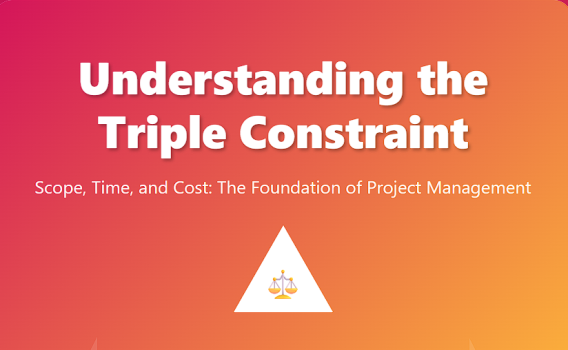
Every project manager faces a constant challenge: balancing scope, time, and cost to deliver successful results. These three factors form the foundation of project management, commonly known as the Triple Constraint or Iron Triangle.
Top 5 Project Management Software
Understanding the triple constraint helps teams set realistic expectations, manage resources effectively, and deliver projects that meet stakeholder goals — without sacrificing quality.
Let’s explore each element in depth, understand how they interact, and learn practical ways to keep them balanced.
✅ What Is the Triple Constraint?
The Triple Constraint is a core concept in project management that describes the interdependent relationship among three critical factors:
- Scope – what needs to be done (the work).
- Time – how long it will take to complete the work.
- Cost – how much it will cost to deliver the project.
These three form the sides of a triangle — change one, and the others are affected.
For example:
- Expanding the scope increases both time and cost.
- Reducing time may require more resources, raising cost or shrinking scope.
The project manager’s job is to maintain the right balance between these three factors while ensuring quality remains at the center of the triangle.
✅ Element 1: Scope
Scope defines the boundaries of a project — what will be delivered and what won’t. It includes all the work required to achieve the project’s objectives.
☑️ Examples
- For a website development project: number of pages, features, and integrations.
- For a construction project: total area, number of floors, and materials.
☑️ Common Challenges
- Scope creep: Uncontrolled expansion of project requirements.
- Unclear objectives: Misaligned understanding between clients and teams.
☑️ How to Manage It
- Create a detailed scope statement and work breakdown structure (WBS).
- Use change control processes to evaluate and approve scope changes.
- Get stakeholder sign-off before executing work.
Keeping scope controlled ensures that the project delivers what was promised — nothing more, nothing less.
✅ Element 2: Time
Time represents the project schedule, including all activities, milestones, and deadlines. It defines when each part of the work must be completed.
☑️ Examples
- Software release date.
- Construction completion deadline.
- Marketing campaign launch day.
☑️ Common Challenges
- Overly optimistic scheduling.
- Unforeseen delays (supplier issues, change requests, or rework).
- Poor task sequencing or resource allocation.
☑️ How to Manage It
- Use scheduling tools like Gantt charts, Critical Path Method (CPM), or Agile sprints.
- Track progress using earned value management (EVM).
- Build buffers for high-risk tasks.
- Conduct weekly reviews to adjust timelines proactively.
Proper time management improves predictability and keeps stakeholders confident in project delivery.
✅ Element 3: Cost
Cost represents the financial resources required to complete the project — labor, equipment, materials, technology, and overhead.
☑️ Examples
- Staff salaries or contractor fees.
- Software licenses or hardware purchases.
- Marketing, logistics, and quality control expenses.
☑️ Common Challenges
- Inaccurate estimates or overlooked expenses.
- Inflation or supplier price changes.
- Scope changes without budget approval.
☑️ How to Manage It
- Develop a detailed cost baseline early in planning.
- Track spending continuously using cost variance analysis.
- Maintain a contingency reserve for unforeseen risks.
- Communicate regularly with stakeholders about financial performance.
Effective cost control ensures the project remains financially viable from start to finish.
✅ The Interdependence of Scope, Time, and Cost
These three factors are tightly linked. Adjusting one side inevitably affects the others:
| Change | Time | Cost | Scope |
|---|---|---|---|
| Scope increases | Typically ↑ (more work to schedule) | Typically ↑ (additional resources/materials) | Expanded requirements/features |
| Scope decreases | Often ↓ (less to deliver) | Often ↓ (fewer hours/spend) | Reduced features/deliverables |
| Time decreases (faster deadline) | Compressed schedule (crashing/fast-tracking) | Usually ↑ (overtime, more people, premium rates) | May need to ↓ (de-scope to hit date) |
| Time increases (more time) | Extended timeline/buffers | May ↑ (longer overhead) or ↓ (less peak staffing) | May allow ↑ (nice-to-have items) |
| Cost decreases (lower budget) | May ↑ (slower pace with fewer resources) | Constrained spend/lean resourcing | Often ↓ (remove lower-value items) |
| Cost increases (more budget) | May ↓ (add resources to accelerate) | Higher investment approved | May ↑ (add features/quality enhancements) |
For instance:
- A company that wants to add new features to a mobile app (increasing scope) will need more developers (higher cost) and additional weeks (longer time).
- Cutting the project budget often leads to reduced features or extended delivery time.
Successful project managers continuously balance these trade-offs through proactive communication, data-driven decisions, and risk management.
✅ Quality: The Hidden Core of the Triangle
While scope, time, and cost form the triangle’s edges, quality lies at its center.
If any constraint is mismanaged — such as rushing to meet deadlines or underfunding resources — quality suffers.
A balanced project achieves:
✔️ Defined scope without unnecessary features.
✔️ Reasonable schedule that ensures thorough testing or review.
✔️ Controlled costs that support the required quality standards.
In essence, quality reflects how well the project satisfies the scope within the time and cost constraints.
✅ How to Balance the Triple Constraint
☑️ 1. Establish Clear Priorities
Decide which constraint is most critical. For example, a product launch may prioritize time, while a government project may focus on cost compliance.
☑️ 2. Use Change Control Mechanisms
Any modification to scope, time, or budget should go through a formal approval process. This prevents chaos and scope creep.
☑️ 3. Communicate Continuously
Regularly update stakeholders about trade-offs and progress. Transparency builds trust when changes are necessary.
☑️ 4. Apply Project Management Tools
Leverage digital tools like Monday.com, Miro, or ClickUp to track progress, manage dependencies, and visualize impacts in real time.
☑️ 5. Monitor KPIs and Variances
Track performance indicators such as Schedule Performance Index (SPI) and Cost Performance Index (CPI) to identify deviations early.
✅ Real-World Example
A marketing agency is hired to produce a global campaign in 8 weeks.
- The scope includes TV ads, social media content, and influencer collaborations.
- The time constraint (8 weeks) is fixed due to the product launch date.
- To meet the deadline, the agency increases cost by hiring additional staff.
By adjusting cost to protect time and scope, the project stays successful — demonstrating how the triple constraint works in practice.