 MElkhateeb
➡️ Introduction
In project management, time is one of the most valuable — and limited — resources.
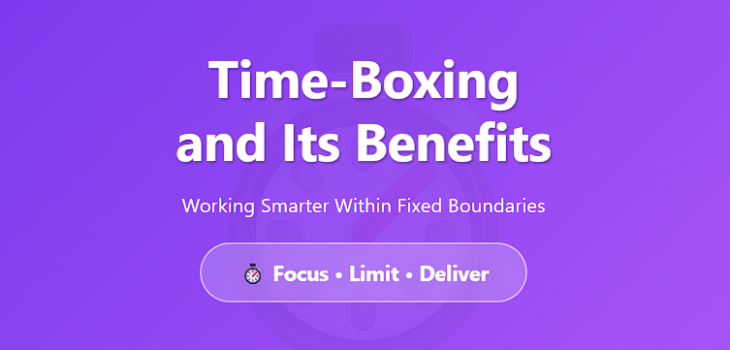
That’s where time-boxing comes in: a simple yet powerful technique that helps teams maintain focus, increase productivity, and prevent perfectionism from derailing progress.
Top 5 Project Management Software
Time-boxing means setting a fixed, maximum amount of time for an activity and committing to stop when the time is up, regardless of whether the task is 100% complete.
This article explains how time-boxing works, why it’s used by successful project managers and Agile teams, and the measurable benefits it brings to both individuals and organizations.
✅ What Is Time-Boxing?
Time-boxing is a scheduling technique that assigns a specific duration — or “box” — to a task, phase, or activity.
Instead of allowing work to expand indefinitely, teams define boundaries in advance:
✔️ Start time and end time are fixed.
✔️ Progress is reviewed after each time-box.
✔️ Adjustments are made for the next iteration if needed.
This approach is central to Agile, Scrum, and Lean methodologies, where it’s used for sprints, meetings, and deliverables.
✅ Key Elements of a Time-Box
✅ Key Elements of a Time-Box
Core components that make time-boxing an effective productivity and scheduling technique.
| Element | Description | Example |
|---|---|---|
| Fixed Duration | A pre-determined time frame in which a specific task or activity must be completed. | A 2-hour time-box for writing the project charter. |
| Defined Objective | A clear and measurable goal to achieve within the time-box. | Finalize stakeholder list and communication plan. |
| Focus and Commitment | Team members dedicate uninterrupted attention during the time-box period. | No emails or unrelated meetings while completing sprint planning. |
| Review and Feedback | An evaluation of outcomes once the time-box ends to assess effectiveness and plan adjustments. | Review results after each 2-week sprint to refine backlog priorities. |
✅ How to Implement Time-Boxing
☑️ 1. Identify the Activity
Select a specific task or process that would benefit from a clear time boundary — for example, documentation, testing, or planning.
☑️ 2. Define Duration and Objective
Set a realistic but firm limit on time and clearly define what success looks like at the end of the time-box.
☑️ 3. Schedule It in Your Calendar
Treat time-boxes like meetings: schedule them, protect the time, and notify the team.
☑️ 4. Focus Exclusively
During the time-box, avoid context switching. The goal is deep focus, not multitasking.
☑️ 5. Review and Reflect
At the end of each time-box, evaluate results. Did you achieve the intended outcome? What can be improved next time?
✅ Benefits of Time-Boxing
✔️ Improves focus and productivity — minimizes distractions and helps prioritize what truly matters.
✔️ Prevents over-analysis — encourages progress over perfection.
✔️ Supports Agile project management — used in Scrum sprints, stand-ups, and retrospectives.
✔️ Enhances time awareness — builds better estimation skills over time.
✔️ Reduces burnout — creates a healthy balance between deep work and rest.
✅ Common Mistakes to Avoid
❌ Setting unrealistic time-box durations.
❌ Ignoring review sessions after each time-box.
❌ Using time-boxing as a form of pressure rather than structure.
❌ Overlapping multiple time-boxes that conflict with each other.
✅ Tools That Support Time-Boxing
✔️ Monday.com – Create time-boxed tasks and track progress visually.
✔️ Miro – Use templates for planning, retrospectives, and workshops with fixed durations.
✔️ Toggl Track – Monitor real time spent inside each time-box.
✔️ Google Calendar – Block dedicated time for deep work sessions.
✅ Final Thoughts
Time-boxing is a simple yet transformative practice that turns goals into actionable time commitments.
By working within clear boundaries, teams learn to focus on results, not endless effort.
The secret of high-performing teams isn’t working longer — it’s working smarter within time that counts.