 MElkhateeb
➡️ Introduction
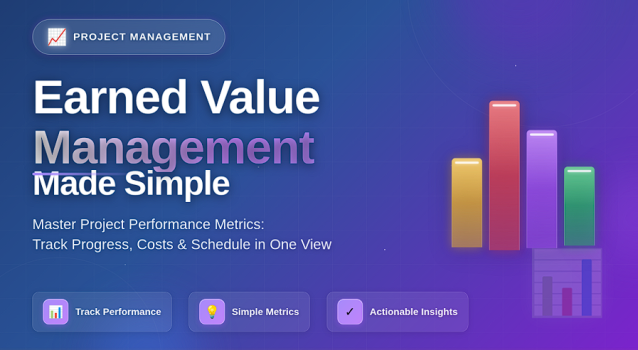
Earned Value Management (EVM) is one of the most powerful tools in project management — yet often one of the most misunderstood.
Top 5 Project Management Software
At its core, EVM is a quantitative method that integrates scope, schedule, and cost to measure project performance objectively. It tells you whether you are on track, ahead, or falling behind, using simple, standardized metrics.
When used correctly, EVM helps you forecast final costs, anticipate delays, and make informed decisions before problems escalate.
This guide simplifies EVM into easy-to-understand concepts you can start applying today.
✅ What Is Earned Value Management?
Earned Value Management compares what you’ve planned to do, what you’ve actually done, and how much it cost.
It integrates three critical data points:
✔️ Planned Value (PV) – What you intended to accomplish by a certain date.
✔️ Earned Value (EV) – The value of what you actually completed.
✔️ Actual Cost (AC) – How much you actually spent to get there.
These three metrics reveal whether the project is performing as expected — financially and temporally.
✅ Why EVM Matters
✔️ Provides objective, data-driven insight instead of guesswork.
✔️ Enables early detection of cost or schedule variances.
✔️ Facilitates accurate forecasting of total project cost and completion date.
✔️ Improves stakeholder communication with clear, visual metrics.
✔️ Promotes accountability across teams and contractors.
✅ Key Earned Value Management Metrics
Core formulas that measure project health using scope, schedule, and cost data.
| Metric | Formula | Interpretation |
|---|---|---|
| 1. Cost Variance (CV) | CV = EV – AC | Shows whether you’re under or over budget. Positive = under budget. |
| 2. Schedule Variance (SV) | SV = EV – PV | Indicates if work is ahead or behind schedule. Positive = ahead of plan. |
| 3. Cost Performance Index (CPI) | CPI = EV ÷ AC | Efficiency of cost usage. CPI < 1 = over budget; CPI > 1 = efficient. |
| 4. Schedule Performance Index (SPI) | SPI = EV ÷ PV | Progress efficiency. SPI < 1 = behind schedule; SPI > 1 = ahead. |
| 5. Estimate at Completion (EAC) | EAC = BAC ÷ CPI | Forecast of total project cost at completion based on current performance. |
| 6. Estimate to Complete (ETC) | ETC = EAC – AC | How much more money is needed to finish the project. |
✅ How to Apply EVM in Practice
✔️ Define the Work Breakdown Structure (WBS): Ensure all deliverables are measurable.
✔️ Set the Cost Baseline: Establish planned value (PV) for each activity.
✔️ Collect Actual Data: Track work progress and real expenses frequently.
✔️ Calculate EV, AC, and PV: Update these values weekly or biweekly.
✔️ Analyze Variances: Use CV and SV to identify issues early.
✔️ Forecast Outcomes: Adjust project strategy using EAC and CPI.
✅ Tools That Simplify EVM
✔️ Microsoft Project – Automates PV, EV, and AC calculations.
✔️ Smartsheet – Offers built-in dashboards for performance tracking.
✔️ Monday.com – Visual boards with earned value formulas and cost tracking.
✔️ Power BI – Custom visualization of EVM indicators.
✔️ Excel/Google Sheets – Perfect for smaller projects or teaching EVM basics.
✅ Common Mistakes to Avoid
❌ Starting EVM without a proper cost baseline.
❌ Confusing “percent complete” with earned value.
❌ Ignoring regular data updates — stale inputs break accuracy.
❌ Overreacting to single-period variance instead of trend analysis.
❌ Using EVM only as a reporting tool instead of a management process.
✅ Best Practices
✔️ Integrate EVM with risk and schedule control for a complete performance view.
✔️ Keep data sources consistent across financial and project systems.
✔️ Train teams on interpretation, not just formulas.
✔️ Use visual dashboards to communicate insights clearly.
✔️ Re-baseline after major approved scope changes only.
✅ Final Thoughts
Earned Value Management doesn’t have to be complicated. When understood properly, it gives project managers a powerful early-warning system — turning raw data into actionable intelligence.
The strongest teams don’t wait for cost overruns — they see them coming through earned value insight.