 MElkhateeb
➡️ Introduction
Pressure is part of every project — tight deadlines, shifting priorities, demanding clients, or unexpected issues.
But for a project manager, the real challenge is not the pressure itself — it’s keeping the team motivated, focused, and confident while the pressure rises.
Top 5 Project Management Software
Motivated teams perform better, solve problems faster, and stay committed when challenges appear.
This article teaches practical, psychology-based techniques every project manager can apply immediately.
✅ Why Motivation Drops Under Pressure
When the heat rises, team members often experience:
✔️ Stress and cognitive overload
✔️ Fear of failure or blame
✔️ Unclear priorities
✔️ Fatigue or burnout
✔️ Reduced creativity and initiative
Your job is to reverse these reactions by creating safety, clarity, and energy — even during peak stress.
✅ Proven Strategies to Motivate Your Team Under Pressure
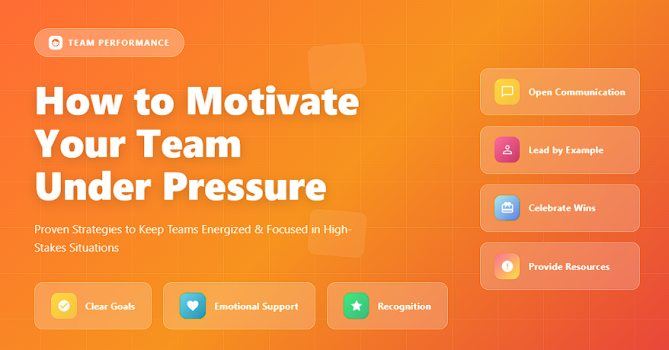
✅ How to Motivate Your Team Under Pressure
Science-backed tactics that strengthen morale during stressful project phases.
| Motivation Strategy | Why It Works | How to Apply It |
|---|---|---|
| 1. Clarify Priorities | Reduces stress by removing uncertainty. | Hold quick alignment meetings and highlight only the top 3 priorities. |
| 2. Break Work Into Small Wins | Creates momentum and psychological reward loops. | Turn big tasks into 1–2 hour micro-goals and celebrate progress. |
| 3. Protect the Team From Noise | Reduces distractions and mental load. | Filter client interruptions and handle sensitive escalations yourself. |
| 4. Lead With Calm | Teams mirror the emotional state of the leader. | Use steady tone, structured communication, and confident body language. |
| 5. Offer Help, Not Pressure | Builds trust and reduces fear of failure. | Ask, “What blockers can I remove for you today?” |
| 6. Recognize Effort Publicly | Triggers dopamine + reinforces psychological safety. | Celebrate contributions during meetings or dashboards. |
| 7. Maintain Transparency | Reduces rumors and unnecessary stress. | Share the real status, risks, and mitigation plans clearly. |
| 8. Support Well-Being | Sustains energy and reduces burnout. | Encourage breaks, flexible work windows, or rotation of heavy tasks. |
✅ Additional Techniques to Boost Motivation
✔️ Use Visual Progress Boards (Miro, Monday.com)
Keeps everyone aligned on what’s done, what’s next, and where support is needed.
✔️ Hold Quick Daily Stand-Ups
Creates shared focus and eliminates hidden blockers.
✔️ Celebrate Milestones
Even small wins can shift morale from “pressure” to “progress.”
✔️ Provide Psychological Safety
Make it clear that mistakes are learning opportunities — not blame triggers.
✔️ Empower Ownership
Let team members choose how to approach tasks, not just what to do.
✅ What NOT to Do Under Pressure
❌ Increase micromanagement
❌ Communicate only when something goes wrong
❌ Ignore fatigue or emotional stress
❌ Shift all pressure to the team
❌ Focus on tasks instead of people
These mistakes drain motivation fast.
✅ Best Practices for Long-Term Motivation
✔️ Build a culture of recognition and support
✔️ Provide frequent clarity, not constant supervision
✔️ Encourage innovation and autonomy
✔️ Keep communication brief, consistent, and calm
✔️ Review pressure points regularly and adjust workloads
✅ Final Thoughts
Pressure doesn’t destroy teams — poor leadership during pressure does.
When you stay calm, provide clarity, and reinforce trust, your team becomes stronger, more resilient, and more committed.
Under pressure, great project managers don’t just manage tasks — they lift people.