 MElkhateeb
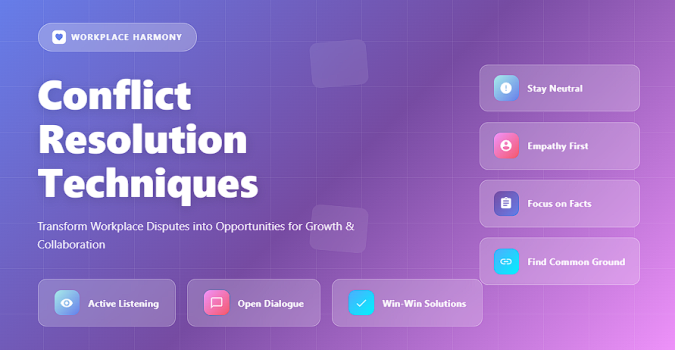
➡️ Introduction
Conflict is a natural part of teamwork — especially in projects where deadlines, expectations, personalities, and priorities collide.
The goal is not to eliminate conflict but to manage it constructively so the team can stay aligned, productive, and motivated.
Top 5 Project Management Software
Great project managers treat conflict as information, not as a threat.
When handled early and professionally, conflict becomes an opportunity for better communication, improved processes, and stronger working relationships.
✅ Why Conflict Happens in Teams
Conflict typically emerges from:
✔️ Misaligned goals or unclear priorities
✔️ Role ambiguity
✔️ Breakdown in communication
✔️ Competing resource needs
✔️ Personality differences
✔️ High pressure or workload
✔️ Lack of shared understanding
The root cause matters — because different conflicts require different resolution techniques.
✅ Practical Conflict Resolution Techniques
✅ Effective Conflict Resolution Techniques
Clear, practical methods to transform conflict into collaboration.
| Technique | Why It Works | How to Apply It |
|---|---|---|
| 1. Active Listening | Reduces tension and ensures people feel heard. | Listen fully, summarize back what you heard, and validate feelings. |
| 2. Mediation | A neutral third party helps clarify misunderstandings. | Facilitate structured discussions where both sides share equally. |
| 3. Collaboration (Win-Win) | Builds shared solutions that address both sides’ needs. | Brainstorm together and select options benefiting all involved. |
| 4. Compromise | Provides a middle ground and prevents deadlocks. | Encourage each side to give up something of lower priority. |
| 5. Root-Cause Analysis | Addresses underlying issues instead of surface symptoms. | Use tools like 5 Whys or Fishbone Diagram to find real causes. |
| 6. Setting Clear Expectations | Prevents recurring conflict and misalignment. | Reconfirm roles, tasks, priorities, and communication rules. |
| 7. Escalation (When Needed) | Serious conflicts require higher-level decisions. | Follow your escalation path through sponsor or leadership. |
✅ Steps to Resolve Conflict Effectively
✔️ Step 1 — Identify the conflict early
Look for signs like silence, tension, reduced collaboration, or repeated misunderstandings.
✔️ Step 2 — Understand each perspective
Gather facts separately before bringing parties together.
✔️ Step 3 — Stay neutral
Focus on behavior and impact — not personalities.
✔️ Step 4 — Facilitate a conversation
Encourage open communication with equal speaking time.
✔️ Step 5 — Agree on the root cause
Ensure both parties understand what the real issue is.
✔️ Step 6 — Choose and apply the appropriate technique
Not every conflict needs the same approach.
✔️ Step 7 — Document the agreement
Capture decisions, actions, and ownership.
✔️ Step 8 — Follow up
Monitor progress to ensure the conflict does not reappear.
✅ Tools That Support Conflict Resolution
✔️ Miro – Root-cause analysis workshops and structured conversation boards
✔️ Monday.com – Track agreements, deadlines, and corrective actions
✔️ Smartsheet – Manage issue logs and escalation workflows
✔️ Slack / Teams – Clarify misunderstandings quickly
✔️ Power BI – Visualize bottlenecks and performance trends that may cause conflict
✅ Common Mistakes to Avoid
❌ Ignoring the conflict
❌ Taking sides
❌ Letting emotions lead the discussion
❌ Avoiding facts and focusing on assumptions
❌ Trying to win the argument instead of solving the issue
❌ Escalating too early or too late
✅ Best Practices
✔️ Allow people to speak without interruption
✔️ Keep discussions structured and time-bound
✔️ Address behavior — not personality
✔️ Stay calm and model professionalism
✔️ Reinforce collaboration and empathy
✔️ Build a culture where concerns can be raised safely
✅ Final Thoughts
Conflict is inevitable — but unmanaged conflict is optional.
The best project managers resolve conflict early, fairly, and deliberately.
Handled correctly, conflict becomes a catalyst for better communication, stronger relationships, and higher team performance.
Conflicts don’t break teams — silence and avoidance do.