
 MElkhateeb
➡️ Introduction
Once risks are identified, the next step is to evaluate them. But not all risks require the same level of analysis.
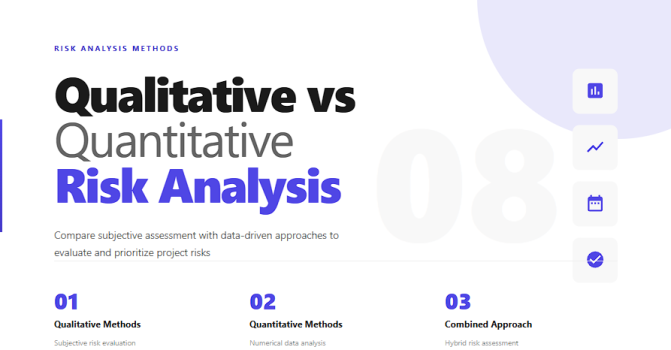
Project managers use two primary techniques to understand risk exposure:
✔️ Qualitative Risk Analysis
✔️ Quantitative Risk Analysis
Top 5 Project Management Software
Both methods help you prioritize threats and opportunities, but they differ in depth, data requirements, and decision-making impact.
This article explains each method clearly and shows when to use one over the other.
✅ What Is Qualitative Risk Analysis?
Qualitative risk analysis uses descriptive, non-numeric, and experience-based assessments to understand the likelihood and impact of risks.
It answers questions like:
➡️ How serious is this risk?
➡️ How likely is it to occur?
➡️ Should we address it first or later?
It’s fast, collaborative, and ideal early in the project.
✔️ Tools Used
- Probability & Impact Matrix
- Risk Categorization
- Risk Urgency Assessment
- Workshops & SME judgment
✅ What Is Quantitative Risk Analysis?
Quantitative risk analysis uses numerical data, statistics, and mathematical modeling to understand the measurable impact of risks on project cost and schedule.
It answers questions like:
➡️ How much money could we lose if this risk happens?
➡️ How many days could be added to the schedule?
➡️ What is the probability we finish within budget?
It provides deeper insights but requires more data and expertise.
✔️ Tools Used
- Monte Carlo Simulation
- Sensitivity Analysis (Tornado Diagrams)
- Decision Tree Analysis
- Expected Monetary Value (EMV)
- Three-Point Estimating (PERT)
✅ Qualitative vs Quantitative Risk Analysis
How they differ in purpose, data, speed, and outputs.
| Aspect | Qualitative Analysis | Quantitative Analysis |
|---|---|---|
| Type of Evaluation | Descriptive, non-numeric, judgement-based. | Numeric, data-driven, statistically modeled. |
| Purpose | Prioritize risks quickly. | Measure potential cost and schedule impact. |
| Speed | Fast and simple. | Slower and more resource-intensive. |
| Data Required | Minimal data; relies on expert judgment. | Detailed numbers, statistics, historical data. |
| Tools | Risk matrix, categories, SME input. | Monte Carlo, EMV, decision trees, PERT. |
| Output | Risk priorities (High/Medium/Low). | Numeric estimates (days, dollars, probabilities). |
| When to Use | Early stages or when data is limited. | Large, complex projects with detailed data. |
✅ When to Use Qualitative Risk Analysis
Use qualitative analysis when you need:
✔️ a quick overview of risks
✔️ prioritization for planning
✔️ early-stage risk understanding
✔️ team-wide collaboration
✔️ minimal data requirements
Perfect during initiation and early planning.
✅ When to Use Quantitative Risk Analysis
Use quantitative analysis when you need:
✔️ numeric accuracy
✔️ probability of finishing on time
✔️ cost exposure in dollars
✔️ schedule exposure in days
✔️ scenario modeling
✔️ executive-level decision support
Perfect for large, high-budget, or high-risk projects.
❌ Common Mistakes to Avoid
❌ Using quantitative techniques without proper data
❌ Skipping qualitative analysis and jumping straight to numbers
❌ Relying only on judgment without team input
❌ Forgetting that both methods complement each other
⭐ Best Practices
✔️ Always start with qualitative analysis
✔️ Use quantitative analysis for top-priority risks
✔️ Document both results clearly
✔️ Use visuals (heat maps, tornado charts)
✔️ Update risk analysis throughout the project
⭐ Final Thoughts
Qualitative and quantitative risk analysis are not competitors — they are complementary tools.
Qualitative analysis helps you prioritize, while quantitative analysis helps you predict.
Together, they give project managers a complete understanding of risk exposure.
The strongest risk strategies combine human judgment with hard numbers.