
 MElkhateeb
➡️ Introduction
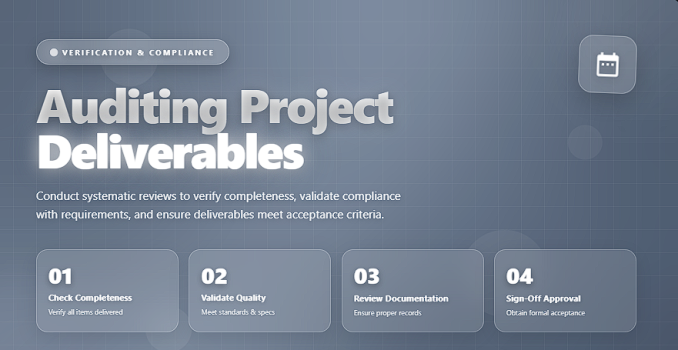
Auditing project deliverables is one of the most powerful quality assurance practices in project management. It verifies whether the work produced truly meets the agreed requirements, standards, and success criteria.
Without proper auditing, teams risk delivering outputs that are incomplete, incorrect, misaligned with stakeholder expectations, or non-compliant with regulations.
Top 5 Project Management Software
A structured deliverable audit not only protects quality — it also protects time, budget, and customer satisfaction by detecting problems early, before they escalate into costly rework.
This guide explains exactly what deliverable audits are, why they matter, and how to execute them effectively in any project environment.
✅ What Is a Deliverable Audit?
A deliverable audit is a systematic review of project outputs to confirm:
✔️ They meet documented requirements
✔️ They comply with internal and external standards
✔️ They are complete and free of errors
✔️ They align with stakeholder expectations
✔️ They are ready for approval or handover
Audits can be conducted internally (by the project team) or externally (by clients, quality teams, or regulatory bodies).
✅ Why Deliverable Audits Matter
Strong audits lead to:
✔️ Higher customer satisfaction
✔️ Fewer revisions and defects
✔️ Reduced risk of project delays
✔️ Stronger compliance and traceability
✔️ Improved confidence among stakeholders
✔️ Better performance metrics for future projects
Deliverable audits are not about finding fault — they are about ensuring the project delivers exactly what was promised.
✅ Types of Deliverable Audits
✔️ 1. Requirements Compliance Audit
Confirms that each deliverable matches defined requirements, user stories, or specifications.
✔️ 2. Quality Standards Audit
Ensures deliverables meet technical, organizational, or industry quality standards.
✔️ 3. Process Audit
Evaluates whether deliverables were produced following approved processes, methodologies, or best practices.
✔️ 4. Documentation Audit
Reviews accompanying documentation such as user manuals, test results, acceptance criteria, or change logs.
✔️ 5. Regulatory or External Audit
Required in certain industries (healthcare, finance, engineering) to maintain compliance and avoid legal issues.
✅ How to Conduct an Effective Deliverable Audit
✔️ 1. Define the Audit Scope
Before reviewing anything, determine:
- Which deliverables are being audited
- What standards or requirements will be used
- Who will participate in the audit
- What the approval criteria are
A clear scope prevents unnecessary delays or confusion.
✔️ 2. Gather All Reference Documents
Essential sources include:
- Project scope statement
- Requirements documents
- Acceptance criteria
- Quality standards
- Change requests
- Previous audit findings
- Process documentation
You cannot evaluate work correctly without comparing it to the right baselines.
✔️ 3. Review Deliverables Systematically
Use a structured audit checklist (I can create one for you).
Verify:
✔️ completeness
✔️ accuracy
✔️ consistency
✔️ compliance
✔️ usability
✔️ formatting
✔️ traceability to requirements
Document all findings clearly and objectively.
✔️ 4. Identify Gaps, Defects, or Risks
Common findings include:
❌ missing components
❌ incorrect calculations or logic
❌ inconsistent branding or formatting
❌ unclear content
❌ deviation from process
❌ incomplete documentation
Classify each issue by severity (High, Medium, Low).
✔️ 5. Assign Corrective Actions
For every defect, define:
- Required fix
- Responsible owner
- Target completion date
This ensures accountability and timely closure.
✔️ 6. Conduct a Follow-Up Review
Re-audit the updated deliverable to confirm all issues were resolved.
This step is essential before submitting the deliverable for client approval or final acceptance.
✔️ 7. Document Final Approval
Record:
✔️ final review results
✔️ acceptance signatures
✔️ version numbers
✔️ completion date
This becomes part of the project’s quality record and lessons-learned archive.
🛠️ Tools for Auditing Deliverables
You can manage deliverable audits using:
✔️ Excel / Google Sheets (audit templates, checklists)
✔️ Monday.com (quality boards, automation)
✔️ Smartsheet (QA workflows)
✔️ Confluence / SharePoint (documentation reviews)
✔️ Jira (for Agile acceptance and defect tracking)
✔️ Miro (visual process audits)
❌ Common Mistakes to Avoid
❌ Treating audits as optional
❌ Reviewing only at the end instead of incrementally
❌ Using vague acceptance criteria
❌ Not involving the right subject matter experts
❌ Ignoring small inconsistencies that create major rework later
❌ Poor documentation of findings and actions
⭐ Best Practices for Strong Deliverable Audits
✔️ Audit early and often
✔️ Use detailed acceptance criteria
✔️ Apply checklists for consistency
✔️ Involve cross-functional reviewers
✔️ Create a version control system
✔️ Track issues until they are fully resolved
✔️ Store findings for lessons learned
⭐ Final Thoughts
Deliverable audits are one of the most effective ways to guarantee that a project meets its promises — not just internally, but in the eyes of clients, users, and stakeholders.
A strong audit process leads to fewer issues, better quality, faster approvals, and greater project success.
Excellence in deliverables builds trust.
Trust builds long-term partnerships and repeat business.