 MElkhateeb
➡️ Introduction
Even the best-planned projects can drift off track due to shifting priorities, unexpected delays, technical issues, unclear requirements, or resource challenges.
A project going off track is not a failure—it’s a signal that corrective action is needed.
Top 5 Project Management Software
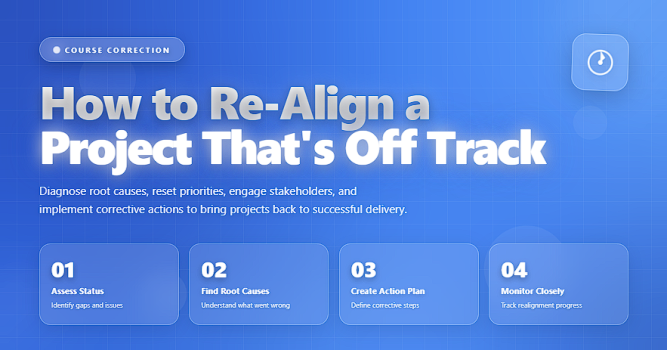
Re-alignment is the structured process of analyzing the problem, making smart adjustments, and restoring project performance. Successful project managers know how to identify early warning signs, stabilize execution, and communicate changes clearly to stakeholders.
This guide walks you through the exact steps to bring a struggling project back under control.
✅ Common Signs a Project Is Going Off Track
Project drift often starts small but quickly accelerates if unmanaged.
Key warning indicators include:
✔️ repeated missed deadlines
✔️ increasing backlog or unresolved issues
✔️ unclear or shifting requirements
✔️ budget overspending
✔️ low team morale or capacity overload
✔️ stakeholder complaints
✔️ high rework rate
✔️ neglected risk items triggering issues
If two or more symptoms appear consistently, immediate intervention is required.
✅ Step-by-Step: How to Re-Align a Project That’s Off Track
Below is a deep, structured recovery process used by senior project managers.
✔️ Step 1: Conduct a Rapid Project Health Assessment
Start with a fast but thorough review of the project’s current state:
- Are tasks meeting expected timelines?
- Are resources fully available?
- Are risks turning into issues?
- Is scope changing too often?
- Are dependencies causing delays?
Gather data from:
✔️ status reports
✔️ team feedback
✔️ metrics dashboards
✔️ burndown/burnup charts
✔️ budget reports
This creates a 360° view of what’s working—and what isn’t.
✔️ Step 2: Identify Root Causes
Use root-cause analysis techniques such as:
- 5 Whys
- Fishbone (Ishikawa) diagram
- Pareto analysis
- Interviews with team members
Root causes often fall into categories:
✔️ planning gaps
✔️ unrealistic estimates
✔️ unclear requirements
✔️ poor communication
✔️ lack of resources
✔️ technical complexity
✔️ external delays (vendors, approvals)
Solving symptoms will not fix the project—solve the root.
✔️ Step 3: Re-Prioritize Scope and Deliverables
When a project is off track, the fastest recovery often comes from smarter prioritization.
Actions include:
✔️ remove or postpone low-value scope
✔️ break large features into manageable increments
✔️ review “must-have” vs “nice-to-have” items
✔️ align with business value and deadlines
This is where negotiation with stakeholders becomes essential.
✔️ Step 4: Re-Baseline the Schedule and Budget
✅ Updated Baseline Elements
Key components to revisit when realigning a project.
| Baseline Element | What to Adjust | Why It Matters |
|---|---|---|
| Scope | Remove, refine, or reprioritize deliverables. | Prevents overload and supports focus. |
| Schedule | Update durations, dependencies, and milestones. | Creates realistic expectations. |
| Cost | Recalculate resource and vendor allocations. | Avoids surprise overruns. |
| Risks | Update risk exposure and triggers. | Prepares the team for new uncertainties. |
✔️ Step 5: Strengthen Communication Channels
When a project struggles, communication must intensify.
Do the following:
✔️ hold more frequent stand-ups or check-ins
✔️ share shorter, clearer status updates
✔️ escalate blockers early
✔️ establish a single source of truth for updates
Clear communication = faster recovery.
✔️ Step 6: Provide Additional Support to the Team
Off-track projects often overwhelm teams.
To support them:
✔️ rebalance workloads
✔️ bring in temporary resources or SMEs
✔️ provide quick training if needed
✔️ remove low-value tasks or noise
A stable team will recover faster than an overloaded one.
✔️ Step 7: Implement Corrective Actions
Corrective actions may include:
✔️ redesigning workflow or process
✔️ improving estimation practices
✔️ replacing or upgrading tools
✔️ adjusting delivery methodology
✔️ redesigning dependencies or integrations
✔️ renegotiating vendor agreements
Focus on changes with immediate, measurable impact.
✔️ Step 8: Reinforce Risk Management
Off-track projects have higher vulnerability to new risks.
Strengthen your risk process by:
✔️ updating the risk register
✔️ adding new risks discovered during analysis
✔️ reviewing triggers weekly
✔️ assigning new risk owners
✔️ revising response strategies
Better risk oversight prevents the project from slipping again.
✔️ Step 9: Monitor Recovery Progress Closely
After realignment, measure progress through:
✔️ earned value metrics (SPI, CPI)
✔️ milestone completion
✔️ velocity trends
✔️ quality and defect metrics
✔️ stakeholder satisfaction
✔️ workload stability
If recovery is not visible within 2–3 cycles, adjust again.
🛠️ Tools That Support Project Realignment
✔️ Miro – root-cause diagrams, workflow redesign
✔️ Monday.com – schedules, automations, dashboards
✔️ Jira – backlog refinement, sprint planning
✔️ Power BI – realignment dashboards
✔️ Excel/Google Sheets – baselines, KPIs, rework tracking
❌ Common Mistakes to Avoid
❌ Blaming individuals instead of fixing the system
❌ Repeating the same decisions that caused slippage
❌ Avoiding difficult conversations with stakeholders
❌ Failing to re-baseline when conditions have changed
❌ Ignoring early warning signs
⭐ Best Practices
✔️ Take corrective action early
✔️ Focus on business value, not just task completion
✔️ Use data-driven decision-making
✔️ Keep communication frequent and simple
✔️ Revisit assumptions and dependencies regularly
✔️ Celebrate small wins during recovery
⭐ Final Thoughts
A project going off track is not unusual — what matters is how you respond.
With structured analysis, transparent communication, and disciplined corrective actions, you can bring almost any project back under control.
Great project managers don’t just deliver projects.
They recover them.