 MElkhateeb
➡️ Introduction
Project closure is one of the most underestimated phases in project management. Many teams finish the last deliverable and rush into the next initiative — leaving behind unresolved issues, missing documentation, financial gaps, and valuable lessons unrecorded.
Proper closure ensures that the project is completed formally, stakeholders are satisfied, knowledge is captured, and the organization is prepared for future work.
Top 5 Project Management Software
Closing a project isn’t just an administrative task — it’s a disciplined process that protects value, strengthens organizational maturity, and confirms that the project achieved its objectives.
This article walks you through the essential steps to close a project properly, based on best practices from PMI, modern PMO standards, and real-world project environments.
✅ 1. Confirm All Deliverables Are Completed
Before anything else, validate that every deliverable defined in the scope has been completed, reviewed, and accepted.
What this includes:
✔️ verifying functional and technical requirements
✔️ confirming all tasks are marked “Done”
✔️ ensuring acceptance criteria are met
✔️ validating quality and compliance standards
This step prevents surprises during client or stakeholder sign-off.
✅ 2. Obtain Formal Acceptance from Stakeholders
A project is not closed until the client, sponsor, or relevant authority signs off.
Why formal acceptance matters:
✔️ eliminates ambiguity
✔️ protects the team from late scope disputes
✔️ provides legal and budgetary closure
Use a Project Acceptance Form, handover document, or sign-off letter.
✅ 3. Close All Contracts and Financial Accounts
Contract and procurement closure is a mandatory part of professional project management.
This includes:
✔️ validating vendor deliverables
✔️ approving final payments
✔️ resolving disputes or claims
✔️ closing purchase orders
✔️ updating financial records
✔️ releasing unused budget
Financial closure ensures no open liabilities exist after the project ends.
✅ 4. Conduct a Final Project Review
A structured final review confirms whether the project met objectives in terms of:
✔️ cost
✔️ schedule
✔️ scope
✔️ quality
✔️ stakeholder satisfaction
This review should highlight what went well, what didn’t, and how performance aligns with baselines.
✅ 5. Document Lessons Learned
Lessons learned are the most valuable output of the closing phase.
They convert project experience into organizational knowledge.
Topics to document:
✔️ successful practices worth repeating
✔️ risks that materialized and why
✔️ mistakes that caused delays or waste
✔️ process gaps
✔️ stakeholder challenges
✔️ team performance insights
Record lessons learned in your PMO knowledge base or organizational repository.
✅ 6. Archive All Project Documents
Proper documentation ensures traceability, compliance, and future reference.
Archive items include:
✔️ project charter
✔️ scope documents
✔️ contracts
✔️ risk registers
✔️ change logs
✔️ test results
✔️ communication logs
✔️ final reports
✔️ financial records
Organized archives prevent operational gaps and support audits.
✅ 7. Release Resources
Once the project is officially closed, release:
✔️ team members
✔️ equipment
✔️ office space
✔️ external contractors
✔️ unused software licenses
This step supports cost efficiency and team morale as people return to their functional duties or next assignments.
✅ 8. Celebrate Success & Acknowledge the Team
Project closure isn’t complete without recognition.
Why celebration matters:
✔️ increases morale
✔️ builds trust
✔️ strengthens team culture
✔️ reinforces positive behaviors
A simple thank-you session, an appreciation email, or a small celebration goes a long way.
✅ 9. Create the Final Project Closure Report
The closure report is the official end-of-project document.
It includes:
✔️ summary of objectives
✔️ final budget and schedule results
✔️ key deliverables completed
✔️ major risks encountered
✔️ lessons learned
✔️ recommendations for future projects
This is often required by PMOs, auditors, or governing bodies.
⭐ Final Thoughts
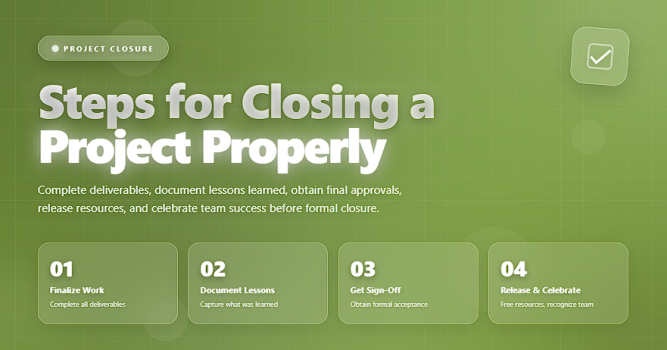
Closing a project properly ensures that all deliverables are validated, stakeholders are satisfied, finances are locked, knowledge is captured, and the organization transitions smoothly into its next priorities.
A disciplined closure phase strengthens:
✔️ organizational learning
✔️ project governance
✔️ stakeholder trust
✔️ future project success
Great project managers don’t just finish projects —
they close them professionally, completely, and strategically.