
 MElkhateeb
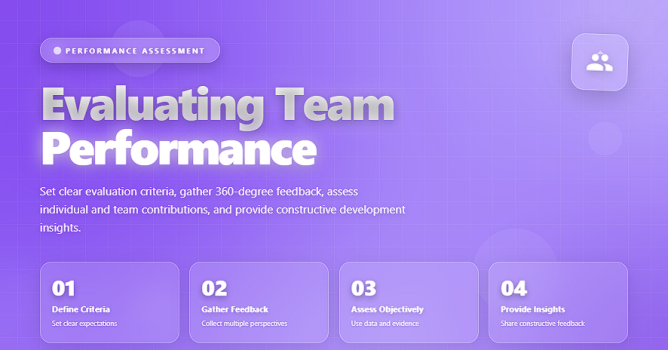
Below is a professional, educational, SEO-optimized article on Evaluating Team Performance, written in your house style and ready to rank on Google, ChatGPT, and Claude.
(No tables were needed for this topic, but if you want one, I can add your responsive code.)
Top 5 Project Management Software
✅ Evaluating Team Performance: A Practical Guide for Project Managers
➡️ Introduction
A high-performing project team doesn’t happen by chance — it’s shaped through clarity, feedback, accountability, and continuous improvement.
To keep work on track and ensure consistent delivery, project managers must evaluate team performance objectively and regularly.
Performance evaluation is not about assigning blame.
It is about identifying strengths, improving collaboration, preventing burnout, aligning expectations, and ensuring the project team has what it needs to succeed.
This guide explains how to evaluate team performance, the methods you can use, what metrics matter, and how to turn insights into meaningful action.
✅ Why Evaluating Team Performance Matters
Effective performance evaluation helps project managers:
✔️ detect team challenges early
✔️ prevent quality issues and delivery delays
✔️ identify training needs and skill gaps
✔️ strengthen communication and accountability
✔️ boost team morale through recognition
✔️ improve future project outcomes
Strong evaluation practices lead to stronger project teams — and stronger outcomes.
✅ Key Dimensions of Team Performance
Performance in project environments is multi-dimensional. A complete evaluation considers the following:
✔️ 1. Productivity
- Are tasks completed on time?
- Are team members delivering consistently?
- Is the workload balanced across the team?
✔️ 2. Quality of Work
- Are deliverables meeting quality standards?
- Is rework increasing or decreasing?
- Are defects being caught early?
✔️ 3. Collaboration & Communication
- Do team members share information openly?
- Are conflicts resolved quickly and professionally?
- Is feedback exchanged respectfully?
✔️ 4. Accountability
- Do team members take ownership of tasks?
- Are commitments honored?
- Are blockers raised proactively?
✔️ 5. Problem-Solving Capability
- Does the team handle challenges creatively?
- Do they escalate issues early?
- Are solutions sustainable or temporary fixes?
✔️ 6. Adaptability
- Can team members handle scope changes?
- Do they adjust well to new tools, processes, or timelines?
✔️ 7. Stakeholder Satisfaction
- How do clients, sponsors, and other departments perceive the team?
- Are interactions professional and timely?
✅ Methods for Evaluating Team Performance
A professional performance assessment uses several methods, not just one.
✔️ 1. One-on-One Conversations
Private discussions reveal concerns, motivation levels, and obstacles team members may not share publicly.
✔️ 2. Team Retrospectives
Used in Agile and traditional environments, retrospectives help teams reflect on what went well and what needs improvement.
✔️ 3. KPIs and Metrics
Examples:
- task completion rate
- cycle time
- defect rate
- rework volume
- milestone adherence
- customer satisfaction score
✔️ 4. 360-Degree Feedback
A full picture collected from:
- peers
- stakeholders
- clients
- the project manager
- self-evaluation
✔️ 5. Observation
Everyday behavior shows reliability, involvement, cooperation, and initiative.
✔️ 6. Feedback from Stakeholders
Direct insights from departments, clients, or sponsors reveal how the team is perceived externally.
✅ Tools to Support Team Performance Evaluation
✔️ Monday.com — task performance & workload tracking
✔️ Jira — cycle time, throughput, sprint performance
✔️ Smartsheet — dashboards for team productivity
✔️ Miro — collaborative retrospectives
✔️ Microsoft Planner / Teams — tracking small internal teams
✔️ Google Sheets / Excel — flexible custom evaluation templates
✅ How to Conduct a Professional Performance Evaluation
✔️ Step 1: Define Evaluation Criteria
Use consistent, objective standards based on responsibilities, quality expectations, and project goals.
✔️ Step 2: Collect Performance Data
Gather data from metrics, reports, observations, and feedback channels.
✔️ Step 3: Assess Individual and Team Contributions
Evaluate both:
- individual performance
- collective team output
✔️ Step 4: Identify Strengths and Improvement Areas
Be specific. Avoid vague comments like “work faster.”
Use measurable observations.
✔️ Step 5: Provide Constructive Feedback
Feedback should be:
✔️ direct
✔️ respectful
✔️ supported by examples
✔️ focused on behaviors, not personalities
✔️ Step 6: Set Improvement Actions
Define clear, achievable actions such as training, mentorship, workload adjustments, or process improvements.
✔️ Step 7: Follow Up and Re-Evaluate
Evaluation is not a one-time event — it is continuous.
Review progress and adjust action plans regularly.
❌ Common Mistakes to Avoid
❌ waiting until the end of the project to evaluate performance
❌ focusing only on mistakes instead of strengths
❌ ignoring team dynamics and communication issues
❌ relying only on your own perspective
❌ providing vague or emotional feedback
❌ comparing team members against each other
⭐ Best Practices for High-Impact Performance Evaluation
✔️ evaluate early and frequently
✔️ focus on facts and evidence
✔️ celebrate achievements publicly
✔️ address issues privately
✔️ customize evaluation methods to team maturity
✔️ use a balance of qualitative and quantitative insights
✔️ create a continuous improvement culture
⭐ Final Thoughts
Evaluating team performance is one of the most powerful responsibilities of a project manager.
It shapes team culture, strengthens collaboration, increases productivity, and protects the project from hidden problems.
When done professionally, performance evaluation becomes a catalyst for growth — not criticism.
Strong project managers track performance.
Great project managers develop their teams.
🔍 SEO Summary
Primary Keyword: evaluating team performance
Supporting Keywords: team performance metrics, how to assess team performance, project team evaluation
Meta Title: Evaluating Team Performance: A Complete Guide for Project Managers
Meta Description: Learn how to evaluate team performance using structured criteria, KPIs, feedback methods, and best practices to strengthen collaboration and project outcomes.
Image Alt Text: Project manager evaluating team performance using charts and reports.
If you’d like, I can write the next article in your sequence, such as:
➡️ Final Performance Reporting
➡️ Documenting Lessons Learned
➡️ Post-Implementation Review
Just tell me!