 MElkhateeb
➡️ Introduction
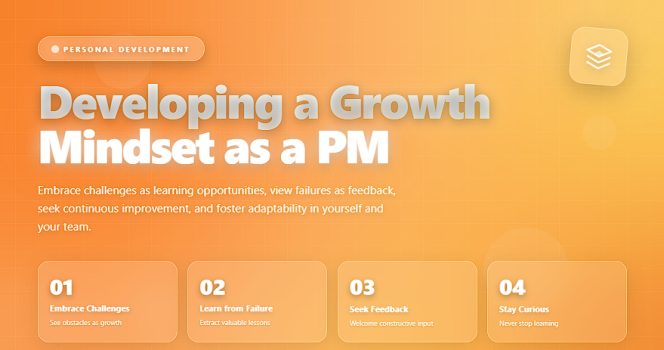
Project management is a discipline defined by complexity, constant change, and high levels of uncertainty. Successful project managers are not those who know everything, but those who continuously learn, adapt, and evolve.
This ability to grow — especially when facing failure, conflict, or major change — is known as having a growth mindset.
Top 5 Project Management Software
A growth mindset isn’t a motivational slogan. It is a strategic advantage that directly impacts decision-making, leadership, communication, stakeholder relations, team performance, and the ability to deliver successful projects in dynamic environments.
This article explains what a growth mindset means for project managers, why it matters, and how to develop it intentionally.
✅ What Is a Growth Mindset in Project Management?
The concept originates from Dr. Carol Dweck’s research, which distinguishes between:
✔ Fixed Mindset
Believes skills and intelligence are static.
→ Avoids challenges
→ Takes feedback personally
→ Gives up easily when obstacles appear
✔ Growth Mindset
Believes skills can be developed through learning and effort.
→ Seeks challenges
→ Learns from mistakes
→ Welcomes feedback
→ Adapts faster
In project management, a growth mindset translates into:
✔ improving processes proactively
✔ seeking better data and insights
✔ analyzing project failures without fear
✔ learning continuously
✔ encouraging team innovation
✔ adapting strategies when risks occur
A PM with a growth mindset becomes a resilient leader who lifts team performance and navigates uncertainty with confidence.
✅ Why a Growth Mindset Matters for Project Managers
✔ 1. Better Decision-Making Under Uncertainty
Projects rarely go as planned. A growth-oriented PM adjusts quickly, re-evaluates assumptions, and makes thoughtful decisions instead of sticking stubbornly to failing plans.
✔ 2. Stronger Leadership and Team Motivation
Teams follow leaders who are open, curious, and improvement-focused.
A growth mindset fosters trust, psychological safety, and honest communication.
✔ 3. Higher Adaptability to Change
Scope shifts, stakeholder changes, supplier delays…
Rigid PMs break under pressure.
Growth-minded PMs adapt without losing control.
✔ 4. Continuous Improvement in Processes
Your retrospectives, lessons learned, and performance metrics become tools for evolution, not blame or punishment.
✔ 5. Stronger Stakeholder Relationships
Stakeholders respect PMs who learn quickly, admit gaps, and take accountability while improving each iteration.
✅ How to Develop a Growth Mindset as a PM
✔ 1. Embrace Challenges, Don’t Avoid Them
If a project seems “too complex,” treat it as an opportunity to grow — new tools, new industries, new methodologies.
✔ 2. Reframe Failures as Lessons
Every failed milestone, incorrect estimate, or misaligned requirement is data.
Ask:
➡ “What can this teach me?”
➡ “What will I do differently next time?”
This is how expert PMs grow faster.
✔ 3. Replace “I Can’t” With “I Can Learn How”
When dealing with budgeting, stakeholder politics, or technical environments, use the mindset:
“I may not know this yet, but I can learn.”
✔ 4. Seek Feedback Regularly
Top project managers request feedback from:
✔ team members
✔ sponsors
✔ clients
✔ peers
✔ PMO leaders
Feedback = fuel for growth.
✔ 5. Adopt Continuous Learning Habits
Growth-mindset PMs learn continually through:
✔ certifications (PMP®, CAPM®, Agile, Scrum)
✔ books
✔ case studies
✔ lessons learned logs
✔ upskilling in tech, AI, analytics
Learning is part of the job — not an extra activity.
✔ 6. Encourage Your Team to Take Smart Risks
Teams innovate when they know it’s safe to experiment and fail.
A growth-minded PM builds that environment.
✔ 7. Use Data to Evolve, Not to Judge
Metrics such as velocity, CPI, milestone slippage, and defect rates should highlight improvement areas — not blame individuals.
✔ 8. Celebrate Progress, Not Just Perfection
Big successes start with small improvements.
Acknowledging progress boosts morale and builds momentum.
✔ 9. Stay Curious About New Tools and Methods
AI, automation, dashboards, PMIS, predictive analytics…
Great PMs experiment constantly, adopting tools that improve execution.
✔ 10. Maintain Long-Term Reflection
Schedule time to review:
✔ what worked
✔ what didn’t
✔ what risks taught you
✔ how stakeholders responded
✔ which communications succeeded
Reflection is a growth multiplier.
✅ Growth Mindset Behaviors vs Fixed Mindset Behaviors
Here’s a quick comparison table for readers (no code needed since it’s not a full schedule):
Growth Mindset PMs:
✔ Ask “How can we improve this?”
✔ Break down challenges
✔ Explore new solutions
✔ Accept mistakes as part of progress
✔ Believe skills can be learned
Fixed Mindset PMs:
❌ Avoid feedback
❌ Fear project complexity
❌ Repeat the same mistakes
❌ Blame external factors
❌ Believe talent is fixed
✅ How a Growth Mindset Impacts Project Outcomes
📌 Better Resilience
Projects recover faster from risks, delays, and scope issues.
📌 Higher Team Ownership
When leaders grow, teams grow with them.
📌 Continuous Process Optimization
Retrospectives, lessons learned, and KPIs become engines for improvement.
📌 Stronger Stakeholder Confidence
Sponsors trust PMs who remain adaptable and improvement-driven.
📌 Improved Project Success Rates
A growth mindset enhances performance across planning, execution, monitoring, and closing.
⭐ Final Thoughts
A growth mindset is not optional — it is a core leadership requirement for modern project managers.
The complexity of today’s work demands leaders who are:
✔ curious
✔ adaptable
✔ reflective
✔ improvement-driven
Developing a growth mindset transforms how you lead projects, engage teams, manage risks, and deliver results.
The best project managers aren’t the ones who know the most —
they are the ones who grow the fastest.