 MElkhateeb
➡️ Introduction
A project doesn’t truly end when the final deliverable is submitted. The real value comes from understanding what worked, what didn’t, and how future projects can benefit.
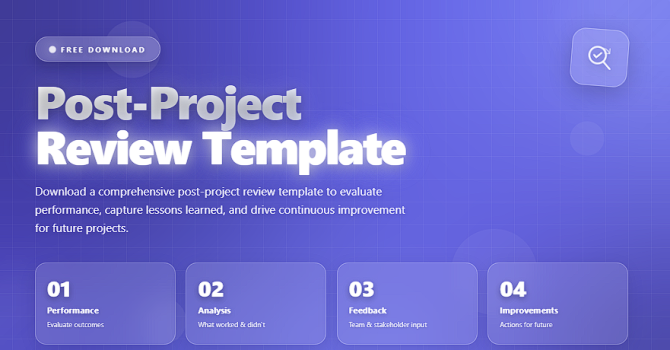
A Post-Project Review (PPR) — sometimes called a Project Retrospective or Project Closure Review — is a structured activity that evaluates project outcomes, team performance, processes, risks, quality, and stakeholder satisfaction.
Top 5 Project Management Software
A well-designed Post-Project Review Template helps teams:
✔ capture lessons learned
✔ identify improvements for future projects
✔ celebrate achievements
✔ prevent repeated mistakes
✔ enhance organizational knowledge
This guide provides a professional template, a clear structure, and actionable guidance to run effective post-project evaluations.
✅ What Is a Post-Project Review?
A Post-Project Review is a formal assessment conducted after project completion.
Its purpose is to evaluate:
- how the project performed
- whether objectives were met
- how resources were used
- what challenges occurred
- how well risks and changes were managed
- what improvements should be applied next time
It is one of the most important elements of a healthy project management culture.
✅ Post-Project Review Template
A complete structure for evaluating project performance.
| Section | Description | Inputs Needed |
|---|---|---|
| 1. Project Summary | Short overview of objectives, scope, timeline, and budget. | Charter, baseline plan. |
| 2. What Went Well | Successful processes, achievements, deliverables, communication wins. | Team feedback, stakeholder surveys. |
| 3. What Didn’t Go Well | Issues, bottlenecks, delays, technical challenges. | Risk logs, change logs, schedule variance. |
| 4. Lessons Learned | Key learnings that should be applied to future projects. | Team retrospective notes. |
| 5. Recommendations | Improvements for processes, tools, communication, skills. | Root cause analysis, team suggestions. |
| 6. Stakeholder Feedback | Feedback from client, sponsor, and key stakeholders. | Interviews, surveys. |
| 7. Final Outcome Review | Assessment of scope delivered, goals achieved, and success criteria met. | KPIs, deliverables list, acceptance notes. |
✅ How to Conduct a Post-Project Review (Step-by-Step)
✔️ 1. Gather Data from the Entire Project
Collect documents such as:
- project plan & baseline
- risk register
- change requests
- issue logs
- budget reports
- quality metrics
- stakeholder feedback
A complete picture produces better insights.
✔️ 2. Involve the Full Team
Bring in voices from:
✔ project team members
✔ technical experts
✔ client representatives
✔ sponsor (optional)
A review is strongest when multiple perspectives are included.
✔️ 3. Facilitate an Honest, Structured Discussion
Use questions like:
- What helped the project succeed?
- What slowed us down?
- What problems repeated themselves?
- What did we learn about communication, tools, or people?
- What would we change next time?
Encourage openness — no blame culture.
✔️ 4. Document Lessons Learned Clearly
Lessons must be specific, actionable, and reusable.
❌ “Communication was slow.”
✔ “Weekly stakeholder check-ins reduced confusion and should be used in all future initiatives.”
✔️ 5. Identify Improvement Opportunities
Examples:
- better requirement clarification
- stronger change management
- improved vendor communication
- clearer estimation methods
- earlier risk identification
Turn experience into future capability.
✔️ 6. Capture Stakeholder Satisfaction
Include feedback from:
✔ sponsor
✔ customer
✔ end users
✔ operational teams
This builds long-term trust and continuous improvement.
✔️ 7. Share and Archive the Review
Store the final review in your:
- PMO repository
- organizational knowledge base
- team wiki
- document archive
Future project managers will rely on this knowledge.
❌ Common Mistakes to Avoid
❌ Turning the session into a blame meeting
❌ Forgetting to record root causes
❌ Not sharing the findings
❌ Allowing the review to become a formality
❌ No follow-up actions
⭐ Best Practices
✔ Keep the discussion structured
✔ Celebrate wins, not only failures
✔ Create actions directly from lessons
✔ Use visuals (dashboards, timelines, charts)
✔ Store lessons centrally for access in future projects
✔ Repeat reviews at phase gates, not only at the end
⭐ Final Thoughts
A Post-Project Review is not just the final step of a project — it is the foundation for improving all future projects.
Organizations that consistently run strong reviews build knowledge faster, reduce repeated mistakes, and dramatically increase project success rates.
Great PMs don’t just finish projects — they learn from them.