 MElkhateeb
➡️ Introduction
Construction projects are among the most complex, high-risk, and tightly regulated types of projects in the world. They involve multiple stakeholders, strict safety requirements, heavy equipment, intensive coordination, long timelines, and millions of dollars at stake.
Top 5 Project Management Software
Because of this complexity, construction has developed some of the most disciplined planning practices in project management — practices that every project manager, in any industry, can learn from.
Whether you manage IT projects, marketing campaigns, software releases, or operations improvements, construction projects can teach powerful lessons about scope control, scheduling, communication, risk management, quality, and stakeholder coordination.
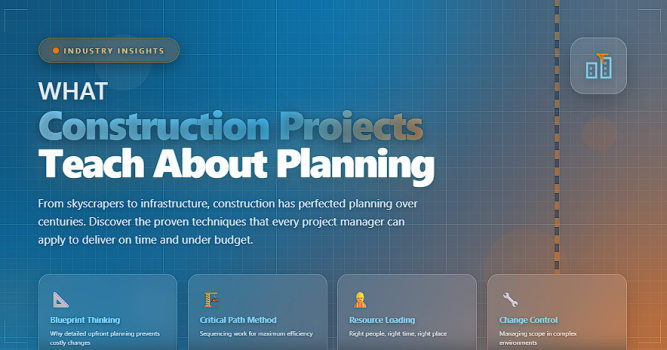
This article breaks down the most valuable planning lessons that construction teaches all project managers — backed with real-world insights and a responsive table for quick reference.
📌 Lessons Construction Projects Teach About Planning
Key principles you can apply to any industry.
| Lesson | Explanation | Why It Matters |
|---|---|---|
| Detailed Upfront Planning | Construction begins only after scope, drawings, and approvals are 100% clear. | Prevents rework, cost overruns, and surprises. |
| Clear Work Breakdown Structure (WBS) | Every task, material, and activity is broken into precise components. | Improves cost control and scheduling accuracy. |
| Strict Change Control | Scope changes require formal reviews, approvals, and new budgets. | Protects timelines and prevents overruns. |
| Risk Planning and Contingencies | Construction plans for weather, supply chain delays, safety hazards, and more. | Maintains schedule reliability and cost protection. |
| Daily Progress Tracking | Site teams track tasks, materials, labor, and safety every single day. | Issues are spotted early before they grow. |
| Multi-Stakeholder Coordination | Engineers, architects, contractors, and inspectors must stay aligned. | Prevents schedule conflicts and design miscommunication. |
| Quality and Safety Embedded in Planning | QA/QC and safety controls are built into the plan, not added later. | Improves outcomes and minimizes accidents and rework. |
🏗️ 1. Construction Teaches the Power of Detailed Upfront Planning
Construction projects invest a massive amount of time in:
✔️ feasibility studies
✔️ architectural drawings
✔️ structural engineering designs
✔️ permits and legal approvals
✔️ resource planning
✔️ site preparation
✔️ cost estimating
Why?
Because one small mistake early becomes a multi-million-dollar problem later.
In other industries, teams often rush into execution — but construction proves that proper planning is cheaper than fixing mistakes.
🏗️ 2. Break Work Down With Extreme Clarity (WBS Discipline)
Construction uses highly detailed Work Breakdown Structures, breaking every element into:
- tasks
- materials
- labor
- equipment
- subcontractors
- inspections
This eliminates ambiguity and allows precise scheduling and costing.
Lesson: The more clarity in your WBS, the stronger your project control.
🏗️ 3. Manage Scope Changes With Discipline
In construction, every change must go through:
✔️ design review
✔️ cost estimation
✔️ contract update
✔️ schedule impact analysis
✔️ formal approval
This protects the project from “decision chaos.”
Lesson: Apply strict change control, no matter your industry.
🏗️ 4. Plan for Risks and Worst-Case Scenarios
Construction risk planning includes:
✔️ weather delays
✔️ supply chain shortages
✔️ equipment failures
✔️ soil issues
✔️ structural risks
✔️ safety incidents
Teams create contingency reserves, alternative suppliers, and backup workflows.
Lesson: If construction can predict the unpredictable, so can you.
🏗️ 5. Track Progress Constantly — Not Weekly
Construction tracks progress:
✔️ per shift
✔️ per crew
✔️ per task
✔️ per material delivery
Daily reporting means daily control.
Lesson: The more frequently you track progress, the faster you detect risks.
🏗️ 6. Align All Stakeholders Early and Often
Construction requires collaboration between:
- architects
- engineers
- contractors
- site supervisors
- clients
- government inspectors
Misalignment leads to delays, redesigns, and disputes.
Lesson: Early stakeholder alignment reduces friction and boosts delivery success.
🏗️ 7. Build Quality and Safety Into the Plan
Construction can’t rely on “inspect later.”
Quality and safety must be designed upfront, including:
✔️ inspections
✔️ structural tests
✔️ material specifications
✔️ safety briefings
✔️ compliance checklists
Lesson: Quality and safety must be part of planning — not afterthoughts.
⭐ Final Thoughts
Construction projects deliver some of the strongest lessons in planning because they operate in a world where mistakes are costly, deadlines are rigid, and safety is non-negotiable.
No matter the industry, applying construction-level planning discipline helps you:
✔️ prevent rework
✔️ protect budgets
✔️ reduce delays
✔️ improve quality
✔️ increase team alignment
If you want better project outcomes, plan like you’re building a skyscraper — not a simple task list.