 MElkhateeb
➡️ Introduction
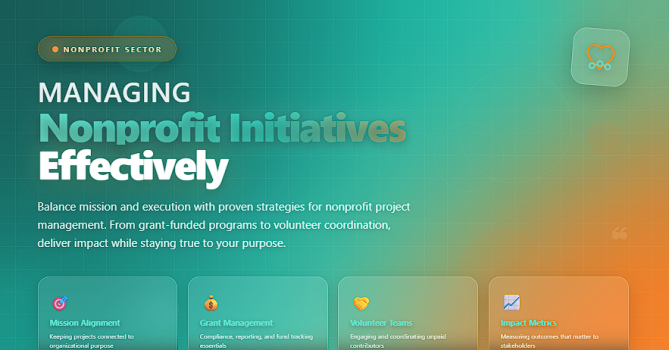
Managing nonprofit initiatives requires a unique blend of strategic planning, resource allocation, community engagement, and impact measurement. Unlike traditional business projects, nonprofit initiatives operate under tight budgets, volunteer-heavy teams, grant-driven timelines, and mission-focused outcomes.
Top 5 Project Management Software
To lead nonprofit projects successfully, project managers must combine structure with empathy, financial discipline with creativity, and outcome-driven planning with community-centered values.
This article walks you through how nonprofit initiatives work, their biggest challenges, and proven strategies for delivering meaningful impact.
✅ What Makes Nonprofit Initiatives Different?
Nonprofit projects focus on social value, not profit. Their success is measured in:
✔️ people served
✔️ community improvement
✔️ awareness created
✔️ access provided
✔️ long-term sustainability
This requires shifting from traditional ROI to mission alignment and social impact.
Key Differences Between Nonprofit and Traditional Projects
A quick comparison of structure, funding, and success metrics.
| Area | Nonprofit Initiatives | Traditional Projects |
|---|---|---|
| Funding | Donations, grants, sponsorships, public funds. | Revenue, budgets, investments. |
| Teams | Volunteers + limited paid staff. | Full-time skilled workforce. |
| Success Measurement | Social impact & mission achievement. | Profit, KPIs, market results. |
| Constraints | Budget limits, donor expectations. | Market competition, efficiency. |
| Stakeholders | Funders, community, beneficiaries, NGOs. | Clients, executives, end-users. |
✅ How to Manage Nonprofit Initiatives Successfully
✔️ 1. Start With a Clear Mission and Theory of Change
Every nonprofit initiative must tie back to a defined mission.
Use these guiding questions:
✔️ What problem are we solving?
✔️ Who is affected by this problem?
✔️ What change are we trying to create?
✔️ How do our activities lead to measurable outcomes?
This prevents “initiative drift” and keeps your project aligned with the organization’s purpose.
✔️ 2. Build a Realistic and Lean Budget
Nonprofits must maximize impact with limited financial resources.
Include:
- staffing and volunteer coordination
- materials and equipment
- outreach and marketing
- monitoring and evaluation
- administrative overhead
- contingency reserve
Transparency builds donor trust.
✔️ 3. Use Volunteers Strategically
Volunteers bring passion but require structure.
You must:
✔️ assign clear roles
✔️ provide training
✔️ define time commitments
✔️ supervise and recognize contributions
A well-managed volunteer team can multiply your impact.
✔️ 4. Build Strong Stakeholder Relationships
Nonprofit success depends heavily on collaboration.
Key groups include:
- donors and grant-makers
- community leaders
- partner organizations
- government agencies
- beneficiaries
Frequent communication helps maintain support and trust.
✔️ 5. Implement Monitoring & Evaluation (M&E)
You must measure what matters.
Track:
✔️ outputs (activities delivered)
✔️ outcomes (short-term results)
✔️ impact (long-term change)
Nonprofits must prove value to donors and communities.
✔️ 6. Document Everything
Create simple but thorough documentation:
- project plan
- stakeholder list
- communication plan
- risk log
- budget tracker
- impact report
- volunteer roster
This is crucial for audits, grant renewals, and transparency.
✔️ 7. Use Storytelling to Demonstrate Impact
Data is important, but stories move people.
Use:
🎤 real beneficiary quotes
📸 before/after photos
📊 visuals explaining impact
🎬 short videos
Effective storytelling increases donations, partnerships, and visibility.
✔️ 8. Review, Reflect, and Improve
After each initiative:
✔️ conduct a lessons learned workshop
✔️ evaluate what worked and what didn’t
✔️ identify improvements for the next cycle
✔️ update your processes
Continuous improvement keeps nonprofit initiatives sustainable.
❌ Common Challenges in Nonprofit Initiatives
❌ funding instability
❌ burnout among volunteers
❌ unclear roles or responsibilities
❌ donor-driven restrictions
❌ limited technology
❌ poor data collection
❌ scope expansion without resources
Project managers must anticipate and address these early.
⭐ Best Practices for Nonprofit Project Managers
✔️ communicate transparently with all stakeholders
✔️ build simple but strong processes
✔️ use technology to automate admin work
✔️ protect volunteer experience
✔️ track outcomes consistently
✔️ celebrate impact publicly
⭐ Final Thoughts
Managing nonprofit initiatives requires discipline, creativity, empathy, and strong organization.
When done correctly, nonprofit project management creates real change — improving communities, supporting vulnerable groups, and creating opportunities where none existed.
Successful nonprofit initiatives don’t depend on money alone —
they depend on leadership, clarity, commitment, and collaboration.