
 MElkhateeb
➡️ Introduction
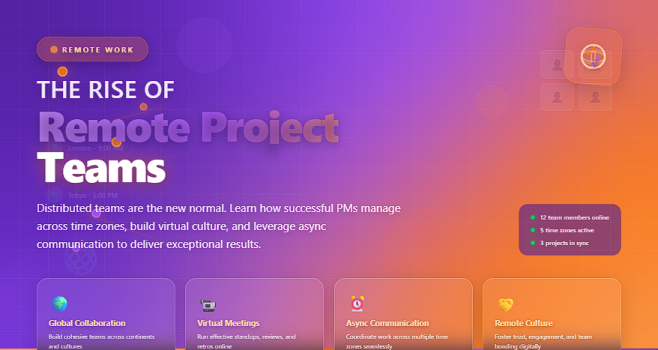
In the last decade—and especially after global disruptions reshaped how organizations operate—remote project teams have shifted from a niche concept to a dominant delivery model. Today, companies across every sector use distributed teams to access global talent, reduce operational costs, increase flexibility, and accelerate project timelines.
Top 5 Project Management Software
But managing virtual teams introduces new challenges in communication, collaboration, performance tracking, and team culture.
Understanding how remote project teams function—and how to lead them effectively—is now an essential skill for every modern project manager.
This article explores why remote project teams are rising, how they change project execution, and the best practices PMs must adopt for long-term success.
✅ Why Remote Project Teams Are Growing
Organizations are embracing distributed teams due to:
✔️ Access to global talent
✔️ Lower overhead costs
✔️ 24/7 productivity across time zones
✔️ Higher employee satisfaction and retention
✔️ Faster scalability for project-based work
✔️ Advances in collaboration tools (Zoom, Teams, Jira, Miro, Slack, etc.)
Remote work is no longer just a trend—it is a strategic advantage.
Benefits and Challenges of Remote Project Teams
A structured overview for modern PMs.
| Aspect | Benefits | Challenges & Solutions |
|---|---|---|
| Talent | Access to global, specialized talent. | Different time zones — use overlapping hours & asynchronous workflows. |
| Cost Efficiency | Lower office and operational costs. | Budget visibility — adopt real-time tracking tools. |
| Flexibility | Team members work in optimized environments. | Work-life boundaries — establish communication norms. |
| Productivity | Focused work and fewer office distractions. | Isolation — promote team rituals & informal check-ins. |
| Collaboration | Digital tools enable faster documentation. | Tool overload — define a standard tool stack. |
✅ How Remote Work Changes Project Management
Remote teams require a shift in how PMs plan, communicate, and track progress.
✔️ 1. Communication Becomes Intentional
Virtual work removes casual interactions—making structured communication essential.
PMs must define:
- meeting cadence
- async communication rules
- expected response times
- escalation paths
✔️ 2. Documentation Becomes a Core Practice
Remote teams rely on written clarity:
- decision logs
- status updates
- project wiki pages
- clear acceptance criteria
- documented processes
Poor documentation weakens alignment faster in remote environments.
✔️ 3. Trust Must Be Built, Not Assumed
Without physical presence, trust comes from:
✔️ reliability
✔️ transparency
✔️ timely communication
✔️ consistent delivery
Great PMs build trust deliberately—not accidentally.
✔️ 4. Leadership Moves From Monitoring to Empowering
Traditional “supervision models” do not work remotely.
PMs must shift to:
✔️ outcomes over hours
✔️ empowerment over control
✔️ guidance over micromanagement
Remote work rewards high-trust leadership.
✅ Best Practices for Leading Remote Project Teams
✔️ 1. Establish a Clear Communication Architecture
Define:
- which tools to use (Slack, Teams, Email)
- what each tool is for
- how quickly replies are expected
- how decisions are documented
✔️ 2. Create Visibility Through Dashboards
Remote teams rely on:
- Gantt charts
- Kanban boards
- risk dashboards
- resource tracking
- progress metrics
Dashboards replace in-office visibility.
✔️ 3. Encourage Informal Human Interaction
Remote teams need social glue:
✔️ virtual coffee chats
✔️ non-work channels
✔️ celebrations and shout-outs
Strong relationships create strong results.
✔️ 4. Optimize for Asynchronous Work
Not everyone works at the same time.
PMs must design workflows where tasks progress without waiting.
Techniques include:
- detailed briefs
- video instructions
- documented processes
- clear hand-off notes
✔️ 5. Set Clear Performance Expectations
Remote teams thrive when expectations are measurable:
✔️ deadlines
✔️ deliverables
✔️ KPIs
✔️ quality standards
Ambiguity slows remote teams down.
✅ Tools That Enable Remote Project Teams
Modern remote PMs rely on:
Collaboration & Communication
✔️ Zoom
✔️ MS Teams
✔️ Slack
Project Tracking
✔️ Asana
✔️ Jira
✔️ Monday.com
✔️ Trello
Documentation
✔️ Confluence
✔️ Notion
✔️ Google Workspace
Visual Collaboration
✔️ Miro
✔️ FigJam
Choosing the right toolset directly impacts remote productivity.
❌ Common Mistakes When Managing Remote Teams
Avoid these pitfalls:
❌ Assuming communication happens automatically
❌ Overloading teams with too many meetings
❌ Not documenting decisions
❌ Ignoring time zone differences
❌ Micromanaging instead of empowering
❌ Failing to create a sense of team culture
Remote leadership requires intentionality.
⭐ Final Thoughts
Remote project teams are no longer the exception—they are the new standard.
When managed well, they offer unmatched flexibility, global expertise, and scalable performance.
The project managers who master communication, documentation, empowerment, and digital collaboration will thrive in this new era.
Remote teams don’t succeed accidentally —
they succeed because project managers build systems that help people work together from anywhere.