 MElkhateeb
➡️ Introduction
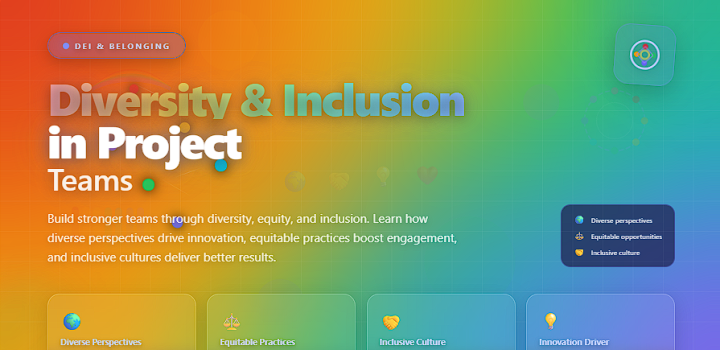
Modern projects operate in environments that are more global, cross-functional, and interconnected than ever before. Teams often include members with different cultural backgrounds, professional experiences, communication styles, and problem-solving approaches.
In this environment, diversity and inclusion (D&I) are not just HR concepts — they are strategic project management advantages.
Top 5 Project Management Software
Research consistently demonstrates that diverse teams:
✔️ solve problems faster
✔️ innovate more effectively
✔️ make better decisions
✔️ deliver higher-quality outcomes
But diversity alone is not enough. Inclusion — the ability for every team member to contribute fully — is what transforms diversity into measurable project success.
This article explores what diversity and inclusion mean in project environments, why they matter, and how project managers can build team cultures where everyone thrives.
✅ What Diversity and Inclusion Mean in Projects
✔️ Diversity
Diversity refers to the range of differences between people in a team. These differences may be:
- Cultural or ethnic
- Educational
- Linguistic
- Professional background
- Gender identity
- Age and generational mindset
- Work style or personality
- Technical expertise
In project teams, diversity enriches the project with multiple perspectives.
✔️ Inclusion
Inclusion ensures that all team members feel:
- respected
- valued
- safe to contribute
- empowered to share ideas
- involved in decision-making
Without inclusion, diversity becomes a missed opportunity because voices are present, but not heard.
✅ Why Diversity and Inclusion Matter for Project Success
✔️ 1. Better Problem Solving
Teams with varied perspectives are more capable of identifying blind spots and generating creative solutions.
✔️ 2. Stronger Risk Management
Different experiences help teams detect risks earlier, understand cultural or operational sensitivities, and challenge assumptions.
✔️ 3. Improved Stakeholder Engagement
Projects often involve diverse users, clients, and partners. A diverse team communicates better across cultures and expectations.
✔️ 4. Higher Team Performance
Inclusive environments promote psychological safety — team members speak openly, offer ideas, raise concerns, and collaborate more efficiently.
✔️ 5. Increased Innovation
Diverse thinking encourages experimentation, alternative approaches, and new insights that lead to better project outcomes.
✅ The Project Manager’s Role in Building an Inclusive Team
A project manager is not just a scheduler or communicator — they are a culture builder.
Here are the core responsibilities:
✔️ 1. Foster Equal Participation
Ensure all voices are heard during meetings, retrospectives, and planning sessions.
✔️ 2. Mitigate Unconscious Bias
Recognize biases in task assignments, performance evaluations, or decision-making.
✔️ 3. Encourage Open Communication
Create safe spaces where team members can respectfully challenge ideas, give feedback, and express concerns.
✔️ 4. Set Clear Collaboration Rules
Define norms for communication, meeting etiquette, escalation paths, and conflict resolution.
✔️ 5. Promote Cross-Cultural Understanding
Provide context for cultural holidays, global working hours, communication preferences, and regional constraints.
✅ Practical Strategies to Improve Diversity & Inclusion in Project Teams
✔️ 1. Build Diverse Teams Intentionally
Choose team members based on complementary strengths — not just experience or availability.
✔️ 2. Rotate Responsibilities
Avoid repeatedly assigning high-visibility tasks to the same individuals.
✔️ 3. Use Inclusive Communication Techniques
- avoid jargon or culturally specific metaphors
- summarize discussion points
- check for understanding
- invite written feedback for introverted team members
✔️ 4. Encourage Knowledge Sharing
Cross-training, mentoring pairs, and collaborative workshops help bridge gaps in experience.
✔️ 5. Provide Equal Access to Opportunities
Ensure fair distribution of:
- leadership roles
- training resources
- client-facing responsibilities
- recognition
✔️ 6. Leverage Technology to Support Inclusion
Tools like Microsoft Teams, Miro, and asynchronous video updates support collaboration across time zones and personality types.
✔️ 7. Address Conflicts Early
Cultural misunderstandings and communication differences can escalate quickly if ignored.
✅ Common Barriers to Diversity and Inclusion
❌ Unconscious Bias
Assumptions about people’s abilities based on past experiences or stereotypes.
❌ Communication Barriers
Language differences or unclear expectations create confusion and exclusion.
❌ Hierarchical Cultures
Team members may hesitate to speak up if the environment does not support upward communication.
❌ Lack of Psychological Safety
If individuals fear criticism, they will not contribute openly — regardless of their background.
✅ How to Measure Inclusion in a Project Team
Project managers can assess inclusion through:
✔️ participation levels during meetings
✔️ team surveys and feedback loops
✔️ frequency of knowledge sharing
✔️ fairness in task distribution
✔️ team morale and retention
✔️ conflict frequency and resolution effectiveness
Regular reflection ensures the team culture stays healthy.
⭐ Final Thoughts
Diversity and inclusion are not abstract ideals — they are measurable drivers of project success.
A diverse team brings broader knowledge, richer insights, and more innovative thinking. Inclusion transforms that diversity into collaborative strength.
Great project managers don’t just manage tasks —
they create environments where people succeed together.