 MElkhateeb
➡️ Introduction
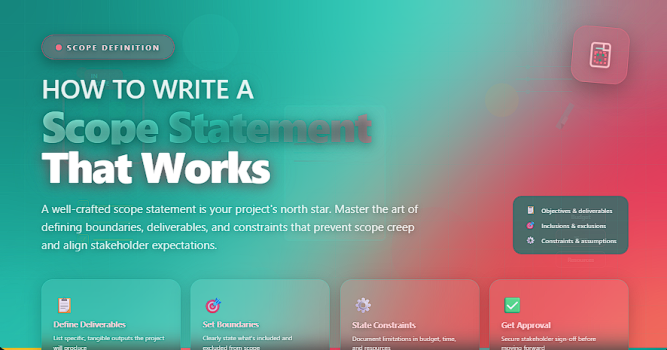
A Scope Statement is one of the most important documents in project planning. It defines what the project will deliver, what it will not deliver, and how the work will be structured. Without a well-defined scope, teams face confusion, rework, scope creep, budget overruns, and missed deadlines.
Top 5 Project Management Software
A strong scope statement gives the entire team clarity, aligns stakeholders, and becomes the foundation for scheduling, budgeting, and risk management.
In this article, you’ll learn how to write a professional scope statement, what to include, and how to avoid the most common mistakes.
✅ What Is a Scope Statement?
A Scope Statement is a formal document that outlines:
✔️ the goals of the project
✔️ the deliverables the team must produce
✔️ the work required to achieve them
✔️ what is considered out of scope
✔️ constraints, assumptions, and success criteria
It is the backbone of project control — anytime uncertainty appears, the team returns to the scope statement for clarity.
✅ Essential Components of a Scope Statement
A clear structure that brings alignment and reduces uncertainty.
| Component | Description | Why It Matters |
|---|---|---|
| Project Purpose | Why the project exists and the problem it solves. | Aligns stakeholders on the goal. |
| Project Objectives | Specific, measurable outcomes the project must achieve. | Sets expectations and targets. |
| Deliverables | Products, features, or outputs the project will provide. | Defines what “done” looks like. |
| In-Scope Items | Work that is included in the project boundaries. | Prevents misunderstandings. |
| Out-of-Scope Items | Work NOT included in the project. | Protects against scope creep. |
| Constraints | Limitations such as deadlines, budget, or resources. | Guides planning decisions. |
| Assumptions | Conditions believed to be true but not guaranteed. | Highlights risk areas early. |
| Acceptance Criteria | Standards for determining if deliverables are approved. | Ensures quality and stakeholder satisfaction. |
✅ How to Write a Strong Scope Statement
✔️ 1. Start with the Project Purpose
Explain why the project exists and what problem it solves.
This sets the tone for all planning decisions.
✔️ 2. Define Clear and Measurable Objectives
Objectives should use the SMART framework:
Specific, Measurable, Achievable, Relevant, Time-Bound.
Strong objectives reduce ambiguity and guide performance tracking.
✔️ 3. List All Project Deliverables
Deliverables may include:
- software features
- reports
- training documents
- hardware components
- prototypes
- process improvements
This becomes the basis for the Work Breakdown Structure (WBS).
✔️ 4. Specify What Is In Scope
Detail the work your team will perform.
Avoid broad or vague language — clarity protects your team.
✔️ 5. List What Is Out of Scope
This step prevents misaligned expectations and future disputes.
If a task is not listed here, stakeholders may assume it is included.
✔️ 6. Document Constraints
Common constraints include:
✔️ budget limits
✔️ regulatory requirements
✔️ fixed deadlines
✔️ restricted resources
Constraints shape how the project is executed.
✔️ 7. Record All Assumptions
Assumptions often hide risks — write them down.
Example:
“Subject matter experts will be available during testing.”
When assumptions fail, risks emerge.
✔️ 8. Define Acceptance Criteria
This sets the standard for project approval.
Strong acceptance criteria help avoid rework and disputes.
✔️ 9. Review with Stakeholders
Before finalizing the scope statement, review it with:
✔️ sponsors
✔️ team leads
✔️ key stakeholders
✔️ subject matter experts
Alignment reduces conflict later.
❌ Common Mistakes to Avoid
❌ Writing vague or overly broad scope descriptions
❌ Forgetting to define out-of-scope items
❌ Ignoring assumptions and constraints
❌ Skipping stakeholder review
❌ Not updating the scope when changes occur
⭐ Best Practices for High-Quality Scope Statements
✔️ Use simple, precise language
✔️ Break deliverables into small, understandable components
✔️ Add visuals (WBS, diagrams, or tables)
✔️ Align the scope with the project charter and objectives
✔️ Keep the scope statement accessible to the entire team
⭐ Final Thoughts
A clear and structured scope statement is the foundation of project success.
It reduces uncertainty, prevents scope creep, and strengthens collaboration.
When done correctly, it becomes a roadmap your team can trust from day one until delivery.
Great project managers don’t just define scope —
they protect it.