 MElkhateeb
➡️ Introduction
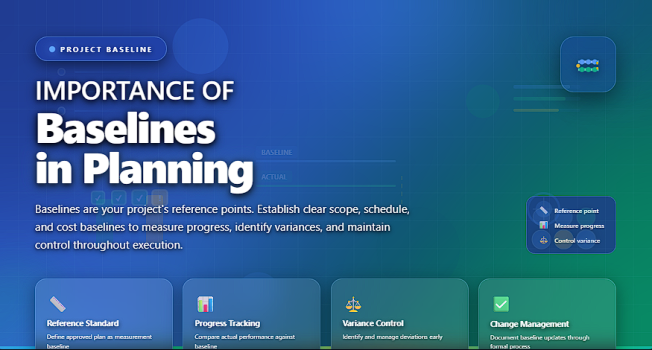
A project baseline is one of the most powerful but misunderstood tools in project management.
It defines what the plan is, how progress will be measured, and when corrective action is required.
Top 5 Project Management Software
Without baselines, a project has no reference point — meaning:
❌ teams can’t track progress accurately
❌ stakeholders cannot understand performance
❌ deviations go unnoticed until it’s too late
❌ recovery becomes far more difficult
Baselines bring clarity, structure, accountability, and measurable control to every phase of a project. This article explains what baselines are, why they matter, and how they help project managers protect timelines, budgets, and deliverables.
✅ What Is a Baseline in Project Management?
A project baseline is the approved version of a key project plan used to measure actual performance.
It represents the “frozen” version of the plan at a specific point in time.
There are three core baselines:
- Scope Baseline — what will be delivered
- Schedule Baseline — when it will be delivered
- Cost Baseline — how much it will cost
Together, they form the Performance Measurement Baseline (PMB) — the benchmark for controlling the project.
✅ Why Baselines Matter
A baseline acts as the project’s yardstick. It tells the team:
➡️ Are we ahead or behind schedule?
➡️ Are we over or under budget?
➡️ Are deliverables meeting expectations?
➡️ When should we take corrective action?
Baselines transform planning into predictive control.
They convert vague estimates into measurable commitments.
Here’s why baselines are essential:
✔️ 1. Provide a Clear Starting Point
A baseline defines the exact plan before execution starts.
This eliminates confusion about scope, responsibilities, and deadlines.
✔️ 2. Enable Accurate Tracking and Reporting
Performance data means nothing unless compared to something.
Baselines allow PMs to measure:
- schedule variance
- cost variance
- earned value
- productivity levels
- completion forecasts
Executives and sponsors rely on this clarity to make informed decisions.
✔️ 3. Strengthen Change Control
Any deviation from the baseline must go through the change control process.
This ensures:
- no hidden scope creep
- no unapproved time extensions
- no budget surprises
Baselines protect the project from uncontrolled changes.
✔️ 4. Improve Forecasting and Predictability
Once tracking begins, the project manager can calculate:
- Estimate at Completion (EAC)
- Estimate to Complete (ETC)
- projected finish dates
These predictions are only accurate when baselines exist.
✔️ 5. Increase Stakeholder Confidence
Stakeholders trust projects that show:
✔️ transparency
✔️ measurable progress
✔️ deviation alerts
✔️ proactive corrections
Baselines make communication structured, factual, and credible.
✅ Types of Baselines Explained
Below is a simplified overview of the three major baselines.
✔️ Scope Baseline
Includes:
- project scope statement
- Work Breakdown Structure (WBS)
- WBS dictionary
This baseline defines exactly what the project will deliver.
✔️ Schedule Baseline
Consists of the approved project timeline.
It sets:
- start dates
- finish dates
- dependencies
- critical path
All real-time progress is compared against this baseline.
✔️ Cost Baseline
Represents the approved project budget, typically shown as a time-phased graph.
It is the foundation for cost control and Earned Value Management (EVM).
✅ When Should Baselines Be Created?
Baselines are created at the end of planning once:
✔️ requirements are validated
✔️ estimates are approved
✔️ stakeholders sign off
✔️ resources are allocated
They must be “locked in” before execution begins.
✅ When Should Baselines Be Updated?
Baselines should only be updated when:
✔️ a major approved change request occurs
✔️ force majeure affects the plan
✔️ customer requirements legally change
✔️ project scope is redefined at top level
Baselines should not be changed frequently — doing so destroys traceability.
✅ How Baselines Help Control Project Performance
✔️ Detect Variances Early
Variance = Actual – Planned
Baselines make these variances visible early — enabling quick correction.
✔️ Support Earned Value Management
Key EVM indicators rely on baselines, such as:
- PV (Planned Value)
- EV (Earned Value)
- AC (Actual Cost)
- CPI / SPI
- EAC / ETC
Without baselines, these metrics cannot exist.
✔️ Strengthen Decision-Making
Baselines help PMs and stakeholders decide:
➡️ Should we spend more resources?
➡️ Should we approve changes?
➡️ Should we adjust priorities?
➡️ Is recovery needed?
They turn project decisions from subjective opinions into data-driven actions.
✅ Best Practices for Managing Baselines
✔️ Document baselines in your PM software
✔️ Share baselines with all stakeholders
✔️ Track performance weekly
✔️ Do not modify baselines without formal approval
✔️ Maintain historical versions for audit and learning
✔️ Integrate baselines into dashboards and reports
⭐ Final Thoughts
Baselines are the foundation of project control.
Without them, teams operate blindly and reactively.
With them, project managers gain visibility, predictability, and authority to steer the project toward success.
A project without baselines is guesswork.
A project with baselines is measurable, manageable, and controllable.