 MElkhateeb
➡️ Introduction
Every successful project starts with clarity. Yet many projects fail not because of poor execution, but because the work itself was never clearly defined. Tasks are vague, responsibilities overlap, and important deliverables are overlooked.
Top 5 Project Management Software
This is where the Work Breakdown Structure (WBS) becomes essential.
A WBS transforms a complex project into a clear, manageable structure by breaking down the total scope into smaller, well-defined pieces of work. It is one of the most powerful planning tools in project management and forms the foundation for scheduling, budgeting, risk management, and control.
In this article, you’ll learn what a WBS is, why it matters, how to create one step-by-step, and how professionals use it to control projects effectively.
✅ What Is a Work Breakdown Structure?
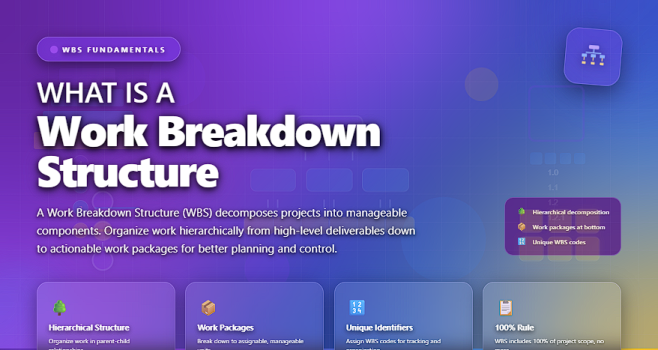
A Work Breakdown Structure (WBS) is a hierarchical decomposition of the total project scope into smaller, manageable components called work packages.
Each level of the WBS represents a more detailed definition of the work required to deliver the project objectives.
In simple terms:
A WBS answers the question: “What work must be done to complete this project?”
It focuses on deliverables, not activities — and ensures nothing important is forgotten.
✅ Why the Work Breakdown Structure Is So Important
A well-constructed WBS helps project managers:
✔️ Define the full project scope clearly
✔️ Prevent scope creep
✔️ Improve estimating accuracy
✔️ Assign clear responsibilities
✔️ Create realistic schedules and budgets
✔️ Identify risks early
✔️ Track progress objectively
Without a WBS, plans are built on assumptions instead of structure.
✅ Key Characteristics of an Effective WBS
Before building one, it’s important to understand what makes a good WBS:
✔️ Deliverable-oriented (focuses on outcomes, not actions)
✔️ Hierarchical (top-down structure)
✔️ Mutually exclusive elements (no overlap)
✔️ Complete (covers 100% of project scope)
✔️ Clear ownership at the work-package level
✅ Levels of a Work Breakdown Structure
How project work is logically decomposed.
| WBS Level | Description | Purpose |
|---|---|---|
| Level 1 | Entire project scope. | Defines the total project objective. |
| Level 2 | Major deliverables or phases. | High-level organization of work. |
| Level 3 | Sub-deliverables. | Improves clarity and planning detail. |
| Work Packages | Smallest manageable units of work. | Basis for estimating, scheduling, and assignment. |
✅ How to Create a Work Breakdown Structure (Step-by-Step)
✔️ 1. Define the Project Objective
Start with a clear project goal.
If the objective is unclear, the WBS will be unclear.
✔️ 2. Identify Major Deliverables
Break the project into high-level deliverables or phases (Level 2).
✔️ 3. Decompose Each Deliverable
Continue breaking down each deliverable into smaller components until you reach work packages.
✔️ 4. Apply the 100% Rule
Ensure the WBS includes 100% of the work required — no more, no less.
✔️ 5. Stop at the Right Level
A good work package is:
✔️ Clearly defined
✔️ Estimable in cost and time
✔️ Assignable to one owner
✔️ Trackable
✔️ 6. Validate with the Team
Review the WBS with stakeholders and team members to confirm completeness and understanding.
✅ Common WBS Mistakes to Avoid
❌ Listing activities instead of deliverables
❌ Over-decomposing work
❌ Missing hidden work
❌ Creating overlapping elements
❌ Ignoring stakeholder input
❌ Treating the WBS as a one-time document
✅ How WBS Supports Other Project Areas
A WBS directly supports:
✔️ Schedule development
✔️ Cost estimating and budgeting
✔️ Risk identification
✔️ Resource planning
✔️ Responsibility assignment (RACI)
✔️ Performance measurement (EVMS)
No professional project plan exists without a solid WBS.
⭐ Final Thoughts
A Work Breakdown Structure is not just a planning tool — it is the structural backbone of the entire project.
When created correctly, it brings clarity, control, and confidence to both the project manager and stakeholders.
When skipped or rushed, chaos quietly enters the project.
If you can’t break it down, you can’t control it.