 MElkhateeb
➡️ Introduction
A Work Breakdown Structure (WBS) is one of the most powerful planning tools in project management — yet many project failures can be traced back to a poorly structured or overly generic WBS.
Top 5 Project Management Software
While the principle of a WBS is universal, the way it is built must vary by industry. A software project, a construction project, and a marketing campaign all require very different deliverables, sequencing, and levels of detail.
In this article, you’ll learn:
✅ how WBS structures differ across industries
✅ what an effective industry-specific WBS looks like
✅ how to avoid common WBS mistakes
✅ how to tailor your WBS for accuracy, control, and execution
✅ Why Industry-Specific WBS Matters
A WBS is not just a task list — it is a deliverable-oriented decomposition of work.
When your WBS matches your industry:
✔️ estimates become more accurate
✔️ responsibilities are clearer
✔️ risks are easier to identify
✔️ progress tracking becomes simpler
✔️ scope control improves significantly
Using a generic WBS across industries often leads to gaps, rework, and cost overruns.
✅ Key Rule Before Reviewing Examples
An effective WBS must always:
✔️ focus on deliverables, not activities
✔️ follow the 100% Rule (captures all scope)
✔️ be detailed enough for control, but not micro-managed
✔️ align with how work is actually executed in that industry
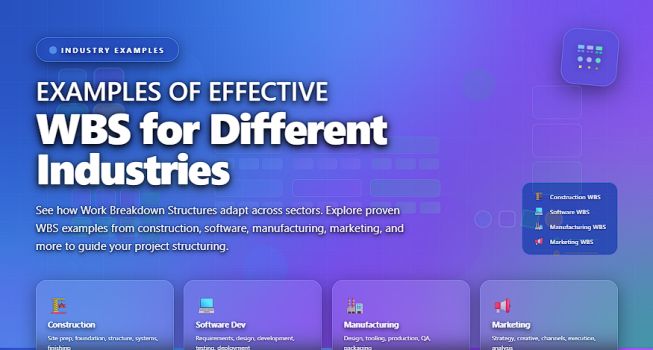
✅ WBS Examples Across Industries
How deliverables are structured differently depending on the project domain.
| Industry | Level 1 WBS Deliverables | Typical Level 2 Decomposition |
|---|---|---|
| Construction | Foundation, Structure, Finishing, Handover | Excavation, Concrete, Steel Works, Inspections |
| Software Development | Requirements, Design, Development, Testing, Deployment | UI Design, Backend Modules, APIs, Test Cases |
| Marketing Campaign | Strategy, Content, Channels, Launch, Analysis | Social Media, Email, Ads, Performance Metrics |
| Manufacturing | Design, Procurement, Production, Quality, Delivery | Materials, Assembly, Inspection, Packaging |
| IT Infrastructure | Planning, Hardware, Software, Configuration, Go-Live | Servers, Network Setup, Security, Data Migration |
| Event Management | Planning, Logistics, Program, Marketing, Closure | Venue, Speakers, Registration, Media Coverage |
✅ How to Choose the Right WBS Structure for Your Industry
✔️ Start from final deliverables, not activities
✔️ Align WBS levels with how work is contracted or executed
✔️ Reflect regulatory and compliance requirements (especially in construction, healthcare, IT)
✔️ Match the WBS with cost tracking and reporting structure
✔️ Involve SMEs who understand real-world execution
✅ Common WBS Mistakes Across Industries
❌ Using task-based instead of deliverable-based structure
❌ Applying a software WBS to construction projects
❌ Going too deep too early
❌ Ignoring subcontracted or outsourced work
❌ Creating WBS without stakeholder validation
✅ Best Practices for Industry-Specific WBS
✔️ Validate the WBS with subject matter experts
✔️ Use historical WBS templates from similar projects
✔️ Ensure every WBS element has a clear owner
✔️ Map WBS elements to schedule and cost accounts
✔️ Keep naming consistent and unambiguous
⭐ Final Thoughts
There is no “one-size-fits-all” Work Breakdown Structure.
The most effective WBS is the one that reflects your industry, your execution model, and your delivery method.
Strong planning starts with structure.
Effective execution starts with the right WBS.