 MElkhateeb
➡️ Introduction
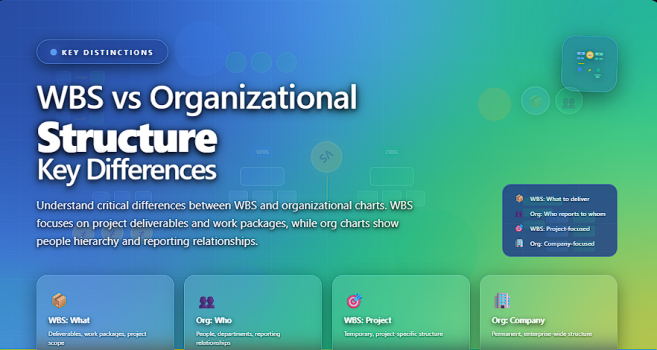
One of the most common points of confusion for new and even experienced project managers is the difference between a Work Breakdown Structure (WBS) and an Organizational Structure.
Top 5 Project Management Software
Both use hierarchy.
Both involve roles and responsibilities.
But they serve very different purposes.
Understanding the distinction between a WBS and an organizational structure is critical for:
✔️ accurate planning
✔️ realistic estimation
✔️ clear accountability
✔️ effective execution
This article explains what each structure is, how they differ, and when to use each one correctly in real projects.
✅ What Is a Work Breakdown Structure (WBS)?
A Work Breakdown Structure (WBS) is a deliverable-oriented decomposition of project work.
It breaks the project scope into smaller, manageable components until the work can be:
✔️ estimated
✔️ scheduled
✔️ assigned
✔️ tracked
✔️ controlled
The WBS answers one key question:
➡️ “What work must be done to deliver this project?”
Key Characteristics of a WBS
✔️ Focuses on work, not people
✔️ Organized by deliverables
✔️ Ends at work packages
✔️ Used for scope, schedule, and cost planning
✔️ Project-specific and temporary
✅ What Is an Organizational Structure?
An Organizational Structure defines how people are arranged within an organization.
It shows:
✔️ reporting relationships
✔️ authority lines
✔️ functional responsibilities
✔️ management hierarchy
The organizational structure answers a different question:
➡️ “Who reports to whom, and who is responsible for what?”
Key Characteristics of an Organizational Structure
✔️ Focuses on people, not work
✔️ Organized by roles or functions
✔️ Exists beyond a single project
✔️ Governs authority and decision-making
✔️ Often stable and long-term
✅ Key Differences: WBS vs Organizational Structure
Understanding what each structure is designed to do.
| Aspect | Work Breakdown Structure (WBS) | Organizational Structure |
|---|---|---|
| Primary Focus | Project work and deliverables | People and reporting relationships |
| Main Question | What work needs to be done? | Who reports to whom? |
| Level of Detail | Very detailed (work packages) | High-level roles and hierarchy |
| Duration | Temporary (project-based) | Permanent or long-term |
| Used For | Scope, schedule, cost, risk planning | Governance and authority |
| Changes When | Project scope changes | Company reorganizes |
| Ownership | Project manager | Senior management / HR |
✅ How WBS and Organizational Structure Work Together
Although they are different, WBS and organizational structure must align.
✔️ The WBS defines what work exists
✔️ The organizational structure defines who can do the work
Project managers often use:
- WBS → to define tasks
- Org Structure → to identify available roles
- RACI Matrix → to connect work to people
✅ Common Mistakes Project Managers Make
❌ Assigning tasks before completing the WBS
❌ Designing a WBS based on departments instead of deliverables
❌ Confusing job titles with work packages
❌ Assuming organizational hierarchy equals project authority
❌ Skipping WBS and jumping directly to scheduling
✅ Best Practices
✔️ Always build the WBS before assigning responsibilities
✔️ Keep the WBS independent of job titles
✔️ Use deliverables, not activities, at higher WBS levels
✔️ Align WBS with scope statement
✔️ Use organizational structure only to allocate resources
✔️ Review WBS with the team for completeness
⭐ Final Thoughts
The WBS and the organizational structure are both hierarchical — but they exist for entirely different reasons.
WBS defines the work.
Organizational structure defines the people.
Understanding this distinction allows project managers to plan accurately, assign responsibilities effectively, and control projects with confidence.