 MElkhateeb
➡️ Introduction
Project transparency is one of the most critical factors behind project success. When stakeholders clearly understand what work is being done, who is responsible, how progress is measured, and where risks exist, projects move faster and encounter fewer surprises.
Top 5 Project Management Software
One of the strongest tools for achieving this transparency is the Work Breakdown Structure (WBS).
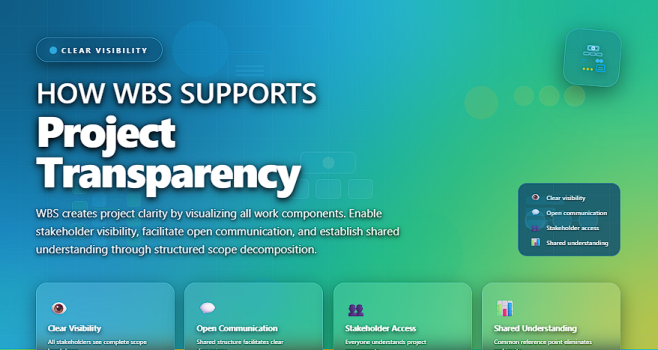
A well-designed WBS transforms a complex project into a clear, visible, and manageable structure. It creates a shared understanding between teams, managers, and stakeholders — removing ambiguity and aligning everyone around the same view of the project.
This article explains how WBS directly supports project transparency, why it matters, and how project managers can use it effectively.
✅ What Is Transparency in Project Management?
Project transparency means that all relevant stakeholders can easily see:
✔️ the full scope of work
✔️ task ownership
✔️ progress status
✔️ dependencies
✔️ risks and gaps
✔️ how decisions impact cost, time, and scope
Lack of transparency leads to miscommunication, rework, delays, and loss of trust.
The WBS acts as the foundation layer that makes transparency possible.
✅ How WBS Enhances Project Transparency
Clear links between structure, visibility, and control.
| WBS Contribution | Transparency Benefit | Practical Impact |
|---|---|---|
| Clear Scope Breakdown | Everyone sees exactly what is included. | Prevents hidden work and scope confusion. |
| Task-Level Visibility | Work is visible at granular level. | Progress and delays are easy to track. |
| Defined Ownership | Clear accountability for every work package. | Eliminates blame-shifting. |
| Progress Tracking | Status is measured objectively. | Reliable reporting to stakeholders. |
| Cost & Time Mapping | Budget and schedule linked to real work. | Easier forecasting and variance analysis. |
| Change Impact Analysis | Changes show immediate ripple effects. | Better decision-making. |
✅ Why Transparency Fails Without a WBS
Without a WBS, projects often suffer from:
❌ unclear scope boundaries
❌ invisible work
❌ unclear ownership
❌ unreliable progress reports
❌ confusion during change requests
❌ stakeholder distrust
A project plan without a WBS is hard to explain, hard to track, and hard to trust.
✅ How Stakeholders Benefit from WBS Transparency
✔️ Project Sponsors
✔️ Understand where money is being spent
✔️ See progress without technical detail
✔️ Make confident funding decisions
✔️ Project Managers
✔️ Control scope and changes
✔️ Detect risks earlier
✔️ Produce accurate reports
✔️ Team Members
✔️ Know exactly what is expected
✔️ Understand priorities
✔️ Take ownership of clear deliverables
✔️ Clients & Customers
✔️ Gain confidence in delivery
✔️ Understand milestones and outcomes
✔️ Reduce misunderstandings
✅ WBS as the Foundation for Transparent Reporting
Many key project documents rely directly on the WBS:
✔️ schedule (Gantt charts)
✔️ cost baseline
✔️ risk register
✔️ performance dashboards
✔️ status reports
✔️ change requests
If the WBS is unclear, all downstream reports become unreliable.
✅ Best Practices for Using WBS to Increase Transparency
✔️ Involve stakeholders when creating the WBS
✔️ Use clear, descriptive work package names
✔️ Assign owners at the lowest possible level
✔️ Link WBS elements to schedule and cost
✔️ Keep WBS updated when changes occur
✔️ Use the WBS as the reference in meetings
❌ Common Mistakes That Reduce Transparency
❌ Making the WBS too high-level
❌ Hiding work in “miscellaneous” items
❌ Not updating WBS after changes
❌ Using unclear or technical naming
❌ Not sharing the WBS with stakeholders
⭐ Final Thoughts
A Work Breakdown Structure is more than a planning tool — it is a transparency engine for your project.
When used correctly, WBS creates shared understanding, builds trust, improves communication, and enables better decisions at every level of the organization.
Projects become transparent not through reports —
but through clear structure and visible work.