 MElkhateeb
➡️ Introduction
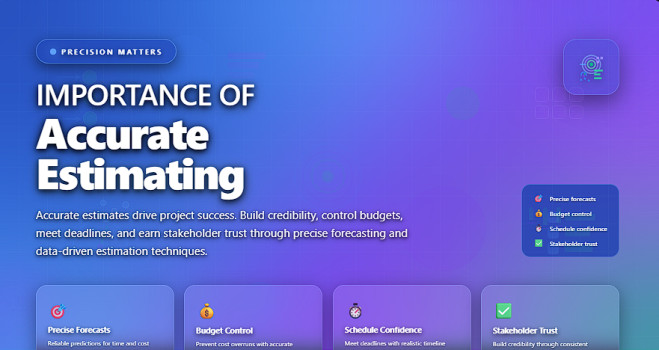
Accurate estimating is one of the most critical foundations of successful project management. Whether you are managing a small internal effort or a multi-million-dollar initiative, your ability to predict time, cost, effort, and resources directly impacts project performance, stakeholder confidence, and organizational decision-making.
Top 5 Project Management Software
Poor estimates lead to unrealistic deadlines, strained teams, blown budgets, and frustrated stakeholders. Strong estimates, however, create stability, predictability, and trust.
Accurate estimating is not a prediction of the future — it is a disciplined process rooted in data, expertise, and continuous refinement.
This article explains why accurate estimating matters, what happens when estimates are wrong, and how project managers can improve their estimating accuracy.
✅ Why Accurate Estimating Matters
✔️ 1. It Sets Realistic Expectations
Estimates shape the entire project environment — scope boundaries, schedule commitments, budget limits, and resource planning.
Accurate estimates help stakeholders understand what is achievable and what trade-offs exist.
Without this clarity, misalignment spreads across teams and leadership.
✔️ 2. It Protects the Project From Overruns
The majority of project failures can be traced back to inaccurate or overly optimistic estimates.
Poor estimating often results in:
- schedule delays
- budget overruns
- resource shortages
- quality degradation
- uncontrolled scope adjustments
Accurate estimates reduce the risk that the project will drift off course.
✔️ 3. It Helps Allocate Resources More Effectively
Reliable estimates allow PMs to plan the right level of staffing, equipment, and budget.
This prevents both:
- overallocation (overloaded teams, burnout), and
- underallocation (idle time, cost inefficiencies).
Organizations that estimate well avoid waste while maximizing productivity.
✔️ 4. It Supports Better Decision-Making
Executives and sponsors rely on estimates to:
- evaluate feasibility
- choose between project options
- prioritize initiatives
- define strategic roadmaps
- approve investments
Inaccurate estimates lead to poor decisions at the portfolio level.
✔️ 5. It Builds Credibility With Stakeholders
Nothing damages trust faster than a project that constantly slips.
Strong estimating helps PMs build a reputation for:
- reliability
- competence
- disciplined planning
- accountability
Stakeholders feel confident when estimates align with reality.
✔️ 6. It Reduces Stress for the Project Team
When teams have achievable workloads and realistic schedules, they experience:
- lower stress
- fewer overtime requirements
- better morale
- higher-quality output
Accurate estimating supports a healthier working environment.
✅ What Happens When Estimates Are Inaccurate?
Poor estimating can create serious operational and financial consequences:
❌ Missed Deadlines
Teams scramble to keep up, and planning becomes reactive instead of strategic.
❌ Budget Blowouts
Cost overruns damage credibility and force emergency funding requests.
❌ Degraded Quality
Rushed work increases defects, rework, and technical debt.
❌ Scope Creep
When the plan is unrealistic, stakeholders push for shortcuts or additions.
❌ Team Burnout
Chronic overloading leads to disengagement, turnover, and loss of productivity.
❌ Leadership Distrust
Executives lose confidence in project governance and decision-making.
Inaccurate estimating doesn’t just affect the PM — it affects the entire organization.
✅ Factors That Influence Estimate Accuracy
✔️ Complexity of the Work
New, untested, or high-uncertainty work requires more careful estimating.
✔️ Level of Requirements Clarity
Unclear requirements = unpredictable outcomes.
✔️ Historical Data Availability
Teams that use past project data produce more accurate forecasts.
✔️ Experience of the Estimator
Subject matter expertise dramatically improves accuracy.
✔️ Dependencies and Constraints
External vendors, cross-team dependencies, and regulatory factors can affect timelines.
✔️ Organizational Culture
Companies that value realistic planning over optimism have more reliable estimates.
✅ Techniques to Improve Estimating Accuracy
✔️ 1. Use Multiple Estimation Methods
- Bottom-Up Estimating for detailed accuracy
- Top-Down Estimating for early-stage forecasting
- Three-Point (PERT) to reduce uncertainty
- Analogous Estimating using past project data
- Parametric Estimating for quantity-based calculations
Combining methods increases reliability.
✔️ 2. Involve the People Who Will Do the Work
Team members often provide more realistic estimates than managers or sponsors.
✔️ 3. Break Down Work Using a WBS
Smaller tasks = more accurate estimates.
Large tasks = higher uncertainty.
✔️ 4. Validate Estimates With Historical Data
If similar projects exist, compare actuals with estimates to detect gaps.
✔️ 5. Add Contingency Buffers Responsibly
Use buffers for:
- unknown risks
- schedule uncertainty
- resource variability
Contingency must be based on logic — not guesswork.
✔️ 6. Review and Refine Estimates Continuously
Estimates are not “set once and forget.”
As you gain information, refine the numbers and communicate updates.
⭐ Final Thoughts
Accurate estimating is not an administrative task — it is a strategic advantage for every project manager.
It builds trust, prevents failure, enhances forecasting, and protects both teams and budgets.
Strong estimating leads to strong execution.
Superior project managers don’t predict the future —
they build accurate models that help them shape it.