 MElkhateeb
➡️ Introduction
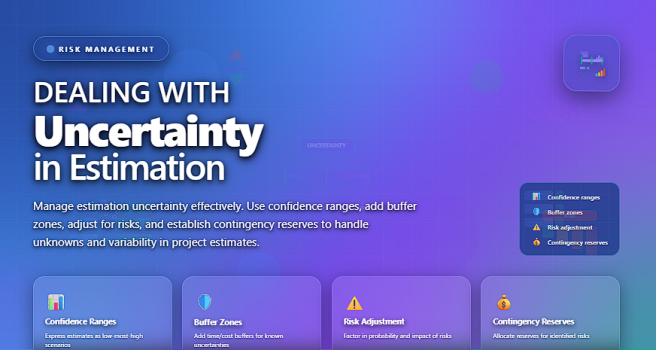
Every project manager eventually faces the same uncomfortable truth: project estimates are never perfect. No matter how much data you collect, how many experts you consult, or how detailed your Work Breakdown Structure is, uncertainty will always exist.
Top 5 Project Management Software
Uncertainty comes from many sources — unclear requirements, new technologies, unfamiliar vendors, optimistic assumptions, shifting priorities, and unpredictable risks.
The goal is not to eliminate uncertainty (you can’t), but to manage it intelligently.
This article explains the types of uncertainty, why estimates miss the mark, and practical techniques for handling ambiguity so you can provide reliable projections without overpromising.
✅ What Causes Uncertainty in Project Estimates?
Uncertainty comes from multiple areas:
✔️ Incomplete or evolving requirements
✔️ Limited historical data
✔️ New or untested technologies
✔️ Assumptions that may not hold true
✔️ External dependencies and vendors
✔️ Unpredictable risks or environmental factors
✔️ Human optimism bias
Understanding the sources helps you build more realistic, data-driven estimates.
✅ Types of Estimation Uncertainty
Where estimation ambiguity typically comes from.
| Uncertainty Type | Description | Impact on Estimates |
|---|---|---|
| Requirement Uncertainty | Requirements are incomplete, unclear, or changing. | Leads to inaccurate scope, time, and cost projections. |
| Technical Uncertainty | New tools, new technologies, or unknown complexities. | Increases development effort and risk. |
| Resource Uncertainty | Uncertain availability, skill levels, or productivity rates. | Causes delays and extended durations. |
| External Uncertainty | Vendors, regulations, weather, or market forces. | Can disrupt timelines or increase costs unexpectedly. |
| Risk-Driven Uncertainty | Potential risks that may or may not occur. | May cause rework, delays, budget overruns. |
✅ Techniques for Handling Uncertainty in Estimation
✔️ 1. Use Ranges Instead of Single-Point Estimates
Avoid saying:
❌ “This task will take 5 days.”
Instead say:
✔️ “This task will take 3–7 days, depending on conditions.”
Ranges reflect uncertainty honestly.
✔️ 2. Apply Three-Point Estimating (PERT)
PERT uses:
- Optimistic (O)
- Most Likely (M)
- Pessimistic (P)
Formula:
[
\text{Expected Duration} = \frac{O + 4M + P}{6}
]
This smooths out extreme estimates.
✔️ 3. Build and Maintain Assumption Logs
Every estimate relies on assumptions.
Document them.
Review them often.
Update estimates when assumptions change.
✔️ 4. Incorporate Contingency Buffers
Add buffers to absorb uncertainty:
✔️ schedule contingency
✔️ cost contingency
✔️ management reserve
This prevents panic when something unexpected occurs.
✔️ 5. Use Historical Data
Past projects provide realistic benchmarks.
Historical data reduces guesswork and improves forecasting accuracy.
✔️ 6. Conduct Risk-Based Estimation
For high-risk tasks:
✔️ add wider estimation ranges
✔️ apply higher contingencies
✔️ reassess estimates frequently
Riskier tasks should not have optimistic estimates.
✔️ 7. Re-estimate Throughout the Project
Estimates become clearer as:
✔️ requirements stabilize
✔️ risks evolve
✔️ tasks are better understood
Continuous re-estimation improves reliability.
❌ Common Mistakes When Dealing with Uncertainty
❌ relying on a single number
❌ ignoring risks in early estimates
❌ underestimating due to optimism
❌ not accounting for dependencies
❌ refusing to adjust estimates as conditions change
⭐ Best Practices for Managing Uncertainty
✔️ communicate early and honestly
✔️ use ranges, not fixed numbers
✔️ validate assumptions with stakeholders
✔️ monitor risks and update estimates frequently
✔️ track estimate accuracy across projects
✔️ prefer data-driven estimates over intuition
⭐ Final Thoughts
Uncertainty is not a failure of planning — it is a natural part of project management.
Your goal as a project manager is to predict uncertainty, communicate it, and absorb it through smart techniques, buffers, and continuous monitoring.
Great estimators don’t avoid uncertainty —
they measure it, manage it, and plan for it.