 MElkhateeb
Introduction
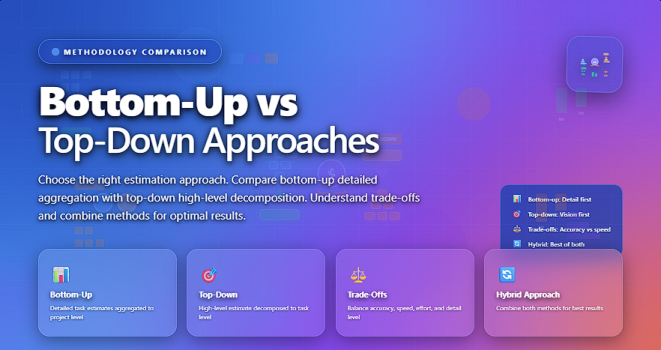
Every successful project—whether small or enterprise-level—depends on one critical decision made early: how planning, estimation, and execution will flow through the organization. Two of the most widely used strategic approaches in project management are Bottom-Up and Top-Down.
Top 5 Project Management Software
While both approaches aim to achieve project objectives efficiently, they differ fundamentally in where decisions originate, how estimates are created, and how teams are engaged. Choosing the wrong approach can lead to unrealistic timelines, budget overruns, disengaged teams, or strategic misalignment.
This article provides a clear, professional, and in-depth comparison of Bottom-Up and Top-Down approaches—helping project managers, PMOs, and leaders understand when to use each, why they matter, and how to combine them effectively in real projects.
What Is the Bottom-Up Approach?
The Bottom-Up approach builds a project plan starting from the lowest level of work. Individual tasks are identified, estimated, and planned by the people who will actually perform them. These detailed estimates are then aggregated upward to form the total project scope, schedule, and cost.
Key Characteristics of Bottom-Up Planning
✔ Task-level focus
✔ Estimates created by subject matter experts
✔ High level of detail and accuracy
✔ Strong team involvement and ownership
✔ Slower planning process, but higher reliability
In practice, this approach answers the question:
“What does the work really take?”
Where Bottom-Up Works Best
• Complex technical projects
• Software development and engineering
• Construction and infrastructure projects
• Projects with high uncertainty or innovation
• Agile and hybrid environments
Bottom-Up planning is especially effective when execution accuracy matters more than speed of approval.
What Is the Top-Down Approach?
The Top-Down approach begins at the strategic or leadership level. Project scope, budget, and timeline are defined first—often based on organizational goals, historical data, or executive expectations. These high-level constraints are then broken down into phases, deliverables, and tasks.
Key Characteristics of Top-Down Planning
✔ Strategic, high-level focus
✔ Fast planning and approval
✔ Strong alignment with business goals
✔ Limited task-level detail early on
✔ Risk of unrealistic estimates
This approach answers a different question:
“What do we want to achieve, and by when?”
Where Top-Down Works Best
• Executive planning and portfolio management
• Early feasibility studies
• Fixed-budget or deadline-driven projects
• Marketing campaigns
• Regulatory or compliance projects
Top-Down planning is most useful when speed, alignment, and direction are more important than precision in early stages.
Bottom-Up vs. Top-Down: Core Differences Explained
The real difference between these approaches is not methodology—it is decision flow and estimation logic.
To make this comparison clear and accessible across all devices, the table below is implemented as a fully responsive HTML table optimized for WordPress.
| Aspect | Bottom-Up Approach | Top-Down Approach |
|---|---|---|
| Starting Point | Individual tasks and activities | Strategic goals and constraints |
| Estimation Method | Detailed task-level estimates created by SMEs | High-level assumptions based on targets or historical data |
| Accuracy | High accuracy (strong execution realism) | Medium to low accuracy early on (depends on assumptions) |
| Planning Speed | Slower (requires breakdown + estimates) | Faster (direction first, detail later) |
| Team Involvement | High involvement (strong ownership) | Limited involvement (alignment via leadership) |
| Risk Level | Lower risk of surprises (details reveal issues early) | Higher risk if constraints are unrealistic |
Advantages and Limitations in Real Projects
Advantages of Bottom-Up
✔ More realistic schedules and budgets
✔ Higher team accountability
✔ Better risk identification
✔ Strong alignment with actual execution
Limitations of Bottom-Up
• Time-consuming to prepare
• Requires skilled team members
• Difficult early on when scope is unclear
Advantages of Top-Down
✔ Faster decision-making
✔ Clear executive direction
✔ Easier stakeholder communication
✔ Strong strategic alignment
Limitations of Top-Down
• Risk of unrealistic expectations
• Lower team ownership
• Often requires later rework
Which Approach Should Project Managers Use?
The most effective project managers do not choose one approach exclusively.
Best Practice: Hybrid Planning
High-performing organizations typically:
• Use Top-Down planning for vision, funding, and timelines
• Apply Bottom-Up planning for execution, estimation, and control
This hybrid model balances strategy with reality—ensuring leadership goals are achievable without burning out teams or exceeding budgets.