 MElkhateeb
✅Introduction
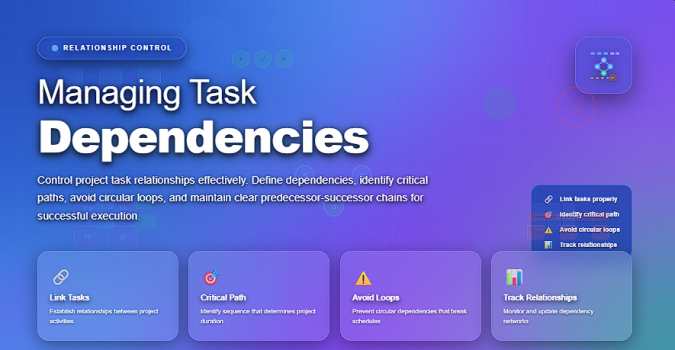
Managing task dependencies is one of the most critical responsibilities in project scheduling. Dependencies define how tasks relate to one another, determine execution order, and directly influence project duration, risk, and flexibility.
Top 5 Project Management Software
✅ Poorly managed dependencies create bottlenecks and delays
✅ Well-managed dependencies improve flow and predictability
✅ Clear dependency logic strengthens schedule credibility
A project schedule is only as strong as the dependency relationships that support it. This article explains what task dependencies are, why they matter, and how to manage them effectively.
✅What Are Task Dependencies?
Task dependencies describe the logical relationships between activities in a project. They specify which task must start or finish before another can begin or end.
Dependencies answer essential questions such as:
✅ What must be completed first?
✅ What can happen in parallel?
✅ Where are the true constraints in the schedule?
Without clearly defined dependencies, schedules become lists of dates rather than tools for managing execution.
✅The Four Types of Task Dependencies
Professional project schedules rely on four standard dependency types.
Finish-to-Start (FS)
This is the most common dependency.
✅ The successor task cannot start until the predecessor finishes
Example: Testing cannot begin until development is complete
FS dependencies reflect linear, step-by-step execution.
Start-to-Start (SS)
In this relationship, tasks start together or with an offset.
✅ The successor can start once the predecessor starts
Example: Documentation starts when development begins
SS dependencies support parallel work and faster delivery.
Finish-to-Finish (FF)
This relationship links task completion points.
✅ The successor cannot finish until the predecessor finishes
Example: Quality review cannot finish until all testing is complete
FF dependencies are useful when outputs must align at completion.
Start-to-Finish (SF)
This is the least common dependency type.
✅ The successor cannot finish until the predecessor starts
Example: Old system support ends when the new system goes live
SF dependencies are rare but important in transition scenarios.
✅Why Managing Dependencies Matters
Dependencies directly affect schedule realism and control.
Effective dependency management:
✅ Prevents unrealistic sequencing
✅ Reveals critical paths and bottlenecks
✅ Improves forecasting accuracy
✅ Supports better risk management
Ignoring dependencies often leads to schedules that look correct on paper but fail during execution.
✅Internal vs. External Dependencies
Not all dependencies are within the project team’s control.
Internal Dependencies
These exist within the project.
✅ Controlled by the project team
✅ Easier to manage and adjust
Examples: Design before development, testing after coding
External Dependencies
These rely on outside parties or events.
✅ Controlled by vendors, regulators, or stakeholders
✅ Higher risk and uncertainty
Examples: Regulatory approval, supplier delivery, client sign-off
External dependencies should always be highlighted and closely monitored.
✅Managing Dependencies Step by Step
Experienced project managers follow a structured approach.
Identify Dependencies Early
✅ Define dependencies during planning, not after scheduling
✅ Involve subject matter experts to validate logic
Early identification reduces rework later.
Validate Dependency Logic
✅ Ask whether tasks truly depend on one another
✅ Avoid assumptions based on habit rather than necessity
Incorrect dependencies reduce flexibility.
Minimize Unnecessary Constraints
✅ Do not overuse Finish-to-Start relationships
✅ Use Start-to-Start or Finish-to-Finish when appropriate
This improves schedule efficiency without increasing risk.
Monitor Dependency-Driven Risks
✅ Track tasks with many successors
✅ Pay special attention to external dependencies
These are common sources of delays.
✅Common Mistakes in Managing Task Dependencies
Even experienced teams make dependency errors.
Frequent Issues Include:
✅ Hard-coding dates instead of using logic
✅ Over-constraining the schedule
✅ Ignoring external dependencies
✅ Failing to update dependencies when scope changes
These mistakes reduce schedule flexibility and hide risk.
✅Task Dependencies and the Critical Path
Dependencies are the foundation of critical path analysis.
✅ The critical path is determined by dependency logic and durations
✅ Any delay on a critical dependency delays the project
✅ Managing dependencies helps protect project end dates
Understanding dependencies is essential for controlling project timelines.
✅Best Practices for Dependency Management
High-performing project teams follow these principles:
✅ Use logic-based scheduling instead of fixed dates
✅ Document complex or unusual dependencies
✅ Review dependencies regularly during status updates
✅ Reassess dependencies after scope or sequence changes
✅ Keep the schedule as simple as possible
Strong dependency management improves both planning and execution.
✅Final Thoughts
Managing task dependencies is not a technical detail—it is a core project management skill. Dependencies define how work flows, where risk concentrates, and how adaptable the schedule can be.
✅ Clear dependencies create realistic schedules
✅ Poor dependencies create false confidence
Successful project managers treat dependency management as an ongoing discipline, not a one-time setup.