
 MElkhateeb
➡️ Introduction
Even the strongest project plans face uncertainty — shifting requirements, late approvals, supplier delays, technical defects, or sudden resource shortages.
To protect the schedule against these unpredictable events, professional project managers rely on one strategic tool: buffer time.
Top 5 Project Management Software
Buffer time (also called schedule contingency) is the deliberate addition of extra time to absorb risks without affecting the final deadline.
When used correctly, buffer time transforms project delivery from reactive firefighting to controlled, reliable execution.
✅ What Is Buffer Time?
Buffer time is planned schedule protection inserted into tasks, phases, or the overall timeline to absorb delays without disrupting the critical path.
It is not padding or guessing.
It is a strategic, risk-based safety margin applied where uncertainty is highest.
✅ Types of Buffer Time in Project Scheduling
Where and how buffers should be placed to protect your schedule.
| Buffer Type | Purpose | Where It Is Used |
|---|---|---|
| Project Buffer | Protects the final delivery date from delays in the critical path. | Placed at the end of the project timeline. |
| Feeding Buffer | Protects the critical path from delays in non-critical tasks. | Inserted where parallel tasks join the critical path. |
| Resource Buffer | Ensures critical resources are available before key tasks begin. | Placed before tasks requiring scarce or shared resources. |
| Management Reserve | Covers unknown risks or unexpected events. | Held by leadership outside the main schedule. |
✅ Why Buffer Time Reduces Delays
Buffer time works because it acknowledges reality:
✔ Tasks rarely finish exactly as planned
✔ Risks materialize even in well-managed projects
✔ Dependencies create cascading impacts
✔ People and resources vary in productivity
Instead of hoping everything will go right, buffers absorb friction, allowing the schedule to remain stable despite uncertainty.
✅ How to Calculate Buffer Time
Here are the most common estimation methods used by professionals:
✔️ Method 1: Risk-Based Buffering
Add buffer proportional to:
- risk probability
- risk impact
- task uncertainty
High-risk tasks get more buffer.
✔️ Method 2: PERT Estimation
PERT formula estimates buffer as:
Buffer = (Worst Case − Best Case) / 6
Used when tasks have variable outcomes.
✔️ Method 3: Percentage Allocation
Common in early planning stages:
- 5–10% of phase duration for stable environments
- 10–25% for innovative or ambiguous work
✔️ Method 4: Critical Chain Method (CCM)
A sophisticated approach where:
- individual task padding is removed
- buffer is added at aggregation points
- focus is placed on flow efficiency
This reduces overall schedule inflation.
✅ Where to Place Buffers in a Project Schedule
Strategic placement is as important as the buffer size.
✔ Insert project buffer at the end of the critical path
✔ Add feeding buffers before tasks merge into the critical path
✔ Place resource buffers ahead of resource-dependent tasks
✔ Keep management reserves outside the main schedule
This protects the timeline at key stress points.
✅ Best Practices for Using Buffer Time
✔ Use data, not intuition, to size buffers
✔ Track buffer consumption during execution
✔ Never hide buffer — communicate it transparently
✔ Avoid adding buffers to every task (creates bloat)
✔ Tie buffers directly to identified risks
✔ Recalculate buffers when re-baselining
❌ Common Mistakes to Avoid
❌ Treating buffer as padding or guessing
❌ Adding too much buffer (inflated schedule)
❌ Adding too little buffer (ineffective protection)
❌ Putting buffer everywhere instead of strategic points
❌ Failing to monitor buffer usage
⭐ Final Thoughts
Buffer time is not a luxury — it is an essential planning technique for managing real-world uncertainty.
When applied intentionally, buffers protect deadlines, stabilize execution, reduce stress, and increase delivery predictability.
Smart project managers schedule tasks.
Great project managers schedule uncertainty.
🔍 SEO Optimization Summary
Primary Keyword: using buffer time to reduce delays
Secondary Keywords: project buffers, schedule contingency, feeding buffer, critical chain buffer
Meta Title: Using Buffer Time to Reduce Delays: Practical Guide for Project Managers
Meta Description: Learn how buffer time protects project schedules from delays. Explore types of buffers, best placement strategies, calculation methods, and best practices.
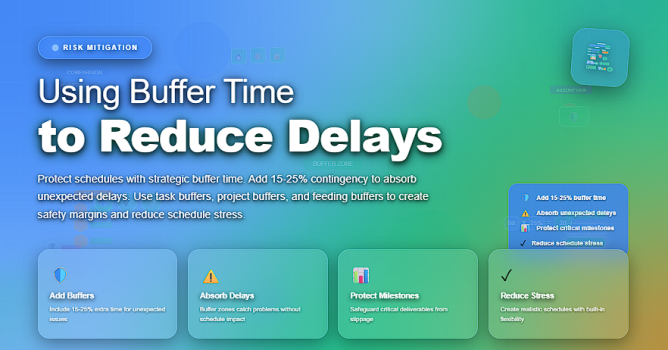
Image Alt Text: Diagram showing project schedule with different types of buffer time.
Would you like the next article in the Scheduling & Control series?
Options:
➡️ When to Adjust Your Timeline
➡️ Tracking Milestone Progress in Real Time
➡️ Managing Delays Using Critical Path