 MElkhateeb
➡️ Introduction
Milestones and deliverables are two of the most misunderstood elements in project planning. Many teams track milestones but fail to link them to actual outputs. Others focus on deliverables but forget to anchor them to measurable checkpoints.
Top 5 Project Management Software
When milestones and deliverables are not aligned:
❌ schedules slip
❌ accountability weakens
❌ quality becomes inconsistent
❌ teams lose sight of progress
Effective alignment ensures that every milestone indicates meaningful progress toward producing a deliverable — not just a date on the calendar. This article explains how to align milestones and deliverables, why it matters, and how project managers can use structured planning to improve visibility and performance.
✅ What Are Deliverables?
Deliverables are tangible outputs produced during the project.
Examples:
- Design documents
- Software modules
- Reports
- Training manuals
- Completed construction phases
Deliverables represent what the project must produce.
✅ What Are Milestones?
Milestones are zero-duration checkpoints used to mark significant stages in the project.
Examples:
- Requirements approved
- Prototype completed
- User testing finished
- Phase 1 closed
Milestones represent when critical progress must be validated.
✅ Why Milestones and Deliverables Must Work Together
Aligning them ensures that:
✔️ progress is measurable
✔️ risks are visible early
✔️ teams stay on schedule
✔️ stakeholders understand status
✔️ quality remains consistent
Milestones without deliverables = activity without evidence.
Deliverables without milestones = evidence without timing.
You need BOTH.
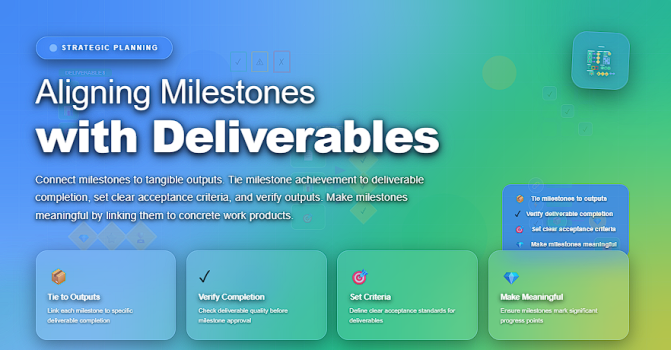
Aligning Milestones with Deliverables
A structured comparison showing how both elements work together.
| Step | Description | Outcome |
|---|---|---|
| 1. Define Deliverables | Identify every output the project must produce. | Clear understanding of required work. |
| 2. Break Deliverables into Phases | Group deliverables into logical work segments. | Foundation for milestone creation. |
| 3. Assign Milestones to Each Phase | Set checkpoints that confirm progress. | Visibility into completion stages. |
| 4. Link Deliverable Completion Criteria | Define what proof is needed to count a milestone as achieved. | Ensures quality and accountability. |
| 5. Integrate Milestones into the Schedule | Add all milestones to the project timeline. | Real-time tracking of both dates and deliverables. |
✅ Best Practices for Alignment
✔️ 1. Make Milestones Measurable
A milestone should never be “in progress.”
It should be either:
✔️ Achieved
❌ Not achieved
✔️ 2. Tie Milestones Directly to Deliverable Criteria
Example:
Milestone: Draft report submitted
Deliverable: First draft of analysis report
Criteria: Must include introduction, methodology, and preliminary findings.
✔️ 3. Use Milestones to Trigger Reviews
Reviews ensure deliverables meet quality standards before moving forward.
✔️ 4. Communicate Milestones Clearly
Stakeholders must understand what is being delivered and when.
✔️ 5. Use Milestones to Manage Risk
Milestones reveal problems early and help prevent schedule or quality failures.
⭐ Final Thoughts
Milestones and deliverables are powerful tools when used together. Deliverables show what the project will produce. Milestones confirm when meaningful progress has been made.
Aligning the two creates transparency, strengthens accountability, and gives project managers an effective control mechanism to ensure the project stays healthy from start to finish.