
 MElkhateeb
➡️ Introduction
A project baseline is your official reference point for scope, schedule, and cost. It shows where the project should be at any moment in time.
But real projects are dynamic. Teams face delays, requirement shifts, unexpected risks, and external disruptions. When changes become significant enough that the current baseline no longer reflects reality, it becomes impossible to measure performance accurately.
Top 5 Project Management Software
That’s when project managers must decide whether to re-baseline — a critical but often misunderstood step in project control.
This article explains when, why, and how to re-baseline your project, ensuring your reporting, forecasting, and decision-making stay accurate and aligned with the new project reality.
✅ What Does Re-Baselining Mean?
Re-baselining is the process of replacing the original scope, schedule, or cost baseline with a revised version that reflects approved changes.
A re-baseline is not a failure. It is a controlled adjustment that enables truthful tracking and protects the integrity of project reporting.
You re-baseline when the current plan is no longer achievable even with corrective actions.
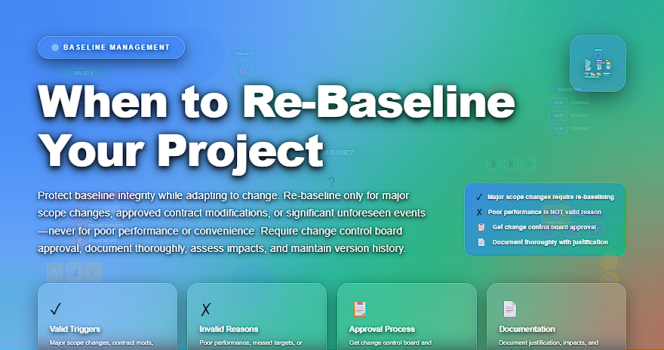
✅ When Should You Re-Baseline Your Project?
Re-baselining must be deliberate and justified. Below are the situations where re-baselining is not only acceptable — it is necessary.
✔️ 1. Major Scope Changes
If stakeholders or clients introduce changes that significantly alter deliverables, effort, or timelines, the existing baseline becomes invalid.
Examples:
- Adding new features
- Redesigning core components
- Changing compliance or regulatory requirements
If scope changes increase effort by 15–20% or more, re-baseline.
✔️ 2. Significant Delays Beyond Corrective Control
Some delays can be fixed through fast-tracking, re-prioritization, or resource reallocation.
But if delays accumulate to the point where the plan cannot be recovered, a re-baseline is necessary.
Examples:
- Critical path slips by weeks or months
- Vendor delays push long-lead items far beyond expectations
- Executive decisions cause waiting periods that stall progress
You cannot track performance accurately against a baseline that is already impossible to meet.
✔️ 3. Major Budget Overruns or Funding Changes
If actual spend diverges significantly from planned spend and the remaining budget must be reallocated or increased, re-baselining ensures financial reporting is realistic.
Examples:
- Material cost increases
- Labor market changes
- Inflation or currency impacts
- New funding approvals
Projects requiring +10% or more budget modifications typically re-baseline.
✔️ 4. External Events Affecting the Entire Project
Some disruptions are impossible to anticipate and can fundamentally alter project execution.
Examples:
- Supply chain breakdown
- New government regulations
- Technological disruptions
- Force majeure events
In these cases, the original plan cannot be restored — so the baseline must be replaced.
✔️ 5. Strategic Shifts in Organizational Priorities
Sometimes the company changes direction, and your project needs to adapt.
Examples:
- New leadership
- Mergers and acquisitions
- Updated corporate strategy
- Market repositioning
If strategic shifts affect scope, funding, or timelines, re-baseline.
✔️ 6. After Major Approved Change Requests
Every change request should be evaluated for its impact.
If cumulative approved changes alter the project significantly, a re-baseline prevents misleading performance metrics.
✔️ 7. When Forecasts Consistently Diverge from the Plan
If your earned value reports or schedule forecasts repeatedly show deviations that cannot be corrected, it’s time to reset.
Indicators include:
- SPI and CPI remain < 0.9 for several periods
- Forecasted completion date shifts repeatedly
- Remaining work estimates far exceed original timelines
A re-baseline restores meaningful reporting.
✅ When Not to Re-Baseline
Re-baselining should not be used as a tool to mask performance issues.
Avoid re-baseline in these situations:
❌ Minor delays that corrective actions can absorb
❌ Team performance problems that require coaching
❌ Poor planning errors that should be addressed, not overwritten
❌ Sponsor pressure to “reset expectations” without justification
A baseline retains value only if it reflects disciplined change management.
✅ How to Re-Baseline the Right Way
If re-baselining is necessary, follow these steps:
✔️ 1. Document the justification
Include data showing why the original baseline is no longer valid.
✔️ 2. Evaluate the full impact
Review scope, cost, schedule, risks, and resources holistically.
✔️ 3. Obtain formal approval
Re-baselining must go through change control or steering committee approval.
✔️ 4. Update all project documents
This includes schedules, budgets, risk registers, procurement plans, and communication plans.
✔️ 5. Communicate the new baseline clearly
Stakeholders must understand the change, its impact, and new expectations.
✔️ 6. Reset performance measurement
Earned Value, KPI tracking, and reporting dashboards should reference the new baseline.
✅ Benefits of Re-Baselining
A well-executed re-baseline provides clarity and stability.
✔️ More accurate forecasts
✔️ Transparent reporting
✔️ Better decision-making
✔️ Improved stakeholder trust
✔️ Realistic expectations for the team
✔️ Renewed alignment on priorities
Re-baselining restores control and credibility to project execution.
⭐ Final Thoughts
Re-baselining is not a sign of failure — it is a sign of strong governance.
Projects evolve, environments change, and assumptions become outdated. A project manager’s responsibility is to ensure the baseline reflects reality, not outdated expectations.
The value of a baseline is not in how early it was set, but in how honestly it reflects the truth.
Approach re-baselining with discipline, transparency, and strategic thinking — and it becomes an essential tool for delivering predictable outcomes.