 MElkhateeb
➡️ Introduction
Most project delays don’t happen because teams are careless.
They happen because plans assume a perfect world — uninterrupted focus, instant decisions, and zero uncertainty.
Top 5 Project Management Software
That world doesn’t exist.
Contingency time is how professional project managers acknowledge uncertainty without surrendering control. It protects delivery dates, absorbs variability, and preserves team focus when things don’t go exactly as planned — which they rarely do.
This article explains what contingency time really is, why it matters, how to size it correctly, and how to build it into schedules without encouraging waste or complacency.
✅ What Is Contingency Time?
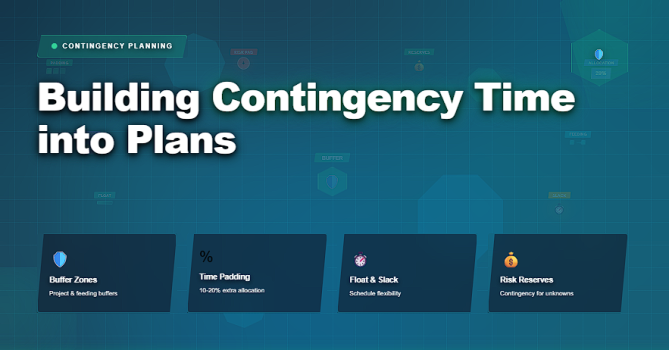
Contingency time is planned schedule buffer reserved to handle known-unknowns — events that are likely to occur but uncertain in timing or impact.
It is used to absorb:
✔️ estimation errors
✔️ minor scope adjustments
✔️ dependency delays
✔️ rework and quality fixes
✔️ decision or approval lag
✔️ short-term resource unavailability
Contingency is not spare time.
It is intentional protection built into the plan.
✅ Contingency vs Padding (Critical Difference)
Understanding this distinction is essential.
Padding
❌ hidden inside individual task estimates
❌ unmanaged and invisible
❌ encourages inefficient behavior
❌ erodes schedule credibility
Contingency
✔️ visible and deliberate
✔️ centrally managed
✔️ tied to identified risks
✔️ released only when needed
Padding hides risk.
Contingency manages it.
📌 Why Projects Fail Without Contingency Time
Plans without contingency rely on one fragile assumption:
everything will go right.
Without buffers, even small disruptions cause:
❌ cascading delays
❌ rushed decisions
❌ quality trade-offs
❌ team burnout
❌ loss of stakeholder confidence
Contingency time turns inevitable variation into manageable adjustment.
📌 Where Contingency Time Should Be Placed
Effective contingency is not scattered randomly. It is positioned strategically:
✔️ before major milestones
✔️ after high-risk phases
✔️ near critical dependencies
✔️ at integration or handover points
✔️ at the project level (not per task)
Placement matters more than size.
✅ How to Build Contingency Time into Project Plans
A structured approach to protecting schedules without hiding risk.
| Step | Action | Outcome |
|---|---|---|
| Identify Risk Areas | Review tasks with uncertainty or dependency exposure | Clarifies where buffers are needed |
| Estimate Base Schedule | Build a realistic, unpadded plan | Creates a transparent baseline |
| Add Central Buffers | Insert contingency near milestones or phase ends | Protects critical delivery points |
| Define Usage Rules | Clarify when and how contingency can be used | Prevents casual consumption |
| Monitor Consumption | Track buffer usage during execution | Provides early warning signals |
| Adjust Proactively | Re-plan if contingency erodes early | Maintains delivery credibility |
❌ Common Mistakes with Contingency Time
❌ hiding buffers inside task estimates
❌ adding contingency without risk analysis
❌ spending buffers too early
❌ failing to track buffer consumption
❌ removing contingency under pressure
❌ treating buffers as optional
These mistakes eliminate the very protection contingency is meant to provide.
⭐ Best Practices
✔️ separate base estimates from contingency
✔️ tie buffers to identified risks
✔️ protect contingency at leadership level
✔️ review buffer health regularly
✔️ communicate buffer logic transparently
✔️ treat contingency as a control mechanism
⭐ Final Thoughts
Building contingency time into plans is not about pessimism —
it is about professional realism.
Strong project managers understand that uncertainty is inevitable.
They don’t deny it, hide it, or hope it disappears.
They plan for it.
Projects succeed not because nothing goes wrong —
but because the plan was strong enough to absorb what did.