 MElkhateeb
➡️ Introduction
Traditional schedules assume certainty.
They treat durations as fixed, dependencies as reliable, and resources as always available.
Top 5 Project Management Software
Reality behaves differently.
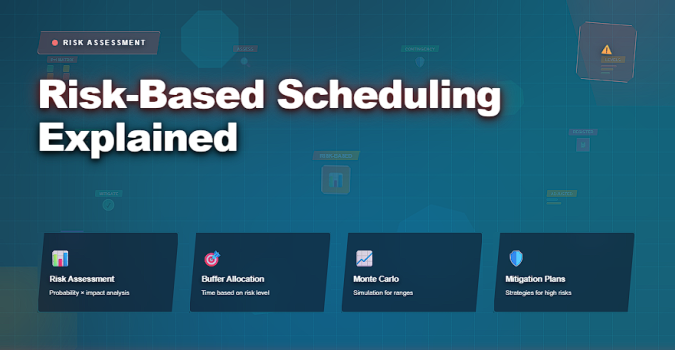
Risk-based scheduling is a planning approach that explicitly acknowledges uncertainty and builds schedules that can absorb disruption instead of collapsing under it. Rather than asking “What is the ideal plan?”, it asks a more professional question:
“Where is this schedule most likely to break — and how do we protect it?”
This article explains what risk-based scheduling is, how it differs from traditional scheduling, when it should be used, and how project managers can apply it in practical, real-world environments.
✅ What Is Risk-Based Scheduling?
Risk-based scheduling is a method of developing and managing project schedules by:
✔️ identifying schedule risks early
✔️ prioritizing high-risk activities
✔️ allocating contingency where uncertainty is highest
✔️ protecting critical paths and milestones
✔️ continuously monitoring schedule risk exposure
Instead of treating all tasks equally, risk-based scheduling focuses attention where delay probability and impact are greatest.
✅ Traditional Scheduling vs Risk-Based Scheduling
The difference is not the tool — it is the mindset.
Traditional Scheduling
✔️ fixed durations
✔️ uniform treatment of tasks
✔️ limited visibility into uncertainty
✔️ reactive response to delays
Risk-Based Scheduling
✔️ variable uncertainty by task
✔️ differentiated treatment of high-risk work
✔️ proactive buffer placement
✔️ early warning and adjustment
Risk-based schedules are not longer by default —
they are more resilient.
📌 Common Sources of Schedule Risk
Risk-based scheduling starts by recognizing where uncertainty lives:
✔️ tasks with poor historical data
✔️ external dependencies and vendors
✔️ approvals and decision points
✔️ shared or constrained resources
✔️ technical complexity
✔️ parallel task execution
✔️ late integration phases
Not all tasks deserve equal protection.
📌 When Should Risk-Based Scheduling Be Used?
Risk-based scheduling is especially valuable when:
✔️ deadlines are non-negotiable
✔️ uncertainty is high
✔️ multiple dependencies exist
✔️ resources are shared across projects
✔️ external stakeholders influence delivery
✔️ failure carries high cost
For low-risk, repetitive work, simpler scheduling may be sufficient.
For complex delivery, risk-based scheduling becomes essential.
✅ Risk-Based Scheduling Framework
How to design schedules that remain stable under uncertainty.
| Step | Action | Purpose |
|---|---|---|
| Identify Risky Tasks | Highlight tasks with high uncertainty or dependency exposure | Focus protection where it matters most |
| Assess Impact | Evaluate delay consequences on milestones and delivery | Prioritize high-impact risks |
| Allocate Contingency | Place buffers near high-risk areas | Absorb variability proactively |
| Protect Critical Path | Monitor tasks driving final delivery | Prevent cascading delays |
| Track Early Signals | Watch for estimate overruns and dependency slippage | Enable early intervention |
| Re-Assess Continuously | Update risk exposure as conditions change | Keep the schedule resilient |
❌ Common Misunderstandings About Risk-Based Scheduling
❌ “It means adding more time everywhere”
❌ “It makes schedules pessimistic”
❌ “It replaces good estimating”
❌ “Only large projects need it”
❌ “Tools automatically manage risk”
Risk-based scheduling refines judgment — it does not replace it.
⭐ Best Practices
✔️ separate risk assessment from estimation
✔️ protect milestones, not individual egos
✔️ review risk exposure regularly
✔️ visualize buffer consumption
✔️ align stakeholders on risk logic
✔️ treat schedules as living forecasts
⭐ Final Thoughts
Risk-based scheduling does not eliminate uncertainty —
it respects it.
Strong project managers understand that reliable delivery is not about perfect predictions, but about designing plans that survive reality.
Projects succeed not because nothing goes wrong —
but because the schedule was built to handle what did.