 MElkhateeb
➡️ Introduction
Most projects track risks in one place and timelines in another.
That separation is convenient — and dangerous.
Top 5 Project Management Software
When risks are managed independently from schedule updates, teams lose visibility into how uncertainty is actually affecting delivery. Timelines look stable while risks quietly grow. Then, suddenly, dates move — and stakeholders feel surprised.
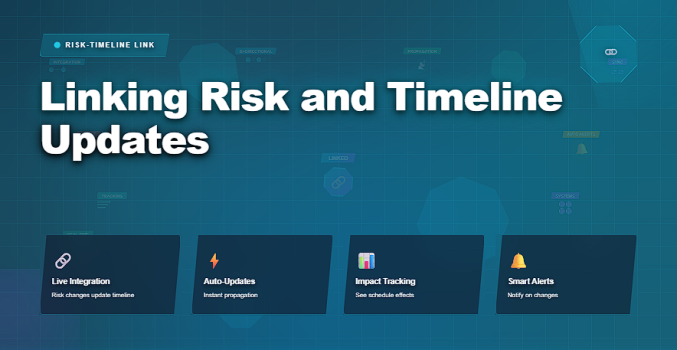
Linking risk and timeline updates closes this gap. It turns risk management from a static register into a living input to scheduling decisions.
This article explains why risk and timeline updates must be connected, how to link them practically, and how project managers can create a single, coherent view of delivery health.
✅ Why Risk and Timeline Updates Must Be Connected
Risk is not theoretical.
If a risk materializes, it changes the schedule.
When risks and timelines are disconnected:
❌ risks feel abstract
❌ schedule changes appear sudden
❌ warning signals are missed
❌ trust erodes
When they are linked:
✔️ schedule changes are expected
✔️ decisions happen earlier
✔️ stakeholders understand why dates move
✔️ delivery becomes predictable
Risk without schedule impact is noise.
Schedule updates without risk context are confusion.
✅ What “Linking Risk and Timeline Updates” Really Means
Linking does not require complex tools. It means:
✔️ every significant risk has a potential schedule impact
✔️ timeline updates reference active risks
✔️ risk probability changes trigger schedule review
✔️ buffer usage is tied to risk realization
✔️ schedule forecasts reflect current risk exposure
The schedule becomes a risk-adjusted forecast, not a static plan.
✅ Common Disconnects That Cause Problems
Most breakdowns happen because:
❌ risks are reviewed monthly, schedules weekly
❌ risk owners differ from schedule owners
❌ risk impact is qualitative only (“high/medium”)
❌ timeline updates report dates without confidence
❌ buffer consumption is not linked to risk events
These gaps prevent early action.
✅ How to Link Risk and Timeline Updates
Turning risk information into schedule-aware decisions.
| Risk Activity | Timeline Action | Result |
|---|---|---|
| Risk Identified | Estimate potential delay impact | Early awareness of exposure |
| Risk Probability Increases | Review affected tasks and buffers | Proactive schedule adjustment |
| Risk Triggers Observed | Activate contingency or resequence work | Reduced delay impact |
| Risk Materializes | Consume buffer and update forecast | Controlled schedule movement |
| Buffer Erosion | Escalate and reassess remaining risk | Avoid late surprises |
| Risk Closed | Stabilize and reconfirm dates | Restored confidence |
✅ How to Reflect Risk in Timeline Updates
Effective timeline updates should include:
✔️ current target date
✔️ confidence level (high / medium / low)
✔️ active risks affecting the date
✔️ buffer status
✔️ decisions required
This shifts reporting from status to forecast.
✅ Practical Example (Simple but Powerful)
Instead of saying:
“Milestone A is scheduled for June 15.”
Say:
“Milestone A is forecast for June 15 with medium confidence, driven by vendor approval risk. Two days of buffer remain. Decision needed by May 28 to maintain the date.”
Same information — radically different value.
❌ Common Mistakes
❌ updating dates without explaining why
❌ tracking risk separately from schedules
❌ hiding uncertainty to appear confident
❌ failing to escalate buffer erosion
❌ changing forecasts without documenting risk drivers
These behaviors create confusion and distrust.
⭐ Best Practices
✔️ treat the schedule as a risk-adjusted forecast
✔️ link each major risk to a schedule element
✔️ review risk and timeline together weekly
✔️ track buffer health visibly
✔️ communicate confidence, not just dates
✔️ document why dates move
⭐ Final Thoughts
Linking risk and timeline updates is not about adding reporting overhead.
It is about telling the truth early, clearly, and usefully.
Strong project managers do not surprise stakeholders with late dates.
They prepare them with risk-aware forecasts.
Projects remain credible not because risk disappears —
but because it is visible, connected, and actively managed.