 MElkhateeb
➡️ Introduction
Every project plan sits between two dangerous extremes.
Top 5 Project Management Software
Too much optimism creates fragile schedules, underestimated effort, and surprise delays.
Too much realism — interpreted as pessimism — can slow decisions, inflate plans, and erode confidence.
Great project managers do not choose one side.
They balance optimism and realism deliberately.
This balance allows teams to stay motivated while still preparing for uncertainty. It protects credibility without killing momentum. And it transforms planning from guesswork into disciplined forecasting.
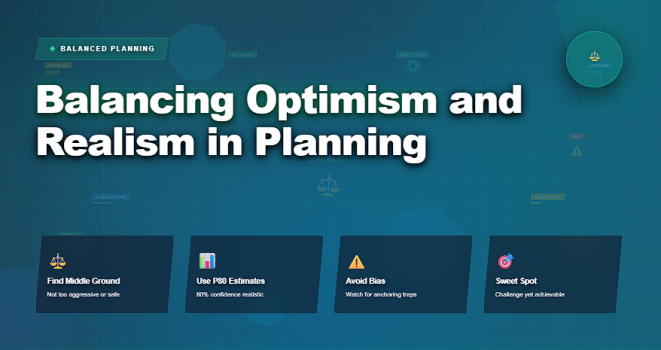
This article explains what optimism and realism really mean in project planning, why both are necessary, where imbalance causes damage, and how to apply a practical framework that keeps plans ambitious and believable.
✅ What Optimism and Realism Mean in Planning
Optimism in planning reflects belief in capability, progress, and improvement. It shows up as:
✔️ confidence in the team
✔️ ambitious goals
✔️ belief in learning and adaptation
✔️ motivation to deliver faster and better
Realism in planning reflects respect for uncertainty, constraints, and historical data. It shows up as:
✔️ honest estimates
✔️ acknowledgement of risk
✔️ buffers and contingencies
✔️ acceptance that variation exists
Optimism fuels action.
Realism protects delivery.
Planning fails when one replaces the other.
✅ Why Extreme Optimism Breaks Plans
Unchecked optimism creates plans that look impressive — and collapse quickly.
Common symptoms include:
❌ aggressive timelines without buffers
❌ ignoring historical performance
❌ underestimating integration and rework
❌ assuming perfect availability
❌ treating risks as unlikely exceptions
These plans depend on flawless execution. Reality rarely cooperates.
✅ Why Excessive Realism Can Also Be Harmful
Overcorrecting toward realism can be just as damaging.
Symptoms include:
❌ padded estimates everywhere
❌ slow approvals and hesitation
❌ lack of urgency
❌ disengaged teams
❌ stakeholders questioning ambition
When realism turns into pessimism, planning loses its motivational power.
✅ Balancing Optimism and Realism in Project Planning
How to build ambitious plans that remain credible under uncertainty.
| Planning Area | Optimism Applied | Realism Applied |
|---|---|---|
| Goals | Set ambitious, value-driven outcomes | Validate feasibility with constraints |
| Estimates | Assume learning and improvement | Use historical data and ranges |
| Schedule | Target aggressive but achievable dates | Add visible contingency buffers |
| Risks | Believe risks can be mitigated | Plan responses and triggers |
| Resources | Trust team capability and growth | Plan based on actual capacity |
| Commitments | Communicate confidence and direction | Share confidence levels, not certainties |
✅ Practical Techniques to Maintain Balance
Strong project managers use techniques that preserve both sides:
✔️ separate targets from commitments
✔️ use ranges instead of single-point estimates
✔️ protect milestones with contingency, not padding
✔️ review assumptions explicitly
✔️ communicate confidence levels, not guarantees
Balance is maintained through structure, not personality.
❌ Common Planning Traps
❌ optimism bias (“we’ll figure it out”)
❌ pessimistic padding (“just to be safe”)
❌ hiding buffers inside tasks
❌ ignoring historical performance
❌ confusing ambition with accuracy
These traps slowly erode trust and predictability.
⭐ Best Practices
✔️ anchor estimates in data, not hope
✔️ use optimism to set direction
✔️ use realism to protect delivery
✔️ revisit assumptions as the project evolves
✔️ align stakeholders on confidence, not certainty
✔️ treat planning as continuous forecasting
⭐ Final Thoughts
Balancing optimism and realism is not a soft skill —
it is a core planning discipline.
Great project managers inspire belief and design protection.
They aim high without pretending uncertainty doesn’t exist.
Projects succeed not because plans are perfect —
but because they are ambitious enough to matter and realistic enough to survive.