 MElkhateeb
➡️ Introduction
Agile teams do not plan releases by locking scope and hoping for the best.
They plan releases by balancing direction with flexibility.
Top 5 Project Management Software
Release planning in Agile sits between long-term strategy and short-term sprint execution. It provides enough structure to align stakeholders and teams, while still allowing adaptation as learning increases.
When done well, Agile release planning creates confidence without rigidity.
When done poorly, it becomes either a fixed plan disguised as Agile — or a vague wish list with no predictability.
This article explains the fundamentals of Agile release planning, how it works, what inputs it requires, and how to use it to guide delivery without sacrificing adaptability.
✅ What Is Agile Release Planning?
Agile release planning is the process of forecasting what value will be delivered over a medium-term horizon, typically across multiple sprints.
It focuses on:
✔️ outcomes, not detailed task lists
✔️ priorities, not fixed scope
✔️ forecasting, not guarantees
✔️ alignment across teams and stakeholders
A release plan answers the question:
“Given what we know today, what is the most valuable set of outcomes we can deliver over the next release window?”
✅ How Agile Release Planning Differs from Traditional Release Planning
The difference is not the absence of planning — it is how certainty is treated.
Traditional Release Planning
✔️ fixed scope baseline
✔️ detailed upfront commitments
✔️ changes treated as failures
✔️ long-range promises
Agile Release Planning
✔️ flexible scope within constraints
✔️ progressive detail
✔️ changes treated as learning
✔️ rolling forecasts
Agile release plans are directional, not contractual.
✅ Key Inputs to Agile Release Planning
Effective release planning depends on the quality of inputs:
✔️ a prioritized product backlog
✔️ a clear product vision and goals
✔️ historical team velocity
✔️ known dependencies and constraints
✔️ high-level risk awareness
✔️ release cadence (number and length of sprints)
Weak inputs lead to unstable release plans.
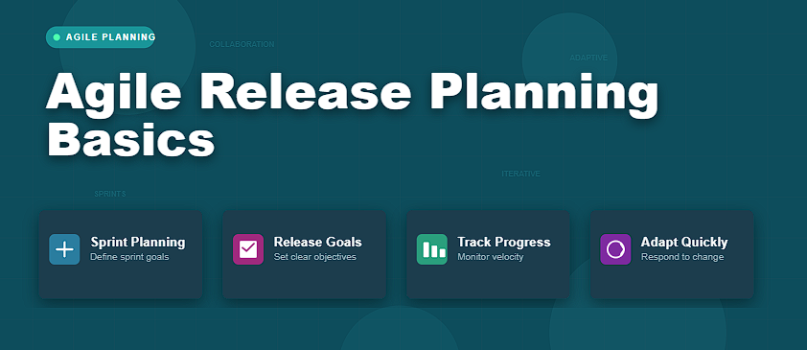
✅ Agile Release Planning Basics
From product vision to a realistic release forecast.
| Step | Focus | Output |
|---|---|---|
| Define Release Goal | Business outcome or customer value | Clear release objective |
| Select Candidate Features | High-value backlog items | Proposed release scope |
| Estimate at High Level | Relative sizing of features | Rough effort understanding |
| Apply Velocity | Historical delivery capacity | Feasible release forecast |
| Identify Risks | Dependencies, unknowns, constraints | Risk-aware release view |
| Communicate Confidence | What is likely vs aspirational | Aligned stakeholder expectations |
✅ How Agile Release Plans Are Used During Execution
Release plans are living artifacts, not static commitments.
They are updated when:
✔️ velocity stabilizes or changes
✔️ priorities shift
✔️ risks materialize
✔️ learning reduces uncertainty
✔️ scope trade-offs are made
The plan evolves — the goal remains stable.
❌ Common Mistakes in Agile Release Planning
❌ treating the release plan as a fixed contract
❌ overloading releases with too many features
❌ ignoring velocity variability
❌ hiding uncertainty from stakeholders
❌ skipping risk discussions
❌ planning features that are not ready
These mistakes reduce trust and predictability.
⭐ Best Practices
✔️ focus on outcomes, not feature counts
✔️ use ranges and confidence levels
✔️ revisit the release plan regularly
✔️ make trade-offs visible
✔️ protect teams from constant scope churn
✔️ align planning cadence with sprint rhythm
⭐ Final Thoughts
Agile release planning is not about locking the future.
It is about creating a credible path forward.
Strong Agile teams use release plans to align direction, guide decisions, and manage expectations — while staying flexible enough to adapt as reality unfolds.
Agile succeeds not because plans never change —
but because planning remains intentional, transparent, and continuous.