 MElkhateeb
➡️ Introduction
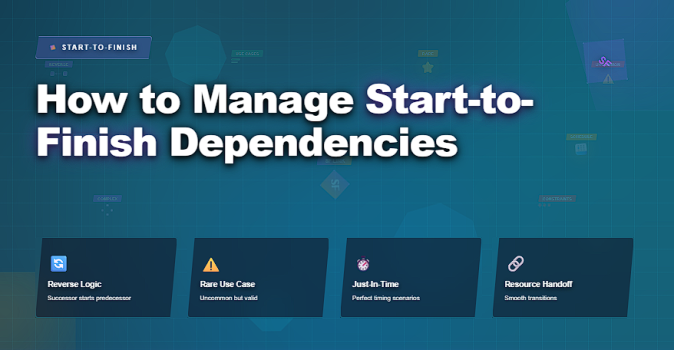
Start-to-Finish dependencies are the most misunderstood relationships in project scheduling.
Top 5 Project Management Software
They are rare, often avoided, and frequently misused — yet when they do apply, they represent critical operational transitions that can make or break a project.
Many project managers either:
• avoid Start-to-Finish relationships entirely
• replace them with awkward workarounds
• or use them incorrectly, creating fragile schedules
This article explains what Start-to-Finish dependencies really mean, when they are appropriate, how to model them correctly, and how to manage the risks they introduce.
✅ What a Start-to-Finish Dependency Really Means
A Start-to-Finish (SF) dependency means:
➡️ A successor task cannot finish until its predecessor starts.
This is fundamentally different from Finish-to-Start logic.
In simple terms:
• the old activity continues
• until the new activity begins
SF dependencies usually represent handover or replacement scenarios, not typical production workflows.
✅ Why Start-to-Finish Dependencies Exist
SF relationships exist to model continuity, not sequence.
They are used when stopping an activity before another starts would create risk, service interruption, or operational failure.
Common situations include:
✔️ system cutovers
✔️ operational handovers
✔️ parallel support models
✔️ legacy-to-new transitions
They ensure there is no gap between responsibilities.
✅ Start-to-Finish Dependency Scenarios
Modeling continuity and controlled transitions.
| Scenario | Predecessor Starts | Successor Finishes |
|---|---|---|
| System Cutover | New system goes live | Old system is shut down |
| Shift Handover | Incoming shift begins | Outgoing shift ends |
| Support Transition | New support team onboarded | Old support team disengaged |
| Vendor Replacement | New vendor operational | Old vendor contract closed |
✅ How to Model Start-to-Finish Dependencies Correctly
To use SF dependencies safely:
✔️ confirm the relationship represents continuity, not sequence
✔️ validate with operational stakeholders
✔️ ensure the predecessor truly starts before the successor can stop
✔️ document the dependency rationale clearly
✔️ monitor these dependencies closely during execution
SF logic should be intentional and explicit, never accidental.
✅ Risks Introduced by Start-to-Finish Dependencies
Because SF dependencies delay task completion until another task starts, they can:
✔️ hide schedule risk
✔️ create late critical paths
✔️ complicate impact analysis
✔️ mask readiness issues
✔️ delay closure activities
Project managers must treat SF relationships as high-attention dependencies.
❌ Common Mistakes with Start-to-Finish Dependencies
❌ using SF to “force” dates
❌ replacing poor planning with SF logic
❌ confusing SF with Finish-to-Start
❌ using SF when a milestone would be clearer
❌ failing to explain SF logic to stakeholders
Most scheduling tools allow SF — but do not protect you from misuse.
⭐ Best Practices
✔️ use Start-to-Finish only when continuity is mandatory
✔️ prefer milestones when possible
✔️ keep SF dependencies visible and documented
✔️ review SF logic during every schedule update
✔️ combine SF with risk mitigation plans
✔️ test schedule behavior by delaying predecessor starts
⭐ Final Thoughts
Start-to-Finish dependencies are not advanced tricks —
they are precision tools.
Used correctly, they protect continuity and reduce operational risk. Used casually, they create confusion and fragile schedules.
Strong project managers understand SF dependencies deeply, apply them sparingly, and explain them clearly.
Projects succeed not because dependencies are complex —
but because they are correct.