 MElkhateeb
➡️ Introduction
Escalation is often misunderstood.
Top 5 Project Management Software
Some project managers escalate too late, hoping problems will resolve themselves. Others escalate too early, creating noise and eroding trust. Both approaches weaken control.
Escalation is not a failure of planning.
It is a control mechanism.
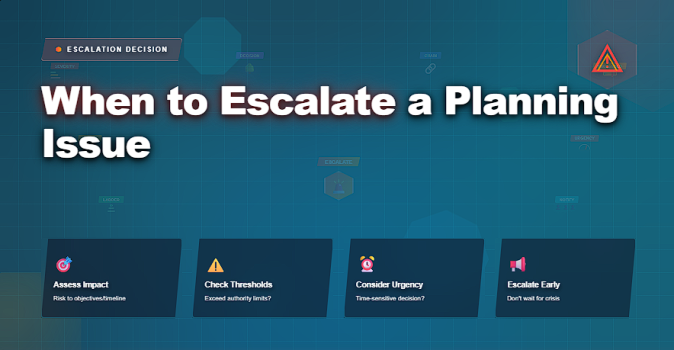
Knowing when to escalate a planning issue is a critical leadership skill. Done well, escalation protects the project, aligns decision-makers, and prevents small problems from becoming irreversible damage.
This article explains what escalation really means, when it is necessary, and how to escalate planning issues without panic, blame, or chaos.
✅ What Escalation Really Is (and Is Not)
Escalation is not:
❌ complaining
❌ shifting responsibility
❌ admitting defeat
❌ creating drama
Escalation is:
✔️ signaling that a decision boundary has been reached
✔️ requesting authority, resources, or trade-offs
✔️ protecting commitments and credibility
✔️ making risk visible at the right level
Escalation exists to restore alignment — not to assign blame.
✅ Why Planning Issues Often Go Un-Escalated
Many planning problems stay hidden longer than they should.
Common reasons include:
✔️ fear of appearing incompetent
✔️ optimism bias (“we can recover”)
✔️ unclear escalation thresholds
✔️ pressure to maintain “green” status
✔️ lack of psychological safety
By the time escalation happens, options are limited.
✅ Escalation Triggers in Planning
Signals that indicate the issue is beyond the project manager’s authority.
| Trigger | What Is Happening | Why Escalation Is Needed |
|---|---|---|
| Repeated Missed Commitments | Recovery actions fail to stabilize the plan | Indicates structural, not tactical, issues |
| Capacity Limits Reached | No feasible way to meet demand with current resources | Requires trade-offs or additional support |
| Conflicting Priorities | Multiple stakeholders demand incompatible outcomes | Only leadership can resolve priority conflicts |
| External Dependency Failure | Vendors, partners, or approvals block progress | Authority needed beyond project control |
| Risk Threshold Breach | Schedule or cost risk exceeds agreed tolerance | Governance intervention required |
✅ How to Escalate Without Creating Panic
Effective escalation is calm and structured.
A strong escalation includes:
✔️ a clear statement of the issue
✔️ evidence and trends, not opinions
✔️ impact on objectives if nothing changes
✔️ options and trade-offs
✔️ a specific request for decision or support
Escalation should invite resolution, not alarm.
✅ What Not to Escalate
Not every problem deserves escalation.
Avoid escalating:
✔️ one-off execution mistakes
✔️ issues still within your authority
✔️ early signals without validation
✔️ problems without proposed options
Escalation works best when used selectively.
❌ Common Escalation Mistakes
❌ escalating too late
❌ escalating without analysis
❌ framing issues emotionally
❌ blaming individuals or teams
❌ escalating repeatedly without new insight
❌ using escalation as self-protection
Poor escalation damages credibility.
⭐ Best Practices
✔️ define escalation thresholds early
✔️ document decisions and boundaries
✔️ escalate based on trends, not surprises
✔️ prepare options before escalating
✔️ follow up after escalation decisions
✔️ normalize escalation as part of governance
⭐ Final Thoughts
Escalation is not a weakness.
Avoiding escalation is.
Strong project managers know their authority limits, monitor signals carefully, and escalate planning issues early enough to preserve options.
Projects succeed not because problems never appear —
but because the right issues reach the right level at the right time.