 MElkhateeb
➡️ Introduction
Time is rarely lost during execution.
It is usually lost during estimation.
Top 5 Project Management Software
Many project managers focus on delivery tactics — faster meetings, tighter follow-ups, more reporting — while the real problem sits upstream. Poor estimates create unrealistic plans, hidden overload, and constant re-planning.
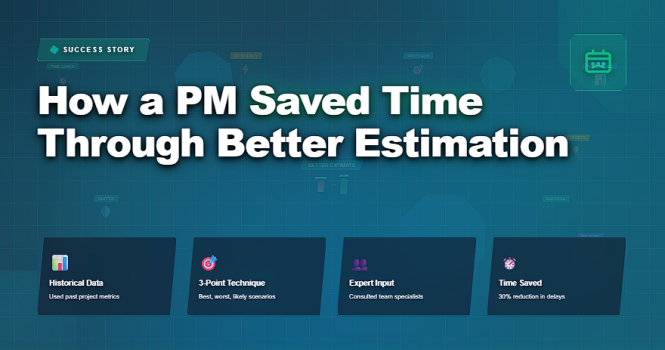
This case study shows how a project manager saved significant time and effort not by pushing the team harder, but by changing the way work was estimated.
The result was a calmer project, fewer surprises, and a schedule that finally held.
✅ Project Context
The project involved delivering a medium-sized IT system enhancement over a four-month period.
Initial conditions:
✔️ shared technical resources
✔️ fixed external milestones
✔️ multiple parallel workstreams
✔️ history of missed internal deadlines
Despite strong technical skills, the project consistently lost time week after week.
✅ The Estimation Problem
The original estimates were built using a familiar but flawed approach:
✔️ optimistic task-level estimates
✔️ assumptions based on best-case scenarios
✔️ little consideration for interruptions
✔️ no explicit buffers
✔️ pressure to “fit” work into target dates
On paper, the plan looked efficient.
In reality, it was fragile.
✅ Estimation Changes That Saved Time
What changed — and why it worked.
| Change | What Was Done | Impact |
|---|---|---|
| Switched to Range Estimates | Used best / most likely / worst cases | Reduced optimism bias |
| Estimated at Task Group Level | Combined related tasks into chunks | More realistic totals |
| Included Interruption Time | Accounted for meetings and support work | Fewer missed commitments |
| Added Explicit Buffers | Placed buffers at milestone level | Schedule absorbed variability |
| Validated with the Team | Reviewed estimates collaboratively | Higher ownership and accuracy |
✅ The Results Achieved
Within one month of applying the new estimation approach:
✔️ milestone dates stabilized
✔️ fewer emergency re-planning sessions
✔️ team overtime dropped significantly
✔️ stakeholder confidence improved
✔️ overall delivery time shortened
Ironically, estimating more conservatively saved time.
⭐ Key Lessons for Project Managers
✔️ Estimation quality determines execution quality
✔️ Optimistic plans create hidden delays
✔️ Buffers protect flow, not laziness
✔️ Team validation improves accuracy
✔️ Better estimation reduces management effort
⭐ Final Thoughts
This project did not succeed because the team worked harder.
It succeeded because the PM planned more honestly.
Strong project managers understand that estimation is not prediction —
it is risk management expressed in time.
Projects save time not by rushing —
but by starting with estimates that reflect reality.