 MElkhateeb
➡️ Introduction
Not all parts of a project can be planned with the same level of detail.
Trying to do so is one of the fastest ways to lose credibility.
Top 5 Project Management Software
Projects operate under uncertainty — evolving requirements, unknown risks, changing priorities, and incomplete information. When teams force detailed plans too early, those plans become outdated almost immediately.
Rolling Wave Planning solves this problem.
It allows project managers to plan in waves of increasing detail, focusing precision where it is possible today while keeping future work flexible until more information is available.
This article introduces rolling wave planning, explains how it works, and shows how it supports realistic schedules without sacrificing control.
✅ What Is Rolling Wave Planning?
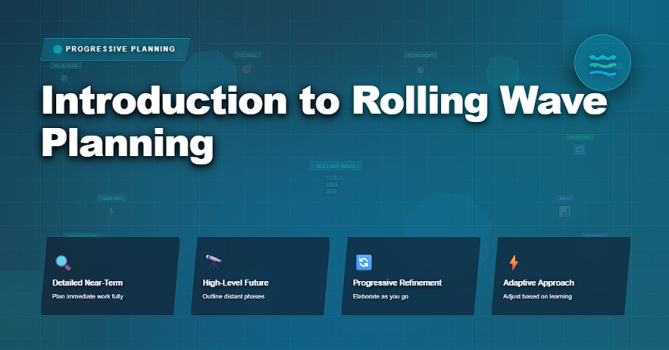
Rolling wave planning is a progressive planning technique where:
✔️ near-term work is planned in high detail
✔️ mid-term work is planned at a summary level
✔️ long-term work remains intentionally high-level
✔️ detail increases as uncertainty decreases
In simple terms:
You plan what you know now — and refine the rest later.
This approach is especially effective in complex, long-duration, or change-prone projects.
✅ Why Traditional Planning Breaks Down
Traditional “fully detailed upfront” planning fails because:
✔️ assumptions are treated as facts
✔️ early estimates lock expectations too soon
✔️ change feels like failure instead of learning
✔️ teams spend time maintaining outdated plans
✔️ confidence erodes when dates keep shifting
Rolling wave planning accepts uncertainty instead of fighting it.
✅ Planning Detail Across Rolling Waves
How clarity increases as uncertainty decreases.
| Planning Horizon | Level of Detail | Purpose |
|---|---|---|
| Near-Term (Next 2–8 Weeks) | Fully detailed tasks and assignments | Enable execution and tracking |
| Mid-Term | Summary activities and milestones | Support forecasting and alignment |
| Long-Term | High-level phases or outcomes | Preserve flexibility |
✅ When Rolling Wave Planning Works Best
Rolling wave planning is especially effective when:
✔️ requirements are evolving
✔️ project duration is long
✔️ technology or scope is uncertain
✔️ multiple stakeholders influence direction
✔️ early decisions unlock later clarity
It is a control strategy — not a lack of planning.
❌ Common Misunderstandings About Rolling Wave Planning
❌ “It means we don’t plan ahead”
❌ “It reduces accountability”
❌ “Stakeholders won’t accept it”
❌ “It creates unstable schedules”
In reality, rolling wave planning increases credibility by avoiding false precision.
⭐ Best Practices for Using Rolling Wave Planning
✔️ define clear planning horizons
✔️ update plans at a regular cadence
✔️ protect near-term commitments
✔️ communicate uncertainty honestly
✔️ link refinements to decision points
✔️ baseline only what is known
Clarity grows through iteration.
⭐ Rolling Wave Planning vs. Agile Planning
Rolling wave planning is not limited to Agile.
It is used in:
✔️ predictive projects
✔️ hybrid environments
✔️ large programs
✔️ construction and infrastructure
✔️ enterprise IT initiatives
The method adapts to the context — not the other way around.
⭐ Final Thoughts
Rolling wave planning accepts a simple truth:
You cannot plan what you do not yet understand.
Strong project managers do not pretend certainty exists where it does not.
They plan progressively, refine intelligently, and commit responsibly.
Projects succeed not because every detail is known on day one —
but because planning evolves in step with reality.