 MElkhateeb
➡️ Introduction
Basic schedules show dates.
Advanced schedules control outcomes.
Top 5 Project Management Software
As projects grow in size and complexity, simple task lists and start–finish dates stop being enough. Dependencies tighten, resources overlap, risks compound, and small delays ripple across the entire plan.
This is where advanced scheduling becomes essential.
Tools like Primavera P6 and Microsoft Project are not just planning tools — they are control systems when used correctly.
This article explains what advanced scheduling really means in Primavera and MS Project, which techniques matter most, and how experienced project managers use these tools to manage complex timelines with confidence.
✅ What “Advanced Scheduling” Really Means
Advanced scheduling is not about using more features.
It is about modeling reality accurately.
In practice, advanced scheduling focuses on:
✔️ realistic dependency logic
✔️ resource and capacity constraints
✔️ critical path and near-critical paths
✔️ schedule risk and buffers
✔️ controlled baselines and change impact
✔️ continuous re-forecasting
The tool supports this — but discipline makes it work.
✅ When Advanced Scheduling Becomes Necessary
Advanced scheduling is essential when:
✔️ projects are long or high-value
✔️ multiple contractors or teams are involved
✔️ resources are shared or constrained
✔️ deadlines are contractual or fixed
✔️ recovery options are limited
At this level, schedule credibility becomes a leadership issue.
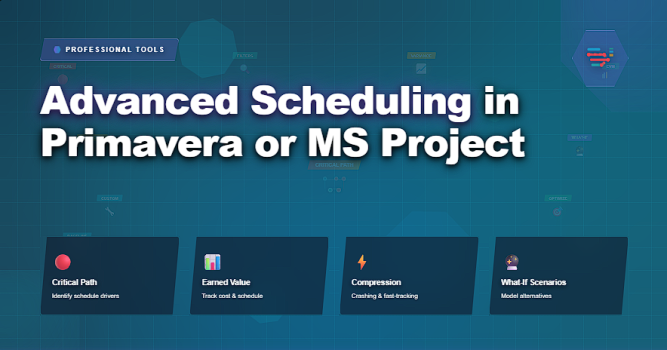
✅ Advanced Scheduling Techniques
How experienced PMs control complex schedules.
| Technique | How It’s Used | Why It Matters |
|---|---|---|
| Critical Path Management | Analyze true driving activities and logic | Focuses attention on what really controls finish date |
| Resource-Leveling | Adjust dates based on resource limits | Prevents unrealistic overload |
| Constraints Control | Minimize hard constraints, track impacts | Preserves schedule logic integrity |
| Multiple Baselines | Compare original, approved, and recovery plans | Supports transparent change control |
| What-If Analysis | Simulate delays, acceleration, or resequencing | Enables informed decisions before action |
✅ Primavera vs. MS Project at an Advanced Level
At advanced maturity, the difference is less about capability and more about context.
Primavera is typically favored when:
✔️ schedules exceed thousands of activities
✔️ multiple contractors submit schedules
✔️ portfolio-level integration is required
✔️ formal schedule assurance is needed
MS Project is often effective when:
✔️ teams are smaller or internal
✔️ integration with Microsoft tools is key
✔️ governance is lighter
✔️ rapid scenario testing is needed
Both tools can support advanced scheduling — discipline determines success.
❌ Common Mistakes in Advanced Scheduling
❌ overusing hard constraints
❌ hiding issues with logic workarounds
❌ ignoring near-critical paths
❌ updating dates without logic review
❌ treating the tool as the plan
Advanced schedules fail when credibility is sacrificed for appearance.
⭐ How Experienced PMs Use These Tools
Strong project managers:
✔️ model cause-and-effect relationships
✔️ protect schedule logic integrity
✔️ review schedules before trusting dates
✔️ use scenarios to guide decisions
✔️ communicate impacts, not just changes
They understand that schedules explain reality — they do not replace it.
⭐ Benefits of Advanced Scheduling Done Right
When applied correctly, advanced scheduling delivers:
✔️ predictable delivery
✔️ early risk visibility
✔️ informed trade-off decisions
✔️ credible commitments
✔️ stakeholder confidence
Control replaces firefighting.
⭐ Final Thoughts
Advanced scheduling is not about complexity.
It is about clarity under constraint.
Tools like Primavera and MS Project become powerful only when they reflect how work actually flows, how resources behave, and how risks emerge over time.
Projects succeed not because schedules are detailed —
but because they are honest, logical, and actively managed.