 MElkhateeb
➡️ Introduction
Schedules do not fail because plans are wrong.
They fail because reality changes faster than humans can re-plan.
Top 5 Project Management Software
Delays, resource shifts, scope changes, and unexpected dependencies are normal in modern projects. What overwhelms teams is not the change itself — it is the manual effort required to constantly rebuild schedules.
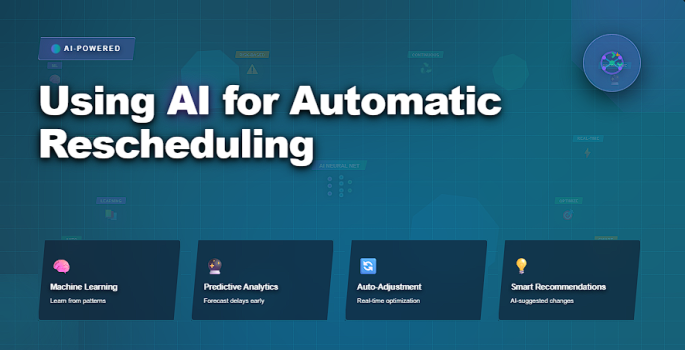
This is where AI-powered automatic rescheduling enters the picture.
Used correctly, AI does not replace the project manager.
It removes mechanical effort, accelerates analysis, and supports faster, more informed decisions when plans inevitably change.
This article explains how AI-driven rescheduling works, where it adds real value, and how experienced project managers use it responsibly.
✅ What Is AI-Based Automatic Rescheduling?
AI-based automatic rescheduling refers to systems that:
✔️ detect schedule changes or disruptions
✔️ recalculate timelines automatically
✔️ consider dependencies, constraints, and resources
✔️ generate revised schedules or options
✔️ highlight trade-offs and impacts
Instead of manually dragging tasks or recalculating dates, the system re-optimizes the schedule based on updated conditions.
The output is not a decision — it is decision support.
✅ Why Manual Rescheduling Breaks Down
Traditional rescheduling becomes ineffective when:
✔️ schedules are large or complex
✔️ resources are shared
✔️ changes occur frequently
✔️ dependencies are tightly coupled
✔️ recovery windows are small
Manual updates are slow, error-prone, and often reactive. By the time the plan is updated, it is already outdated.
AI reduces this delay dramatically.
✅ Core AI Rescheduling Capabilities
How AI supports rapid, realistic re-planning.
| Capability | What It Does | Why It Matters |
|---|---|---|
| Change Detection | Identifies delays, slippage, or resource changes | Triggers early response |
| Dependency Recalculation | Updates downstream impacts automatically | Prevents hidden schedule damage |
| Resource-Aware Adjustment | Reschedules based on real capacity | Avoids unrealistic recovery plans |
| Scenario Generation | Creates multiple recovery options | Supports informed trade-offs |
| Impact Visualization | Shows effects on milestones and deadlines | Improves stakeholder communication |
✅ Where AI Rescheduling Adds the Most Value
AI-driven rescheduling is especially effective when:
✔️ schedules are large or highly interdependent
✔️ multiple projects share resources
✔️ frequent changes are expected
✔️ deadlines are tight or contractual
✔️ rapid decision-making is required
It reduces reaction time — not accountability.
❌ Common Misunderstandings About AI Rescheduling
❌ “AI decides the schedule for us”
❌ “It removes the need for planning discipline”
❌ “Faster schedules are always better schedules”
❌ “AI eliminates uncertainty”
AI accelerates analysis. Humans still decide.
⭐ How Experienced PMs Use AI for Rescheduling
Strong project managers use AI to:
✔️ explore options quickly
✔️ test recovery strategies
✔️ quantify impacts before escalation
✔️ protect critical paths
✔️ reduce manual scheduling effort
They use AI before crises, not after.
⭐ Risks and Limitations to Be Aware Of
AI rescheduling can fail when:
✔️ input data is poor or outdated
✔️ constraints are unrealistic
✔️ logic is flawed
✔️ human judgment is bypassed
✔️ outputs are accepted blindly
Automation amplifies quality — good or bad.
⭐ Final Thoughts
AI-powered rescheduling is not about replacing project managers.
It is about removing friction from one of the most painful parts of planning.
When used responsibly, AI allows teams to respond faster, plan more realistically, and make better decisions under pressure.
Projects succeed not because plans never change —
but because teams adapt quickly, intelligently, and with control.