 MElkhateeb
➡️ Introduction
Project managers rarely lack tasks.
They lack protected time.
Top 5 Project Management Software
Between meetings, stakeholder requests, reporting, issue resolution, and constant interruptions, many PMs spend their days reacting instead of leading. Over time, this erodes focus, increases stress, and weakens decision quality — even on well-planned projects.
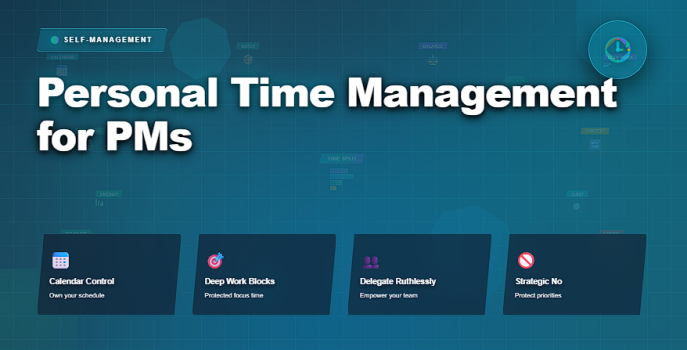
Personal time management for project managers is not about working faster.
It is about controlling attention, energy, and priorities in a role designed to pull you in every direction.
This article explains how project managers can manage their own time effectively, what habits matter most, and how better personal time management directly improves project outcomes.
✅ Why Time Management Is Different for Project Managers
Project managers do not control their time the same way individual contributors do.
PM time is:
✔️ highly interrupt-driven
✔️ decision-heavy
✔️ dependent on others’ progress
✔️ fragmented across contexts
✔️ influenced by external urgency
This makes traditional “to-do list” productivity methods ineffective for PMs.
Effective PM time management focuses on structure, boundaries, and prioritization, not speed.
✅ Time Management Practices for Project Managers
How PMs protect focus, energy, and decision quality.
| Practice | How PMs Use It | Why It Works |
|---|---|---|
| Daily Priority Definition | Identify 2–3 outcomes that matter most | Prevents reactive overload |
| Time Blocking | Reserve time for planning and thinking | Protects strategic focus |
| Decision Windows | Batch decisions instead of constant switching | Reduces cognitive fatigue |
| Meeting Control | Decline or shorten low-value meetings | Creates execution time |
| End-of-Day Review | Prepare tomorrow before signing off | Improves continuity and clarity |
✅ Managing Interruptions Without Losing Control
Interruptions are unavoidable for PMs — unmanaged interruptions are not.
Effective PMs:
✔️ define escalation rules
✔️ batch responses instead of constant checking
✔️ protect “deep work” windows
✔️ clarify what is truly urgent
✔️ delegate where appropriate
The goal is not silence — it is intentional responsiveness.
❌ Common Time Management Mistakes PMs Make
❌ attending every meeting by default
❌ treating email as a task list
❌ planning only tasks, not decisions
❌ reacting immediately to every request
❌ skipping reflection and review
These habits create busy days — not effective leadership.
⭐ How Better Time Management Improves Project Results
When PMs manage their time well:
✔️ decisions are made earlier
✔️ risks are identified sooner
✔️ teams receive faster support
✔️ stress decreases
✔️ leadership credibility increases
Personal time management directly impacts project performance.
⭐ A Simple Daily Time Framework for PMs
Many effective PMs follow this rhythm:
✔️ Morning: priorities and decision planning
✔️ Midday: communication and coordination
✔️ Afternoon: focused execution and follow-ups
✔️ End of day: review and preparation
Consistency matters more than complexity.
⭐ Final Thoughts
Personal time management is not a productivity trick.
It is a leadership capability.
Project managers who manage their time well do not rush more.
They think more clearly, decide more confidently, and lead more effectively.
In complex projects, your time is not just personal —
it is one of the most important project resources you manage.