 MElkhateeb
➡️ Introduction
Many teams still treat planning as an event.
Successful teams treat it as a capability.
Top 5 Project Management Software
In traditional thinking, planning happens at the beginning of a project. Once approved, the plan is “executed,” and changes are treated as exceptions. In reality, this mindset creates fragile projects — plans age quickly, assumptions expire, and decisions fall behind reality.
Modern projects operate in dynamic environments. Requirements evolve, risks emerge, priorities shift, and information improves over time.
That is why planning is not a phase.
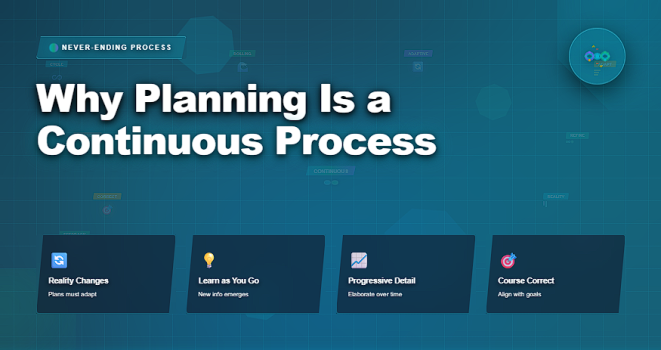
It is a continuous process.
This article explains why planning must be continuous, what continuous planning really means, and how project managers can apply it without slowing delivery.
✅ What Continuous Planning Really Means
Continuous planning does not mean constant re-planning.
It means:
✔️ plans are reviewed regularly
✔️ assumptions are tested during execution
✔️ near-term work is refined as clarity improves
✔️ future work remains flexible
✔️ decisions are updated as conditions change
Planning provides direction, execution provides feedback, and continuous planning connects the two.
✅ Why One-Time Planning Fails
One-time planning fails because:
✔️ early assumptions are incomplete
✔️ uncertainty is highest at the start
✔️ risks evolve during execution
✔️ stakeholders change priorities
✔️ teams learn as they deliver
A static plan cannot survive a dynamic environment.
✅ How Planning Evolves Over Time
From initial direction to execution-informed decisions.
| Planning Stage | Focus | Why It Matters |
|---|---|---|
| Initial Planning | Define goals, scope, and major milestones | Provides direction and alignment |
| Near-Term Planning | Detail upcoming work and dependencies | Reduces execution risk |
| Execution Feedback | Compare plan vs. reality | Validates assumptions |
| Plan Adjustment | Update timelines, priorities, or scope | Keeps plans relevant |
| Learning Integration | Capture insights for future planning | Improves planning maturity |
✅ Continuous Planning vs. Constant Change
Continuous planning does not mean instability.
The difference:
✔️ continuous planning is intentional
✔️ changes are based on evidence
✔️ direction remains stable
✔️ adjustments are controlled
✔️ communication is proactive
The goal is adaptability with discipline, not chaos.
❌ Common Misconceptions About Continuous Planning
❌ “It means we didn’t plan well initially”
❌ “It creates confusion”
❌ “Stakeholders will lose confidence”
❌ “It slows execution”
In reality, continuous planning increases confidence because plans reflect reality.
⭐ Benefits of Treating Planning as a Continuous Process
When planning is continuous:
✔️ risks are identified earlier
✔️ estimates improve over time
✔️ teams stay aligned
✔️ stakeholders trust updates
✔️ execution becomes predictable
Plans become tools — not constraints.
⭐ How Project Managers Enable Continuous Planning
Effective project managers:
✔️ schedule regular planning reviews
✔️ treat plan changes as learning signals
✔️ keep future work flexible
✔️ communicate updates clearly
✔️ protect direction while adjusting detail
They plan with humility — knowing that clarity grows over time.
⭐ Final Thoughts
Planning is not a document.
It is a living decision process.
In complex projects, certainty does not arrive upfront.
It emerges gradually through execution, feedback, and learning.
Organizations that succeed do not plan once and hope.
They plan continuously — and lead with clarity in motion.