
 MElkhateeb
➡️ Introduction
Modern teams do not fail because people lack skills.
They fail because work environments prevent people from doing their best work.
Top 5 Project Management Software
As projects become more complex, distributed, and knowledge-driven, traditional command-and-control leadership becomes less effective. Teams need clarity, trust, autonomy, and psychological safety to perform consistently.
This is where servant leadership becomes highly relevant.
Servant leadership is not about being passive or avoiding authority. It is about using authority to remove obstacles, enable people, and create the conditions for sustainable performance.
This article explains what servant leadership really means in modern teams, how it works in practice, and when it delivers the greatest impact.
✅ What Servant Leadership Really Means
Servant leadership reverses the traditional leadership model.
Instead of asking:
➡️ How can people serve the leader?
Servant leaders ask:
➡️ How can the leader serve the team?
In practice, servant leadership means:
✔️ prioritizing team needs over personal authority
✔️ enabling decision-making at the right level
✔️ removing blockers and friction
✔️ supporting growth and capability
✔️ protecting focus and wellbeing
The leader’s success is measured by team effectiveness, not visibility.
✅ Why Servant Leadership Fits Modern Teams
Modern teams are:
✔️ knowledge-based, not task-based
✔️ cross-functional and interdependent
✔️ distributed across locations and time zones
✔️ required to adapt continuously
In this environment, productivity cannot be forced.
It must be enabled.
Servant leadership creates the trust and autonomy that modern work requires.
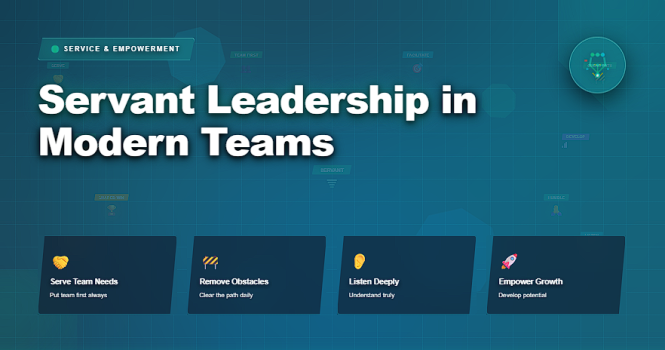
✅ Core Principles of Servant Leadership
How servant leadership operates in modern team environments.
| Principle | How It Shows Up | Why It Matters |
|---|---|---|
| Removing Obstacles | Leader clears blockers and friction | Improves flow and focus |
| Empowering Decisions | Authority delegated to the team | Speeds execution and ownership |
| Active Listening | Leader listens before directing | Builds trust and engagement |
| Supporting Growth | Coaching and skill development | Creates long-term capability |
| Protecting the Team | Filters noise and unrealistic demands | Sustains performance and morale |
✅ Servant Leadership vs. Passive Leadership
A common misconception is that servant leadership means avoiding authority.
In reality:
✔️ servant leaders make decisions
✔️ servant leaders set boundaries
✔️ servant leaders hold teams accountable
✔️ servant leaders intervene when needed
The difference is why they act — to serve outcomes, not ego.
❌ Common Misunderstandings About Servant Leadership
❌ “It means being too soft”
❌ “It works only in Agile teams”
❌ “It removes accountability”
❌ “It slows decision-making”
When applied correctly, servant leadership increases clarity and speed.
⭐ When Servant Leadership Is Most Effective
Servant leadership works best when:
✔️ teams are skilled and motivated
✔️ work is complex or creative
✔️ collaboration is essential
✔️ trust must be built quickly
✔️ long-term performance matters
It is especially powerful in knowledge-driven and project-based environments.
⭐ How Leaders Can Practice Servant Leadership Daily
Effective servant leaders regularly ask:
✔️ What is slowing the team down right now?
✔️ What decisions can be made closer to the work?
✔️ Where is unnecessary pressure coming from?
✔️ How can I support growth today?
Leadership shows up in small, consistent actions.
⭐ Final Thoughts
Servant leadership is not about stepping back.
It is about stepping in — in the right way.
In modern teams, the most effective leaders are those who enable others to succeed, remove friction, and create environments where people can perform at their best.
Servant leadership turns leadership into a multiplier — not a bottleneck.