 MElkhateeb
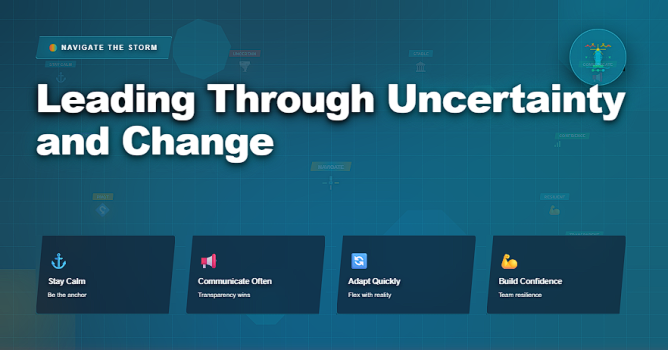
➡️ Introduction
Uncertainty is no longer an exception in projects and organizations.
It is the operating environment.
Top 5 Project Management Software
Market shifts, changing priorities, evolving technology, stakeholder pressure, and incomplete information have become normal conditions — not temporary disruptions. In this reality, leadership is tested not when plans are clear, but when clarity is missing.
Leading through uncertainty and change is not about having all the answers.
It is about providing direction, stability, and confidence when answers are still forming.
This article explains what effective leadership looks like during uncertainty, how strong leaders respond to change, and how teams can stay focused and productive even when conditions keep shifting.
✅ Why Uncertainty Challenges Leaders
Uncertainty creates tension because it:
✔️ limits predictability
✔️ increases anxiety and resistance
✔️ slows decision-making
✔️ exposes weak assumptions
✔️ amplifies communication gaps
When leaders respond poorly, uncertainty turns into confusion.
When leaders respond well, uncertainty becomes managed risk.
✅ What Leadership Means During Change
Leading through change is not about controlling outcomes.
It is about guiding behavior and decisions while outcomes evolve.
Effective leaders during change:
✔️ acknowledge uncertainty honestly
✔️ provide clear short-term priorities
✔️ protect teams from unnecessary noise
✔️ maintain decision discipline
✔️ reinforce purpose and direction
People do not expect certainty —
they expect clarity about what matters now.
✅ Leadership Behaviors That Matter During Uncertainty
How effective leaders stabilize teams during change.
| Leadership Behavior | How It Shows Up | Why It Matters |
|---|---|---|
| Transparent Communication | Honest updates without false certainty | Builds trust and reduces anxiety |
| Short-Term Focus | Clear near-term priorities and goals | Prevents overwhelm and paralysis |
| Decisive Action | Timely decisions with incomplete data | Maintains momentum |
| Emotional Stability | Calm and consistent leadership presence | Regulates team stress |
| Adaptive Planning | Plans adjusted as information improves | Keeps direction relevant |
✅ How Leaders Should Communicate During Change
Effective communication during uncertainty:
✔️ separates facts from assumptions
✔️ explains what is known and unknown
✔️ clarifies decision criteria
✔️ repeats key messages consistently
✔️ invites questions and feedback
Silence creates fear.
Overconfidence creates mistrust.
❌ Common Leadership Mistakes During Uncertainty
❌ pretending certainty exists
❌ delaying decisions too long
❌ overloading teams with information
❌ changing direction without explanation
❌ communicating only when problems escalate
Uncertainty exposes leadership habits — good or bad.
⭐ How Teams Respond to Strong Leadership in Change
When leadership is effective during uncertainty:
✔️ teams remain focused
✔️ trust increases
✔️ adaptability improves
✔️ execution stabilizes
✔️ change resistance decreases
Leadership becomes a source of stability, even when conditions are unstable.
⭐ Practical Questions Leaders Should Ask Themselves
During uncertainty, effective leaders reflect on:
✔️ What decisions truly need to be made now?
✔️ What clarity can I provide today?
✔️ What pressure can I absorb instead of passing down?
✔️ How am I modeling calm and confidence?
Leadership is revealed in how uncertainty is handled — not avoided.
⭐ Final Thoughts
Leading through uncertainty and change is not about certainty.
It is about presence, clarity, and adaptability.
In unpredictable environments, people do not look for perfect plans.
They look for leaders who can guide them forward — steadily, honestly, and decisively.
Strong leadership does not eliminate uncertainty.
It helps teams move through it with confidence.