 MElkhateeb
➡️ Introduction
Projects do not fail only because of poor planning or technical mistakes.
Many fail because ethical lines are crossed quietly — and gradually.
Top 5 Project Management Software
Pressure to deliver faster, cheaper, or “at any cost” often pushes project leaders into difficult decisions. Small compromises become habits. Transparency erodes. Trust weakens. Eventually, performance, morale, and reputation suffer.
Ethical leadership in project management is not about following rules mechanically.
It is about making principled decisions when trade-offs are uncomfortable and pressure is high.
This article explains what ethical leadership really means in project management, why it matters, and how project leaders can practice it consistently — even under constraint.
✅ What Ethical Leadership Really Means in Projects
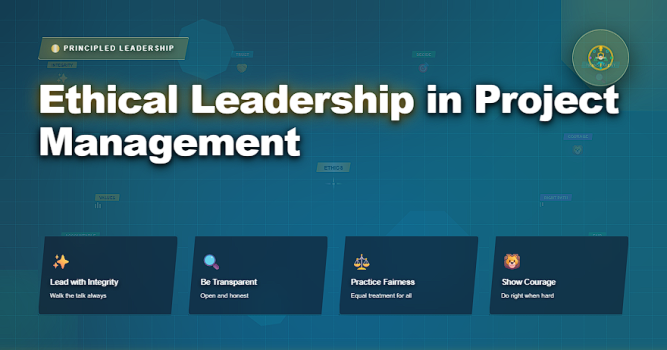
Ethical leadership in project management means leading with integrity, fairness, and accountability, even when doing so is inconvenient.
Ethical project leaders:
✔️ make decisions transparently
✔️ treat people fairly and respectfully
✔️ report progress honestly
✔️ manage conflicts of interest responsibly
✔️ protect stakeholders from hidden risks
Ethics is not about perfection.
It is about choosing integrity over short-term convenience.
✅ Why Ethics Matter in Project Management
Projects sit at the intersection of:
✔️ money and budgets
✔️ deadlines and pressure
✔️ people and power
✔️ commitments and expectations
Without ethical leadership:
❌ risks are hidden
❌ estimates are manipulated
❌ overtime becomes normalized
❌ blame replaces accountability
❌ trust deteriorates
Ethical leadership creates long-term credibility, not short-term comfort.
✅ Core Principles of Ethical Project Leadership
How ethics shows up in real project decisions.
| Ethical Principle | How It Shows Up | Why It Matters |
|---|---|---|
| Transparency | Honest reporting of status, risks, and issues | Builds trust with stakeholders |
| Fairness | Equal treatment and clear expectations | Protects morale and engagement |
| Accountability | Owning decisions and outcomes | Creates credibility and reliability |
| Respect | Valuing time, wellbeing, and expertise | Sustains long-term performance |
| Integrity | Consistent actions aligned with values | Protects reputation and trust |
✅ Ethical Dilemmas Project Managers Commonly Face
Ethical leadership is tested when:
✔️ deadlines conflict with quality
✔️ budgets conflict with fairness
✔️ stakeholders push for unrealistic commitments
✔️ risks are uncomfortable to disclose
✔️ overtime becomes the default solution
Ethical leaders do not avoid these dilemmas —
they address them openly and responsibly.
❌ Common Ethical Failures in Projects
❌ hiding bad news
❌ manipulating estimates
❌ rewarding burnout as commitment
❌ blaming teams for leadership decisions
❌ prioritizing image over truth
These behaviors damage trust faster than missed deadlines.
⭐ How Ethical Leadership Strengthens Project Outcomes
When project leaders act ethically:
✔️ trust increases
✔️ communication improves
✔️ risks surface earlier
✔️ teams feel psychologically safe
✔️ stakeholders respect decisions — even difficult ones
Ethics improves delivery quality, not just compliance.
⭐ How Project Leaders Can Practice Ethics Daily
Ethical project leaders regularly ask:
✔️ Would I be comfortable explaining this decision openly?
✔️ Who is impacted by this choice — and how?
✔️ Am I protecting people or just results?
✔️ Am I trading long-term trust for short-term relief?
Ethical leadership is practiced one decision at a time.
⭐ Final Thoughts
Ethical leadership in project management is not optional.
It is foundational.
Projects are temporary —
but trust, reputation, and people are not.
Great project leaders deliver results without sacrificing integrity.
They lead in a way that others are willing to follow — not because they must, but because they trust the leader behind the plan.