 MElkhateeb
➡️ Introduction
Team culture is rarely defined by mission statements.
It is defined by what happens on a normal workday.
Top 5 Project Management Software
Healthy teams are not perfect. They experience conflict, pressure, and setbacks — just like any other team. The difference is how they respond. Toxic teams, on the other hand, often look productive on the surface while quietly draining trust, motivation, and performance.
Understanding the difference between a healthy and a toxic team is not about labeling people.
It is about recognizing patterns early and addressing them before damage becomes permanent.
This article explains the clear, observable signs of healthy teams versus toxic teams, and what leaders can do when warning signals appear.
✅ What a Healthy Team Really Looks Like
A healthy team is not one without problems.
It is a team that handles problems constructively.
Healthy teams typically show:
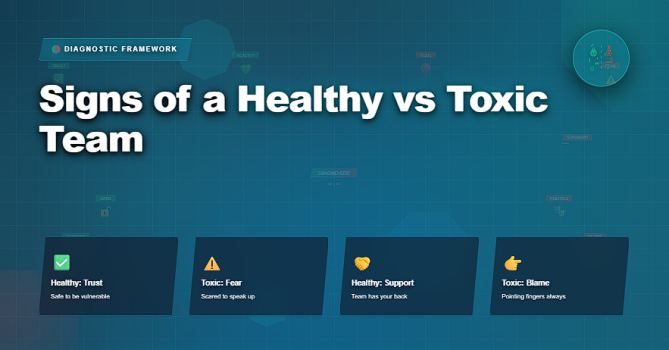
✔️ open and respectful communication
✔️ shared accountability
✔️ trust in leadership and peers
✔️ willingness to raise issues early
✔️ consistent, sustainable performance
Health shows up in behavior, not slogans.
❌ What Defines a Toxic Team
A toxic team is not defined by one bad day or a difficult project phase.
Toxicity appears when:
❌ fear replaces trust
❌ blame replaces accountability
❌ silence replaces honesty
❌ pressure replaces purpose
❌ survival replaces collaboration
Toxic environments damage performance slowly — but deeply.
✅ Healthy vs. Toxic Team Behaviors
Observable signs leaders should monitor closely.
| Area | Healthy Team | Toxic Team |
|---|---|---|
| Communication | Open, respectful, and direct | Guarded, sarcastic, or silent |
| Accountability | Shared ownership of outcomes | Blame-shifting and defensiveness |
| Conflict | Addressed constructively | Avoided or escalated emotionally |
| Psychological Safety | People speak up without fear | Fear of punishment or ridicule |
| Workload & Pressure | Managed and discussed openly | Normalized burnout and overwork |
| Trust | High trust between peers and leaders | Suspicion and information hoarding |
✅ Early Warning Signs Leaders Should Not Ignore
Toxicity often appears gradually through:
✔️ reduced participation in meetings
✔️ increased gossip or side conversations
✔️ high performers disengaging
✔️ frequent misunderstandings
✔️ rising absenteeism or turnover
These signals are easier to correct early than later.
❌ Why Toxic Teams Persist
Toxic teams often survive because:
❌ short-term results mask long-term damage
❌ leaders avoid difficult conversations
❌ pressure justifies bad behavior
❌ issues are normalized over time
Ignoring toxicity does not make it disappear — it embeds it.
⭐ How Leaders Restore Team Health
Effective leaders:
✔️ address behavior directly and calmly
✔️ clarify expectations and norms
✔️ model respectful communication
✔️ protect psychological safety
✔️ reward collaboration, not fear-driven results
Culture changes when leadership behavior changes.
⭐ A Simple Team Health Check
Ask yourself:
✔️ Do people feel safe raising bad news?
✔️ Are mistakes treated as learning or failure?
✔️ Is trust increasing or eroding?
The answers reveal the true state of the team.
⭐ Final Thoughts
Healthy teams are not free of tension.
They are free of fear.
Toxic teams rarely collapse suddenly — they deteriorate quietly. Leaders who recognize the signs early and act decisively protect not only performance, but people.
Strong leaders do not wait for toxicity to become visible.
They build environments where healthy behavior becomes the norm.