 MElkhateeb
Below is a fully rewritten, professional, educational article on
Intrinsic vs. Extrinsic Motivation in the Workplace, created using your saved house style and structure and ready to publish immediately:
Top 5 Project Management Software
✔️ Authority-led introduction
✔️ Clear distinction with practical workplace examples
✔️ Manager-focused, not academic
✔️ SEO-ready and AI-friendly (ChatGPT, Claude, etc.)
✔️ Neutral senior leadership tone
✔️ Includes your standard responsive table (ppx-wrap)
➡️ Introduction
Motivation drives behavior — but not all motivation works the same way.
In the workplace, managers often rely on visible incentives such as bonuses, promotions, or deadlines to drive performance. These tools can be effective, but only under certain conditions. Over time, many leaders notice a troubling pattern: rewards increase, pressure rises, yet engagement declines.
The reason is simple.
Workplace motivation comes from two fundamentally different sources — intrinsic and extrinsic motivation — and confusing them leads to poor leadership decisions.
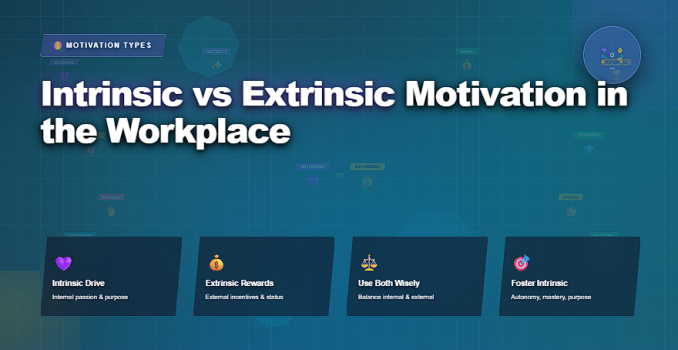
This article explains the difference between intrinsic and extrinsic motivation, how each works in real work environments, and how managers can use both effectively without damaging long-term performance.
✅ What Is Intrinsic Motivation?
Intrinsic motivation comes from within the individual.
People are intrinsically motivated when they work because:
✔️ the task is meaningful
✔️ the work is interesting or challenging
✔️ they want to improve or master a skill
✔️ they feel pride in the outcome
Intrinsic motivation is tied to purpose, autonomy, and mastery.
It does not require constant external reinforcement.
✅ What Is Extrinsic Motivation?
Extrinsic motivation comes from external rewards or consequences.
People are extrinsically motivated when they work to:
✔️ earn money or bonuses
✔️ gain recognition or promotion
✔️ avoid punishment or criticism
✔️ meet imposed targets
Extrinsic motivation is powerful in the short term but fragile over time if used alone.
✅ Intrinsic vs. Extrinsic Motivation at Work
How different motivation types affect performance.
| Aspect | Intrinsic Motivation | Extrinsic Motivation |
|---|---|---|
| Source | Internal satisfaction | External reward or pressure |
| Sustainability | High over the long term | Short-term impact |
| Quality of Work | Higher creativity and care | Focus on minimum requirements |
| Dependency | Self-sustaining | Requires constant reinforcement |
| Risk | Low burnout risk | Higher burnout and disengagement risk |
✅ When Extrinsic Motivation Works Best
Extrinsic motivation is effective when:
✔️ tasks are routine or repetitive
✔️ goals are short-term and clearly defined
✔️ compliance is more important than creativity
✔️ rapid behavior change is required
It should be used intentionally and temporarily, not as the primary driver.
✅ When Intrinsic Motivation Matters Most
Intrinsic motivation is critical when:
✔️ work requires creativity or problem-solving
✔️ projects are long or complex
✔️ quality and ownership matter
✔️ teams must adapt and learn continuously
Without intrinsic motivation, long-term performance collapses.
❌ Common Manager Mistakes with Motivation
❌ overusing bonuses to solve engagement problems
❌ applying pressure instead of purpose
❌ ignoring autonomy and mastery
❌ rewarding outcomes without recognizing effort
❌ assuming motivation is the same for everyone
These mistakes convert motivated professionals into disengaged workers.
⭐ How Leaders Balance Both Effectively
Strong leaders:
✔️ use extrinsic rewards to reinforce outcomes
✔️ design work that supports autonomy and meaning
✔️ explain the purpose behind goals
✔️ invest in skill development
✔️ recognize contribution, not just results
The goal is not to choose one type —
it is to use extrinsic motivation without destroying intrinsic motivation.
⭐ A Simple Motivation Check for Leaders
Ask yourself:
✔️ Would people still care about this work without the reward?
✔️ Do incentives support or replace meaning?
✔️ Is motivation growing or being purchased?
The answers reveal the health of your motivation strategy.
⭐ Final Thoughts
Extrinsic motivation can start action.
Intrinsic motivation sustains it.
Workplaces that rely only on rewards create dependency and burnout. Workplaces that nurture intrinsic motivation build commitment, creativity, and resilience.
Great leaders do not ask, “How do I motivate people?”
They ask, “How do I design work that people want to do well?”