 MElkhateeb
➡️ Introduction
Low morale rarely appears overnight.
It develops silently — then spreads quickly.
Top 5 Project Management Software
Teams with low morale may still deliver work, attend meetings, and meet deadlines. Yet beneath the surface, energy fades, initiative disappears, and commitment weakens. If left unaddressed, low morale turns capable teams into disengaged ones.
Overcoming low morale is not about motivation speeches or temporary rewards.
It requires understanding the causes, restoring trust, and rebuilding meaning and stability.
This article explains why team morale drops, how leaders can recognize early warning signs, and what practical actions restore morale sustainably.
✅ What Low Morale Really Looks Like
Low morale is not always visible as complaints or conflict.
It often appears as:
✔️ reduced participation
✔️ minimal effort beyond requirements
✔️ lack of enthusiasm or curiosity
✔️ quiet disengagement
✔️ declining accountability
Low morale is a leadership signal, not a team failure.
✅ Common Causes of Low Morale
Morale declines when teams experience:
✔️ unclear direction or priorities
✔️ sustained pressure without recovery
✔️ lack of recognition
✔️ poor communication
✔️ feeling unheard or undervalued
People lose morale when effort no longer feels meaningful or fair.
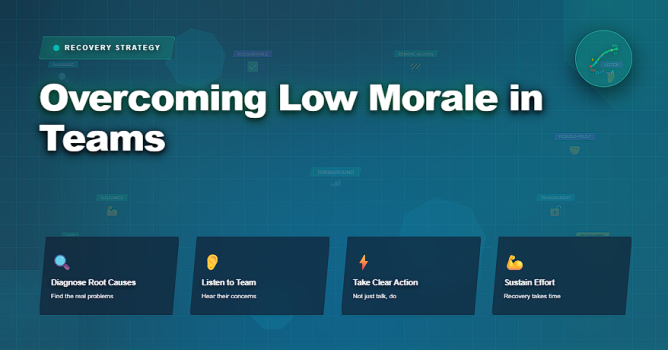
✅ Leadership Actions to Restore Team Morale
What actually rebuilds energy and commitment.
| Leadership Action | How It Helps | Why It Works |
|---|---|---|
| Acknowledge the Reality | Validates team experience | Restores trust and openness |
| Clarify Direction | Removes uncertainty | People need stability to re-engage |
| Recognize Effort | Signals that work matters | Recognition rebuilds motivation |
| Reduce Overload | Restores energy and focus | Burnout kills morale faster than failure |
| Invite Honest Feedback | Gives people a voice | Involvement restores ownership |
✅ The Leader’s Role When Morale Is Low
When morale drops, leadership visibility matters.
Effective leaders:
✔️ listen without defensiveness
✔️ communicate clearly and frequently
✔️ protect the team from unnecessary pressure
✔️ follow through on commitments
✔️ model calm and respect
People watch leadership behavior closely during low-morale periods.
❌ Common Mistakes That Make Morale Worse
❌ ignoring the issue
❌ increasing pressure to “push through”
❌ offering shallow incentives
❌ blaming individuals
❌ pretending positivity will fix everything
These actions deepen disengagement.
⭐ How to Tell Morale Is Improving
Signs morale is recovering include:
✔️ increased participation
✔️ renewed problem-solving
✔️ more open communication
✔️ improved collaboration
✔️ steady energy levels
Morale recovers gradually, through consistent leadership action.
⭐ A Simple Morale Check for Leaders
Ask yourself:
✔️ Do people feel heard?
✔️ Is effort being recognized?
✔️ Is direction stable and clear?
If any answer is unclear, morale remains at risk.
⭐ Final Thoughts
Low morale is not a sign of weak teams.
It is a sign of unresolved leadership and system issues.
Teams regain morale when leaders restore clarity, fairness, and meaning — not when they demand enthusiasm.
Great leaders do not try to “fix morale.”
They fix the conditions that caused morale to fall.