 MElkhateeb
➡️ Introduction
Projects do not fail because teams lack goals.
They fail because team goals and project plans point in different directions.
Top 5 Project Management Software
When a project plan exists in one document and team goals live somewhere else — performance reviews, dashboards, or personal objectives — alignment breaks. Teams stay busy, but progress feels fragmented. Priorities compete, motivation drops, and accountability becomes unclear.
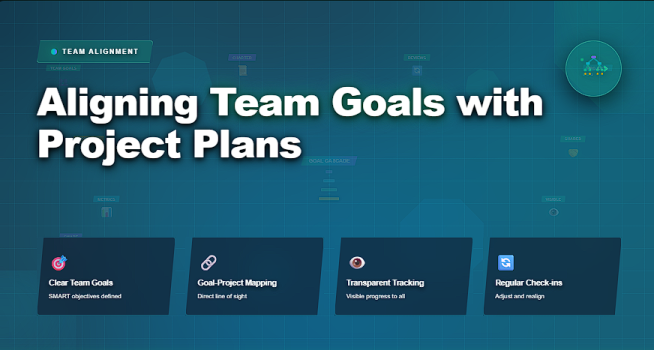
Aligning team goals with project plans is what turns a schedule into a shared execution system.
This article explains why alignment matters, where it usually breaks down, and how project managers can connect team goals directly to project plans in a way that improves focus, ownership, and delivery.
✅ What Alignment Really Means
Alignment does not mean copying project milestones into team objectives.
True alignment means:
✔️ team goals directly support project outcomes
✔️ daily work contributes to planned milestones
✔️ priorities are consistent across roles
✔️ success is measured the same way
✔️ trade-offs are made consciously
When alignment exists, teams understand why their work matters and how it fits.
✅ Why Misalignment Happens So Often
Misalignment typically occurs because:
✔️ project plans focus on tasks, not outcomes
✔️ team goals are set independently of the plan
✔️ success metrics differ across levels
✔️ priorities change without re-alignment
✔️ communication is one-directional
The result is activity without cohesion.
✅ Practical Alignment Mechanisms
How to connect team goals directly to the project plan.
| Alignment Practice | How It’s Applied | Why It Works |
|---|---|---|
| Outcome-Based Milestones | Define milestones by results, not activities | Creates shared purpose |
| Goal Decomposition | Break project objectives into team-level goals | Clarifies contribution |
| Shared Success Metrics | Use the same KPIs across plan and team goals | Eliminates conflicting incentives |
| Priority Transparency | Make trade-offs visible when priorities shift | Maintains trust |
| Regular Re-Alignment | Review goals when plans change | Prevents drift |
✅ The Role of the Project Manager in Alignment
Project managers are the bridge between plans and people.
Strong PMs:
✔️ explain how tasks support outcomes
✔️ translate milestones into team-relevant goals
✔️ adjust goals when plans change
✔️ resolve priority conflicts early
✔️ communicate impact, not just deadlines
Alignment is maintained through conversation, not documentation.
❌ Common Alignment Mistakes
❌ setting team goals once and never revisiting them
❌ measuring activity instead of outcomes
❌ allowing local priorities to override project goals
❌ failing to explain why plans change
❌ assuming alignment without checking
Misalignment usually grows silently.
⭐ Benefits of Strong Goal–Plan Alignment
When alignment is strong:
✔️ teams focus on what matters most
✔️ motivation increases
✔️ accountability becomes clearer
✔️ decisions improve
✔️ delivery becomes smoother
Work feels purposeful instead of fragmented.
⭐ Simple Alignment Check You Can Use
Project managers can ask three weekly questions:
✔️ Do team goals still support the next project milestone?
✔️ Has anything changed that breaks alignment?
✔️ Are teams rewarded for the right outcomes?
If the answer is unclear — alignment needs attention.
⭐ Final Thoughts
A project plan without aligned team goals is just a schedule.
Team goals without a project plan are just intentions.
High-performing projects connect the two deliberately.
They ensure that every goal points toward a shared destination —
and every plan is brought to life by teams who understand why their work matters.