 MElkhateeb
➡️ Introduction
Projects do not collapse because one element goes wrong.
They collapse because scope, resources, and time fall out of balance.
Top 5 Project Management Software
When deadlines tighten, teams are stretched, or scope keeps expanding, project managers are forced into trade-offs — often without a clear framework to guide decisions. The result is burnout, quality erosion, and missed expectations.
Balancing scope, resources, and time is not theoretical project management.
It is daily operational decision-making.
This article explains how these three forces interact, why imbalance occurs, and how project managers can actively manage trade-offs to keep projects realistic, sustainable, and deliverable.
✅ Understanding the Balance (Beyond the Triangle)
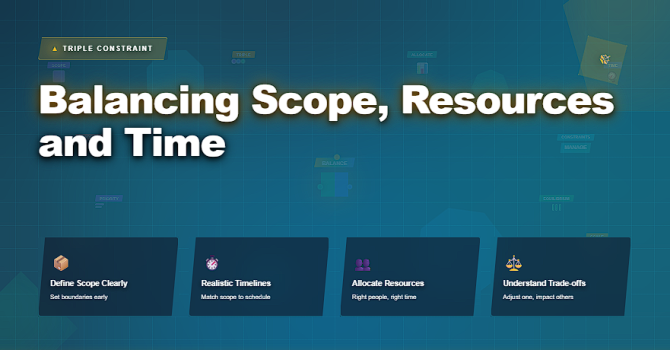
Scope, resources, and time are interdependent constraints.
✔️ Scope defines what must be delivered
✔️ Resources define who and how much capacity is available
✔️ Time defines when delivery must occur
Changing one element always affects the others — whether acknowledged or not.
The mistake is treating them as independent levers.
✅ Why Imbalance Happens in Real Projects
Imbalance usually enters projects through decisions, not execution.
Common causes include:
✔️ committing to fixed deadlines before validating capacity
✔️ adding scope without adjusting timelines
✔️ assuming resources are interchangeable
✔️ compressing schedules without reducing work
✔️ ignoring learning and rework effort
✔️ treating optimism as a planning strategy
The project then spends execution compensating for early planning gaps.
✅ How the Three Constraints Interact
Why adjusting one element always affects the others.
| Change Applied | Immediate Effect | Required Adjustment |
|---|---|---|
| Scope Increase | More work to deliver | Extend timeline or add capacity |
| Deadline Compression | Less time to execute | Reduce scope or increase resources |
| Resource Reduction | Lower delivery capacity | Reduce scope or extend time |
| Skill Constraints | Limited execution flexibility | Re-sequence work or simplify scope |
| Fixed Time & Cost | No flexibility in schedule or budget | Scope becomes the main variable |
✅ Practical Strategies to Maintain Balance
Balancing the three constraints requires active management, not static plans.
Effective strategies include:
✔️ defining which constraint is fixed and which are flexible
✔️ prioritizing scope explicitly, not implicitly
✔️ validating resource capacity before committing dates
✔️ using phased or incremental delivery
✔️ protecting critical skills from overload
✔️ revisiting trade-offs at every major change
Balance is maintained through continuous adjustment.
✅ Making Trade-Offs Explicit (Not Political)
Projects suffer when trade-offs are hidden.
Project managers should:
✔️ surface the impact of every change
✔️ show options instead of absorbing pressure
✔️ use data, not emotion, to explain consequences
✔️ document agreed trade-offs
✔️ revisit decisions when conditions change
Transparency builds trust — even when decisions are difficult.
❌ Common Mistakes That Break the Balance
❌ fixing all three constraints simultaneously
❌ assuming more people always means faster delivery
❌ expanding scope “just this once”
❌ compressing schedules without redesigning work
❌ ignoring learning and rework time
❌ treating trade-offs as personal failures
Imbalance is a system problem, not an individual one.
⭐ Best Practices
✔️ decide early which constraint is non-negotiable
✔️ treat scope as a design variable
✔️ plan based on realistic capacity
✔️ review balance at every milestone
✔️ communicate trade-offs clearly and often
✔️ protect sustainability over heroics
⭐ Final Thoughts
Balancing scope, resources, and time is the core discipline of project management.
Strong project managers do not promise everything. They design realistic plans, manage trade-offs openly, and adjust intelligently as reality unfolds.
Projects succeed not because constraints disappear —
but because balance is maintained deliberately.